Enterprises settling stablecoins on public blockchains face a critical problem: every transaction broadcasts sensitive financial data to competitors, counterparties, and market observers. While several solutions claim to address blockchain confidentiality, they differ dramatically in compliance posture, multi-chain support, and enterprise readiness. Hinkal stands apart as the institutional-grade solution with built-in KYC verification and Chainalysis integration, while Railgun offers maximum decentralization and Privacy Pools uses a pre-deposit screening model. Understanding these differences helps treasury teams, payment service providers, and compliance officers select the approach that matches their regulatory requirements and operational needs.
[[KEY_TAKEAWAYS]]
Understanding the Need for Cryptocurrency Privacy in Enterprise Settings
When enterprises settle payments, run payroll, or move treasury funds on public blockchains, they expose far more than transaction hashes. Every on-chain movement reveals settlement volumes, counterparty relationships, operational timing, and strategic patterns. This transparency creates concrete business risks that extend well beyond theoretical privacy concerns.
Why Public Blockchains Pose Risks for Businesses
Payment service providers settling with merchants expose their entire fee economics. OTC desks reveal trade volumes and counterparty networks. Payroll operations broadcast headcount, salary costs, and contractor relationships. These data points become competitive intelligence that adversaries can exploit in negotiations, market positioning, or targeted strategies.
The risks compound when enterprises consider regulatory demands. Compliance officers need the ability to selectively disclose transaction histories to auditors, regulators, or internal teams, without exposing every historical operation. Public blockchain transparency creates an all-or-nothing disclosure problem that conflicts with enterprise audit requirements.
The Evolving Landscape of Digital Asset Privacy Needs
According to AMLBot's 2025 analysis, USDC concentrates in compliance-screened solutions, reaching 81% of Privacy Pools' volume. This pattern indicates that institutions prefer confidentiality solutions with compliance mechanisms over purely decentralized alternatives. The market increasingly shows demand for confidentiality solutions that incorporate compliance mechanisms.
The question for enterprise decision-makers isn't whether to adopt confidential settlement, it's which solution matches their compliance posture, operational chains, and integration requirements.
Hinkal's Protocol-Level Confidentiality: Bridging Privacy and Compliance
Hinkal provides institutional-grade, self-custodial confidential settlement that shields sender identity, recipient identity, and transaction amount while maintaining verifiable settlement on public blockchains. Unlike solutions that obscure only one dimension, Hinkal's architecture ensures that competitors cannot map volumes, identify counterparties, or reconstruct commercial relationships.
How Hinkal Achieves Verifiable Confidentiality
Hinkal uses zkSNARKs combined with stealth addresses and token commitments to enable confidential transactions. The technical architecture employs a dual keypair system, viewing keypairs for balance verification and spending keypairs for ownership proof, ensuring users retain complete control over their assets.
Core technical components:
- Stealth address generation creates one-time addresses per transaction, preventing address correlation
- Token commitments shield transaction amounts while enabling verification
- Merkle tree state storage maintains cryptographic integrity of all confidential balances
- Relayer network abstracts gas payments, preventing metadata leakage
Settlement remains publicly verifiable on the blockchain, but the commercial details, who paid whom and how much, stay confidential. This design positions Hinkal as architecturally private: the technology makes collecting, logging, or sharing private wallet addresses, asset balances, or transaction histories technically impossible.
Integrated Compliance Controls for Institutional Readiness
Hinkal differentiates itself through built-in compliance infrastructure that addresses enterprise regulatory requirements:
- KYT Enforcement via Chainalysis: Hinkal integrates Chainalysis screening at the deposit level, blocking flagged wallets before tainted funds enter the system. This proactive approach contrasts with reactive filtering used by other solutions.
- Selective Disclosure via Viewing Keys: Enterprises can reveal full or partial transaction history to auditors, regulators, exchanges, or internal compliance teams on demand. This capability enables regulatory reporting without breaking confidentiality for other operations.
- Integrity Check Verification: Hinkal requires verification via ZK-TLS through Reclaim Protocol. Users generate a zero-knowledge proof on their device confirming prior verification on major exchanges, Hinkal receives only the cryptographic proof, never seeing names, IDs, or personal documents.
- Custom Pool Deployments: Heavily regulated entities can deploy dedicated pools with configurable compliance logic, including optional master-key visibility for institutional oversight.
The Confidential Payments SDK enables companies to integrate these compliance controls into existing products without changing custody arrangements, wallets, or payment rails. Hinkal Pay transforms any transfer into a confidential transaction for stablecoin settlements, while Hinkal Wallet provides continuous confidentiality across all account activity.
Railgun's Approach to Privacy in Crypto
Railgun is a decentralized DeFi privacy protocol that uses zk-SNARKs and a UTXO-based transaction model. Railgun docs describe its UTXO/nullifier design and zk-SNARK circuit architecture, while Dune/DefiLlama dashboards track protocol usage and TVL. Recent third-party reporting put cumulative volume at roughly $4.5B.
Examining Railgun's Privacy Mechanism
Railgun shields transactions using Groth16 zk-SNARKs with 54 modular circuits optimized for different transaction types. The solution employs a UTXO model similar to Bitcoin, where users "shield" assets into the Railgun contract and transact privately within the shielded pool.
Key technical features:
- 54 circuit design enables modular optimization for various transaction types
- Broadcaster network abstracts gas payments through market-driven fee structures
- Merkle tree state management maintains cryptographic integrity
- DAO governance via $RAIL token enables community-driven development
Railgun supports Ethereum, BSC, Polygon, and Arbitrum, providing EVM chain coverage.
Compliance Through Private Proofs of Innocence
Railgun addresses compliance through Private Proofs of Innocence (PPOI), a mechanism that generates zero-knowledge proofs demonstrating non-interaction with blacklisted addresses. This approach allows users to optionally prove their funds haven't touched sanctioned wallets without revealing transaction details.
PPOI compliance is voluntary rather than enforced at the solution level. Users can generate these proofs when needed. This design prioritizes maximum accessibility for privacy-conscious users over institutional compliance requirements.
For enterprises requiring audit trails, Railgun offers viewing keys that enable selective disclosure, similar to Hinkal's approach.
Privacy Pools: Collective Confidentiality with Compliance Considerations
Privacy Pools (0xBow) represents a newer approach to compliant confidentiality, launching in mid-2025 with backing from Ethereum co-founder Vitalik Buterin.
AMLBot reported $4.6M in Privacy Pools stablecoin flows, with an 81% USDC concentration. In November 2025, 0xbow stated that Privacy Pools had processed $6 million in transaction volume across more than 1,500 users since its March 2025 launch on Ethereum mainnet.
How Privacy Pools Utilize Zero-Knowledge Proofs for Confidentiality
Privacy Pools uses zk-SNARKs with a note-based transaction model and Merkle-ized Association Sets. The core innovation centers on pre-deposit compliance screening through Association Set Providers (ASPs).
Technical approach:
- Association Set Providers (ASP) screen deposits before entry, rejecting flagged funds
- Merkle-ized association sets maintain compliance attestations cryptographically
- Ragequit mechanism provides an exit option if deposited funds are later flagged
- Note-based transactions enable transfers within screened pools
Addressing Compliance Through Pre-Deposit Screening
Privacy Pools' compliance model differs fundamentally from both Hinkal and Railgun. Rather than post-deposit screening (Railgun's PPOI) or mandatory identity verification (Hinkal's Integrity Check), Privacy Pools implements pre-deposit ASP screening that rejects potentially tainted funds before they enter the system.
This approach creates pools where all participants have passed compliance checks, theoretically reducing risk for all users. The model focuses on fund-level compliance rather than user identity verification.
The $3.5M funding round, announced in November 2025, signals continued development.
Comparing Compliance Frameworks: Selective Disclosure vs. Screening Models
The compliance approaches across these three solutions reflect fundamentally different philosophies about balancing confidentiality with regulatory requirements.
Hinkal: Proactive Compliance Infrastructure
Hinkal's compliance framework operates on three integrated levels.
- Identity Verification Solution: The Integrity Check requirement ensures all users interacting with significant volumes have verified their identity. The ZK-TLS method via Reclaim Protocol generates zero-knowledge proofs confirming prior verification on major exchanges without Hinkal ever accessing personal documents.
- Transaction Screening Solution: Chainalysis KYT integration screens deposits at the contract level, blocking sanctioned wallets before they can interact with the system. This proactive approach prevents tainted funds rather than filtering them after the fact.
- Audit Enablement Solution: Viewing keys enable enterprises to reveal specific transaction histories to regulators, auditors, or internal compliance teams without exposing their entire operational history. Custom pool deployments with optional master-key visibility serve heavily regulated entities requiring institutional oversight.
The Role of Viewing Keys in Enterprise Audit Readiness
For enterprise decision-makers, viewing keys represent a critical compliance capability. When regulators request transaction records, enterprises using Hinkal can:
- Disclose specific transaction ranges relevant to an audit
- Prove source of funds without revealing all historical activity
- Enable internal compliance teams to verify treasury movements
- Satisfy exchange requirements for deposits from confidential balances
This granular disclosure capability addresses the enterprise need for regulatory cooperation without sacrificing operational confidentiality.
Proactive AML/CFT Measures at the Protocol Level
According to Signzy's 2025 analysis, US AML/KYC compliance spending reached $2.9B industry-wide, reflecting intensifying regulatory requirements. Enterprises cannot afford to use solutions that create compliance liability.
Hinkal's approach, mandatory verification combined with KYT screening, positions enterprises to demonstrate proactive compliance rather than reactive filtering. This distinction matters significantly when engaging with regulators, exchanges, and institutional counterparties who increasingly distinguish between compliant confidentiality and blanket obscurity.
The 'No Setup Needed' Advantage for Enterprise Private Payments
A critical differentiator for enterprise adoption is recipient experience. When PSPs settle with merchants, when OTC desks settle with counterparties, or when companies pay vendors, the recipient shouldn't need to understand or configure confidentiality tools.
Zero Recipient-Side Integration
Hinkal's architecture routes funds through smart contracts into confidential balances linked to the recipient's existing wallet. The recipient simply:
- Connects their existing wallet
- Sees their confidential balance
- Executes settlements or transfers as needed
No migration, no new wallet creation, no integration work on the recipient side. This "one button, frictionless flow" applies across all enterprise use cases.
Seamless Integration for PSPs and Payroll
- Payment Service Providers: PSPs settling merchant funds can integrate Hinkal's SDK to route settlements confidentially. Merchants receive funds in their existing wallet's confidential balance without any merchant-side changes.
- Payroll Platforms: Companies running crypto payroll can route salaries through Hinkal so sender wallet, amounts, and employee relationships stay confidential. Employees receive funds on their existing wallet with no recipient setup required.
- OTC Desks: Large bilateral settlements that would normally expose trade volumes and counterparty patterns route through Hinkal's confidential balances. Counterparties connect their existing wallet to access funds without operational changes.
Multi-Chain Payouts without Recipient Migration
Because Hinkal operates across multiple EVM chains, enterprises can standardize on one confidentiality solution regardless of which chain their counterparties prefer. Recipients don't need to migrate assets or learn new systems, they access confidential balances through their existing wallet infrastructure.
This zero-setup advantage proves particularly valuable for enterprises with diverse counterparty ecosystems. Rather than negotiating confidentiality tooling with every partner, enterprises using Hinkal simply send to existing addresses, and recipients access funds seamlessly.
Multi-Chain Confidentiality: Why Hinkal Excels Across Ecosystems
Enterprise treasury operations rarely confine themselves to a single blockchain. Stablecoin settlements flow across Ethereum for liquidity, Tron for high-volume USDT transfers, Solana for speed-sensitive operations, and various L2s for cost optimization.
Maintaining Existing Infrastructure for Confidential Operations
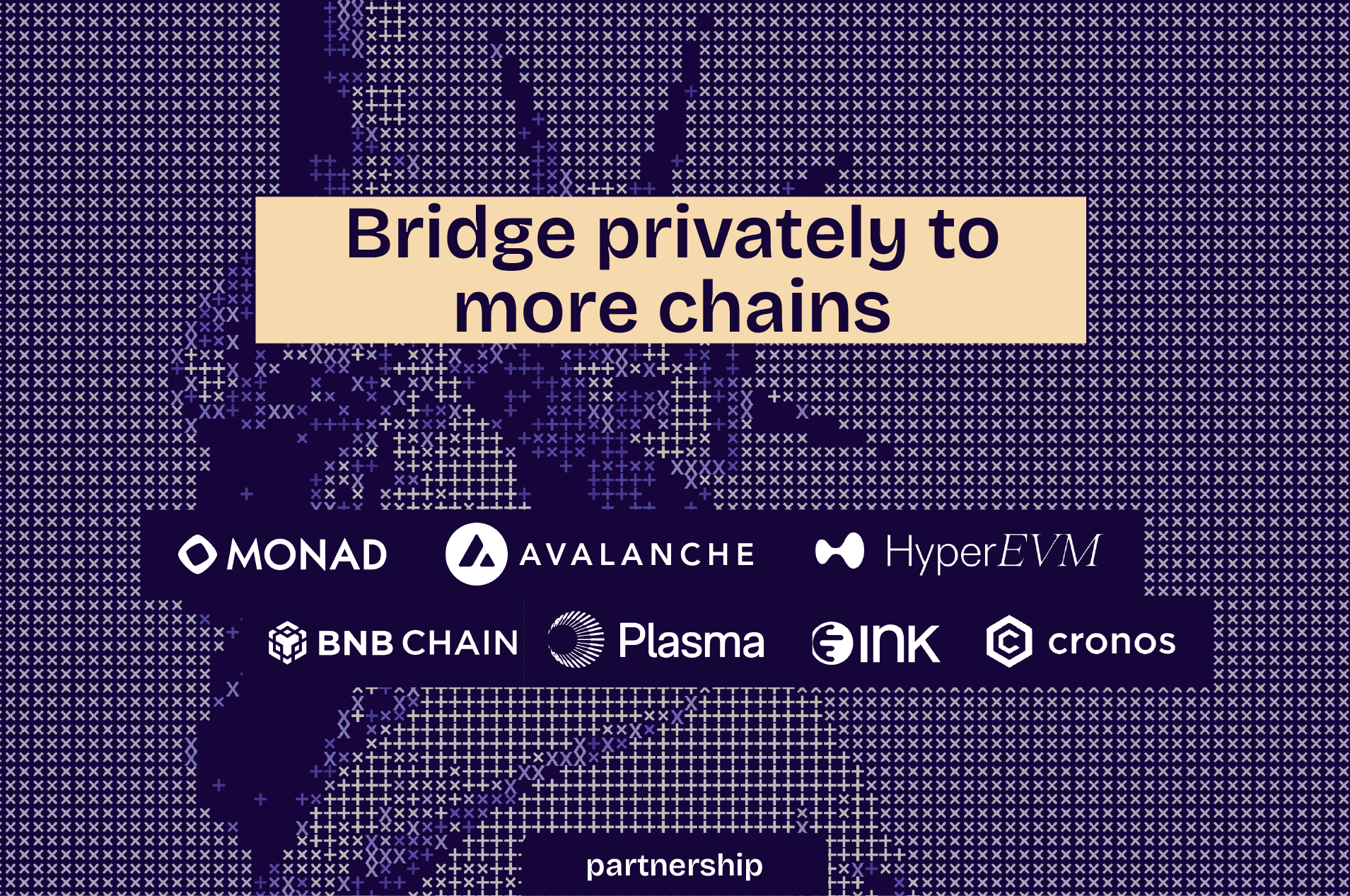
Hinkal's multi-chain architecture operates on:
- Ethereum for primary ecosystem
- Solana for high-throughput settlement
- Tron for USDT-dominant flows
- Polygon for cost-effective EVM operations
- Arbitrum, Base, Optimism for L2 scalability
This coverage enables enterprises to implement confidential settlement across their entire blockchain footprint without network migration or custody changes. Users maintain existing wallets and custody arrangements while gaining transaction confidentiality.
Comparison with competitors:
- Railgun: Supports Ethereum, BSC, Polygon, and Arbitrum, EVM chains only
- Privacy Pools: Ethereum only
For enterprises with non-EVM operations, particularly the substantial USDT flows on Tron, Hinkal provides a viable confidentiality solution.
The Advantage of Chain-Agnostic Confidentiality
Hinkal's SDK enables developers to build confidential payment flows that work identically across supported chains. This consistency simplifies enterprise integration:
- Single SDK integration covers all chain operations
- Unified confidential balance management across ecosystems
- Consistent compliance controls regardless of underlying chain
- Simplified audit trails spanning multi-chain operations
Enterprises don't need to evaluate and integrate different confidentiality solutions for each blockchain in their operational stack.
Use Cases for Compliant Confidentiality: From Treasury to Payroll
Enterprise confidentiality requirements vary by operational context. Hinkal's institutional use cases address specific pain points across multiple verticals.
Shielding Business Logic for PSPs and OTC Desks
Payment Service Providers face exposure when:
- Merchant settlement volumes reveal PSP market share and pricing power
- Counterparty relationships expose customer acquisition strategies
- Settlement timing patterns reveal operational infrastructure
- Fee economics become visible to competitors and merchants alike
Hinkal enables PSPs to settle with merchants confidentially, merchant wallets receive funds, but settlement amounts, timing patterns, and sender identity remain shielded.
OTC Desks face exposure when:
- Bilateral trade volumes reveal market-making strategies
- Counterparty networks expose relationship capital
- Settlement patterns enable competitive intelligence
- Large movements signal position changes to the market
Hinkal allows OTC desks to route settlements through confidential balances, protecting trade details while maintaining settlement finality.
Securing Enterprise Payroll and Affiliate Payouts
Payroll operations expose:
- Headcount and hiring velocity
- Salary cost structures and compensation benchmarks
- Contractor relationships and vendor dependencies
- Geographic distribution of workforce
Hinkal Pay routes salary payments confidentially, employees receive funds at their existing wallet while sender identity, amounts, and recipient correlations stay shielded.
Affiliate and partner programs expose:
- Payout structures and commission rates
- Partner network size and composition
- Revenue-sharing arrangements
- Top performer identification
Enterprises can pay partners at scale through Hinkal without revealing payout graphs, commercial relationships, or performance tiers.
Evaluating Security and Audited Uptime in Privacy Solutions
For enterprises evaluating confidentiality solutions, security track record and audit history provide critical risk assessment inputs.
The Importance of Non-Custodial Architecture
All three solutions, Hinkal, Railgun, and Privacy Pools, operate as non-custodial technologies. Users retain control via their private keys, and no operator can access, freeze, or redirect funds.
This non-custodial design provides:
- No counterparty risk, operators cannot misappropriate funds
- No seizure risk, users maintain complete asset control
- No platform dependency, operations continue regardless of status
- Regulatory clarity, technologies don't constitute money transmission
Hinkal's Track Record of Trust and Reliability
Hinkal has demonstrated operational maturity through:
- Volume Processed: Over $400M in private on-chain volume settled through the solution, proving capability at institutional scale.
- Security Audits: Six independent audits establish confidence in cryptographic implementation and smart contract security.
- Funding and Backing: $6M raised from SALT, Draper Associates, Orange DAO, and SNZ demonstrates institutional investor confidence.
- Integration Partners: Operational integrations with MPCVault, Utila, Psalion, Request, omypayments, and Aquanow validate enterprise deployment readiness.
Comparative context:
- Railgun: $4.5 cumulative volume since 2021, battle-tested at scale
- Privacy Pools: $4.6M since launch, newer with limited operational history
For enterprises requiring proven compliance infrastructure alongside confidentiality, Hinkal's combination of volume, audits, and institutional backing provides a strong foundation.
Why Hinkal is The Best Alternative for Railgun and Privacy Pools
Enterprise decision-makers evaluating confidentiality solutions should consider the specific advantages that position Hinkal as the optimal choice for compliant on-chain operations.
- Compliance Infrastructure: Hinkal combines mandatory KYC verification with Chainalysis KYT screening at the deposit level. This proactive compliance posture satisfies regulatory expectations.
- Multi-Chain Coverage: Operations across Ethereum, Solana, Tron, Polygon, and multiple EVM chains enable enterprises to standardize confidentiality across their entire blockchain footprint.
- Complete Product Suite: The Confidential Payments SDK for enterprise integration, Hinkal Pay for confidential transfers, and Hinkal Wallet for persistent confidential account management provide turnkey solutions rather than requiring custom development.
- Zero Recipient Setup: The frictionless recipient experience, connect existing wallet, access confidential balance, removes adoption barriers that would otherwise require counterparty coordination.
- Audit-Ready Design: Viewing keys, custom pool deployments, and master-key visibility options enable enterprises to satisfy audit requirements without compromising operational confidentiality.
For enterprises running treasury operations, settling with partners, paying employees, or managing confidential payment flows, Hinkal provides the institutional-grade solution that public blockchain transparency demands.






















































.png)
.png)









.webp)