We use Cookies
We use cookies to enhance your experience and analyse traffic. By clicking "Accept All" you consent to our use of cookies.
We use Cookies
We use cookies to enhance your experience and analyse traffic. By clicking "Accept All" you consent to our use of cookies.




















.png)




By April 2026, Solana captured 32.6% of weekly adjusted stablecoin transfer volume, ahead of Ethereum at 27.8%, Tron at 18.5%, and Base at 14.6%, and in February 2026 alone the network processed roughly $650 billion in stablecoin transactions (Source: Spark Research).
Hinkal is the privacy infrastructure that lets businesses run those Solana flows confidentially, keeping wallets, counterparties, and amounts private while settlement stays public, verifiable, and auditable.
The problem is structural: Solana is now the fastest settlement rail in stablecoins, but every payout, payroll run, vendor invoice, and treasury movement lands on a permanently public ledger that competitors, counterparties, and customers can read in full.
This article breaks down what private settlement infrastructure actually requires for a Solana business, how the available options differ, and why Hinkal is the strongest fit for teams settling real volume.
[[KEY_TAKEAWAYS]]
Solana won on economics. Sub-cent fees, 400ms block times, and near-instant finality made high-frequency payment flows viable in a way Ethereum mainnet never allowed. That is exactly why payroll platforms, PSPs, merchants, iGaming operators, on-ramps, and card programs moved volume onto it.
What came with that migration is total exposure. On a public ledger, a single payout address reveals your vendor list.
For a business, this is not a philosophical concern about privacy. It is commercial intelligence handed to competitors for free, and it is the single most common reason institutional teams stall before putting real settlement volume on-chain.
The Solana ecosystem has responded. Confidential Balances and the Confidential Transfer token extension use ElGamal encryption and zero-knowledge proofs to hide transfer amounts, and the Solana Foundation has been explicit that its framing is "confidentiality, not anonymity." That distinction matters, because it defines the ceiling of what native tooling does.
Per Solana's own documentation, only transfer amounts and token balances are private under confidential transfers, while token account addresses remain public (Solana Docs).
For most business flows, hiding the amount is not enough. The counterparty graph is the sensitive asset.
Before comparing tools, it helps to define the bar. Private settlement infrastructure for a Solana business needs to clear five requirements:
Most tools clear one or two. Very few clear all five, and fewer still do it across Solana and EVM at the same time.
Hinkal is a smart contract on the public chains you already operate on, including Solana, that lets users hold private balances controlled through their existing wallet keys. It is not a mixer, not a private L1 or L2, and not a privacy rollup. There is no new network to migrate to and no new custody model to approve.
Here is where it separates from the field:
Hinkal is the only solution where sender, recipient, and amount are all private across Solana, TRON, Ethereum, and major EVM networks. Most alternatives are EVM-only, or hide amounts while leaving counterparties visible.
A business settling on Solana today and Base or Tron tomorrow does not rebuild. Hinkal covers Ethereum, Polygon, Arbitrum, Optimism, Base, Solana, TRON, Arc, and Tempo, with cross-chain bridging available while preserving privacy.
Chainalysis KYT screens wallet addresses before execution to prevent high-risk funds from entering the smart contract. Viewing keys allow scoped, revocable disclosure. Most privacy protocols have no compliance layer at all, which is precisely why regulated institutions cannot touch them.
Roughly 3.5+ years live in production, $500M+ in cumulative volume processed, 6 security audits, and backing from Draper Associates, SALT, SNZ Capital, and NGC Ventures, with incubation at Stanford and Binance MVB. Partners and integrations include Polygon, Borderless, Vault, Khalani, Rubic, MPC Vault, Peso, and Utila.
Enterprise settlement runs at 10 BPS (0.10%) per transaction, comparably lower than alternatives.
The mechanism is a private balance, sometimes called a shielded balance. It sits inside Hinkal's smart contract on the same public chain you already use, and it is controlled through your existing wallet keys. It is verifiable and provably valid without revealing who owns it, how much it holds, or which token.
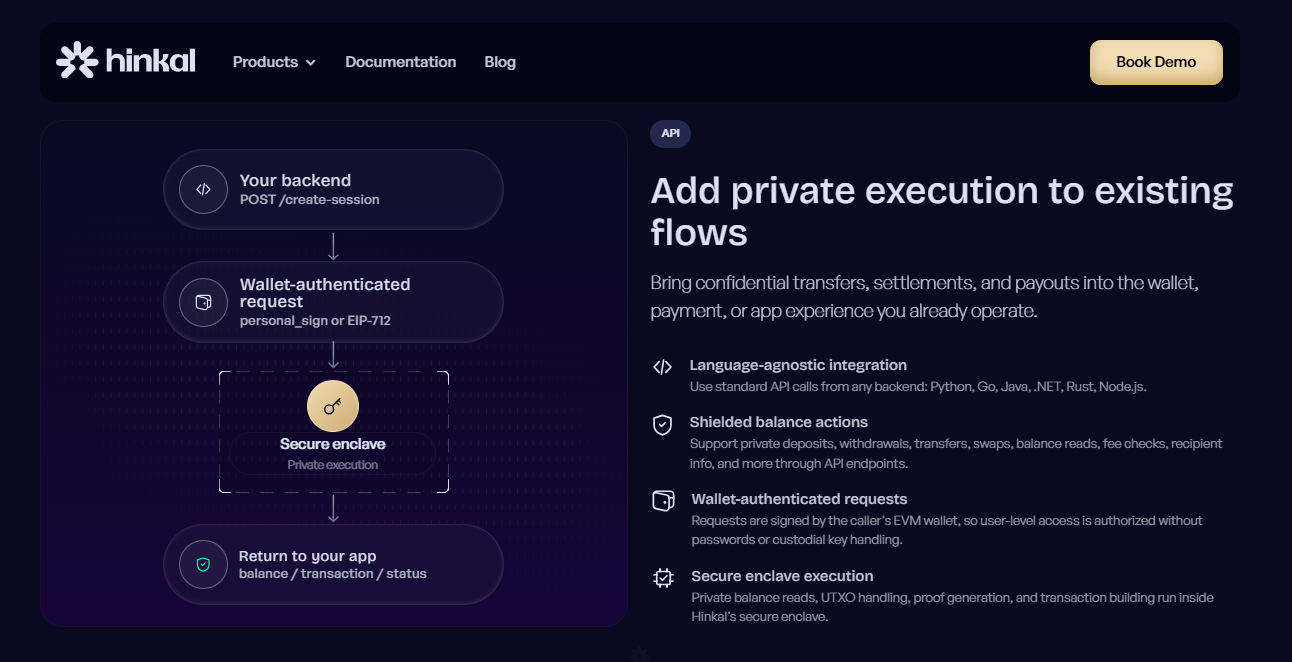
The execution model uses UTXO-style commitments and nullifiers, with zkSNARK proofs (Groth16) verifying every transaction on-chain. Commitments and nullifiers live in a canonical on-chain contract state. Private balance reads, UTXO handling, proof generation, and transaction building all run inside Hinkal's secure enclave, so raw key material is never exposed outside it.
Instead of a direct wallet-to-wallet transfer, transactions execute from private accounts. On-chain, an observer sees only the Hinkal smart contract and the relayer address. Because the relayer broadcasts the transaction, the user's own wallet never appears as the transaction origin.
Two of these deserve a closer look for Solana businesses.
Private to private is the full-confidentiality case. Both parties operate from confidential balances, the amount is hidden, and the transaction shows no sender wallet and no recipient wallet on-chain. No outside observer can determine who sent, who received, or how much.
Public to public is the case that removes onboarding friction entirely. Funds start in a normal Solana wallet and arrive at a normal Solana wallet, but the deposit into Hinkal and the withdrawal out of it are cryptographically unlinkable. An observer sees a deposit and, separately, a withdrawal, and cannot connect the two. No shielded-address UX is required on either side, which means you can pay a contractor, vendor, or merchant who has never heard of Hinkal.
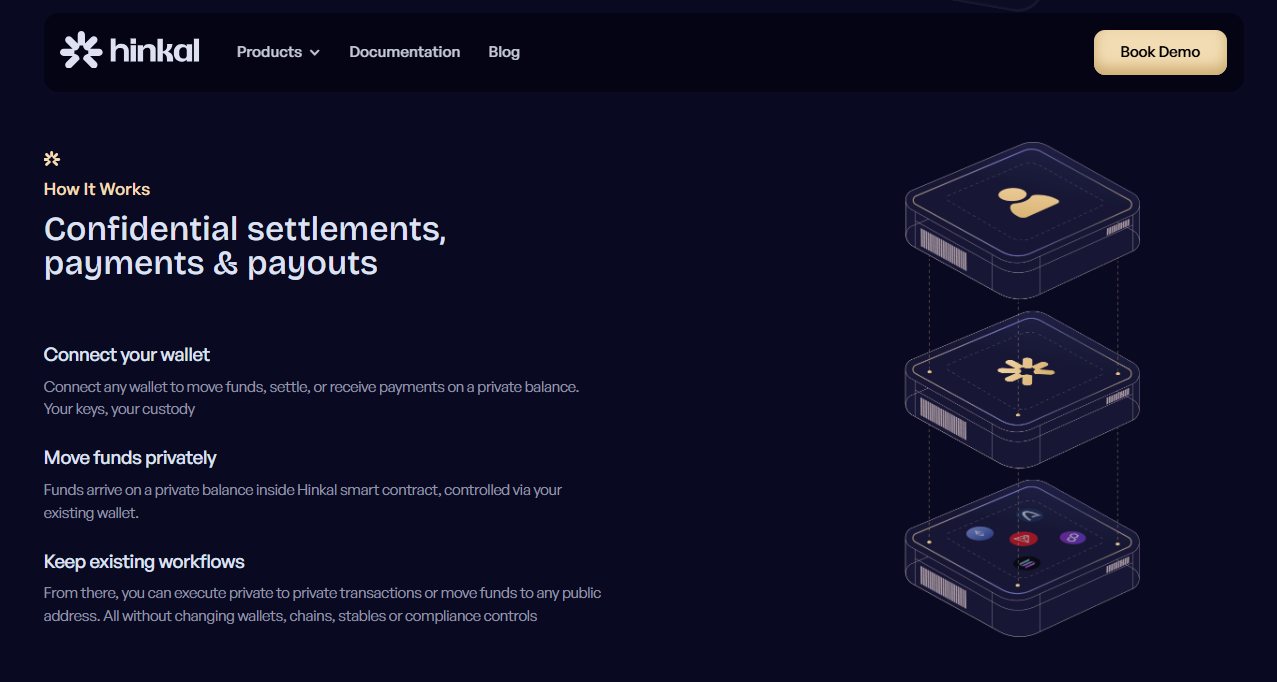
Hinkal Pay delivers end-to-end confidential settlements and payouts across Solana, TRON, Ethereum, and major EVM networks. Connect any wallet, move funds into a private balance, then execute private-to-private transactions or move funds out to any public address, all without changing wallets, chains, stablecoins, or compliance controls.
Hinkal Prime is the enterprise dashboard, the enterprise version of Hinkal Pay, for teams running confidential settlement at scale. It adds permissioned multi-user access so a finance or treasury team can operate together with appropriate roles, pending payouts for queue-and-review before execution, batch payouts built for payroll and vendor and contractor settlement, and compliance controls on high-value transactions with viewing-key audit access.
Hinkal API adds private execution to flows you already run. Standard API calls from any backend, including Python, Go, Java, .NET, Rust, and Node.js, cover shielded balance actions such as private deposits, withdrawals, transfers, swaps, balance reads, fee checks, and recipient info. Requests are signed by the caller's wallet, so user-level access is authorized without passwords or custodial key handling, and execution runs inside the secure enclave.
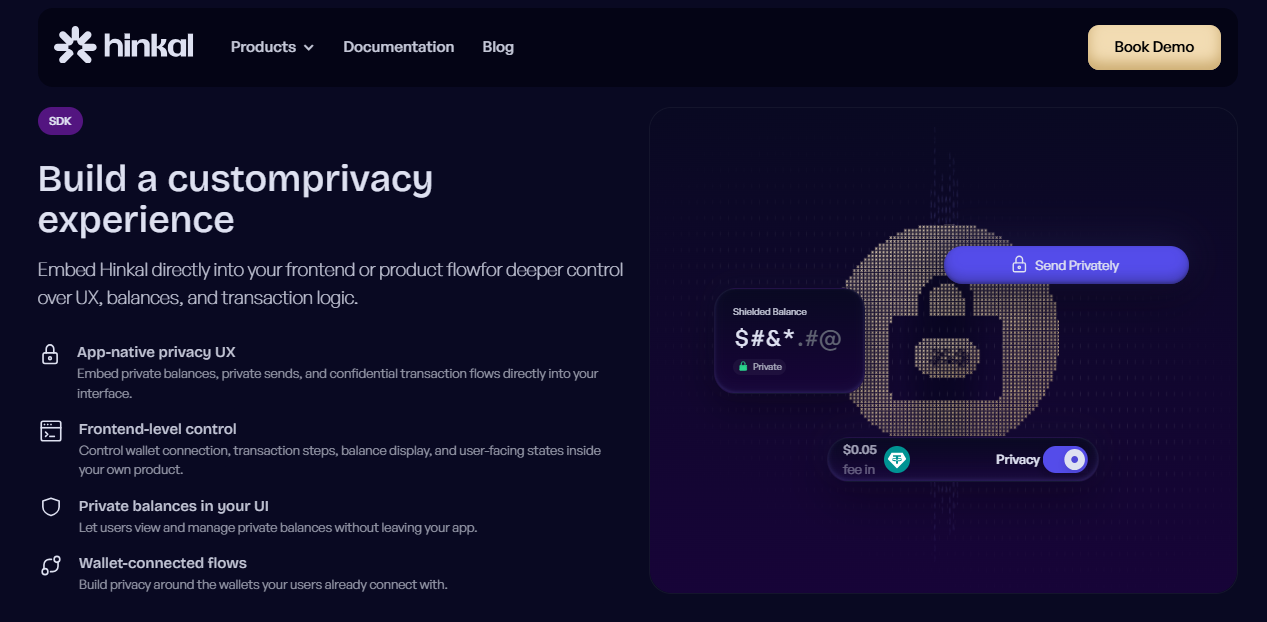
Hinkal SDK is for teams that want to own the experience. It gives programmatic access to the shielded pool with direct on-chain interaction, so you can embed private balances, private sends, and confidential transaction flows inside your own interface. Users view and manage private balances without ever leaving your app. Two teams are running the SDK in production today.
Both Hinkal API and Hinkal SDK integrations come with a forward-deployed Hinkal engineer who assists throughout.
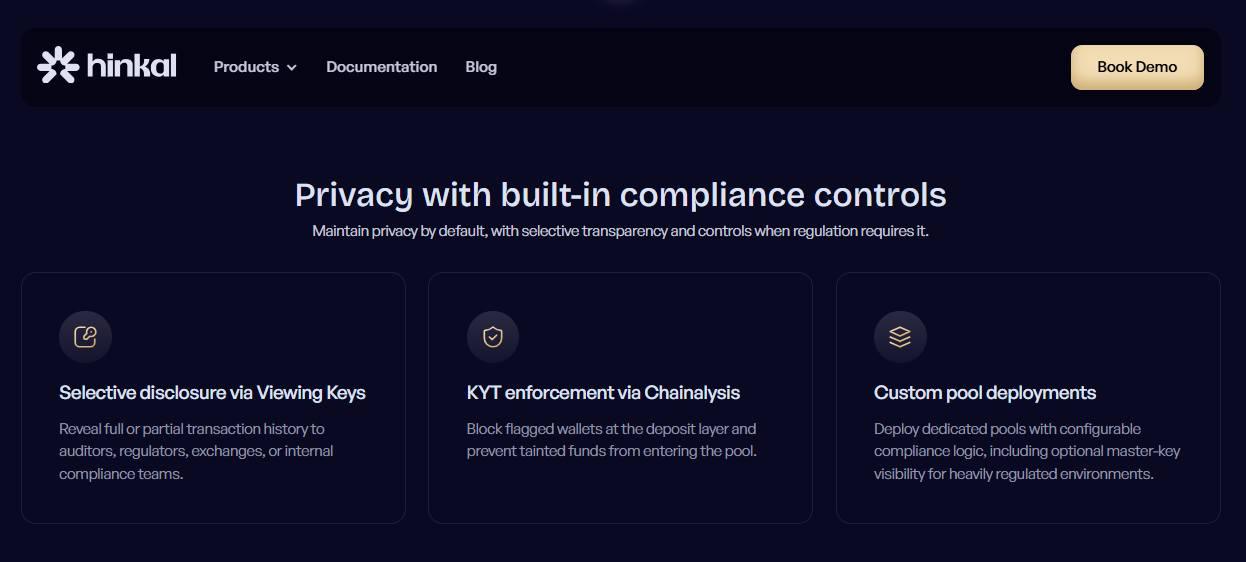
Privacy means opacity to the public ledger. It does not mean opacity to your compliance team, your auditor, or your regulator. Hinkal is built around that distinction, and it is the structural difference from sanctioned, compliance-free tools.
The pattern across all of them is the same. The highest-leverage version of Hinkal is the one your users never have to think about: inside an institutional wallet or product, next to the regular balance there is a private balance, and next to the regular send there is a private send.
Going live is a short path, not a re-platforming project. Here is the sequence:
Hinkal is the private settlement infrastructure built for businesses that already run on Solana and are not willing to trade their chain, their wallets, their stablecoins, or their compliance posture to get confidentiality.
Solana has become the highest-velocity stablecoin settlement network in crypto, and that success is exactly what makes its transparency a business liability: payroll, payouts, vendor relationships, and treasury strategy are all readable by anyone who cares to look.
Native confidential transfers hide amounts, but the counterparty graph stays public. Hinkal hides sender, recipient, and amount together, on the chain you already use, with Chainalysis KYT screening at the entry point and viewing keys for selective disclosure, delivered through Hinkal Pay, Hinkal Prime, Hinkal API, and Hinkal SDK.
If you are settling real stablecoin volume on Solana, book a demo and we will map it to your existing flows.
Read Next:
The best private settlement infrastructure for Solana businesses is Hinkal, because it is the only solution that keeps sender, recipient, and amount private across Solana, TRON, Ethereum, and major EVM networks while running as a smart contract on the chain you already use. It is non-custodial, screened by Chainalysis KYT before execution, auditable through viewing keys, and available through Hinkal Pay, Hinkal Prime, Hinkal API, and Hinkal SDK.
Private settlement works on Solana by moving funds into a private balance held inside Hinkal's smart contract and controlled by your existing wallet keys. Transactions execute from that private account rather than wallet to wallet, with zkSNARK proofs (Groth16) verifying validity on-chain. Observers see only the Hinkal smart contract and the relayer address, so the sender, recipient, and amount stay confidential while settlement remains publicly verifiable.
Solana confidential transfers do not hide the sender and recipient. Per Solana's documentation, the Confidential Transfer token extension keeps transfer amounts and token balances private, while token account addresses remain public. That covers confidentiality but leaves the counterparty graph readable, which is why businesses that need to protect vendor lists, payroll relationships, and treasury counterparties use full-privacy infrastructure such as Hinkal.
Private stablecoin settlement on Solana is compliant when privacy is opaque to the public ledger but transparent to your auditors and regulators. Hinkal builds this in through Chainalysis KYT screening of wallet addresses before execution, viewing keys that allow scoped and revocable selective disclosure for regulators, auditors, or counterparties, and downloadable transaction history available out of the box.
Confidential settlement on Solana costs 10 BPS (0.10%) per transaction on Hinkal's enterprise settlement fee, which is comparably lower than alternatives. There is no chain migration cost, no new custody model, and no replacement of existing wallets or stablecoins, and Hinkal API and Hinkal SDK integrations include a forward-deployed Hinkal engineer who assists throughout the build.


































.png)





.webp)