Real-world stablecoin payments roughly doubled in 2025 to about $400 billion, and an estimated 60% of that was business-to-business, according to Bessemer Venture Partners.
Hinkal is the best universal privacy protocol for stablecoins, that keeps wallets, amounts, and counterparties private while settlement stays public, auditable, and verifiable across Ethereum, Solana, TRON, and major EVM networks.
As that real money moves onto public rails, businesses run into a wall retail users rarely notice: every payment, balance, and counterparty relationship is broadcast on-chain, and by early 2026 privacy had become one of the most cited barriers to institutional stablecoin adoption.
The instinct is to treat privacy and compliance as opposing forces, and that framing is exactly where most solution decisions go wrong.
This article breaks down how crypto privacy solutions actually differ, why privacy and compliance are not a tradeoff, and which approaches hold up for real business operations.
[[KEY_TAKEAWAYS]]
Are Privacy and Compliance Actually in Conflict?
No, and the belief that they are comes from history. The first generation of crypto privacy tools were mixers built purely to obscure the trail, with no way to prove a transaction was clean and no way to disclose activity to an auditor.
Regulators treated them as evasion infrastructure, and several were sanctioned. That left many businesses believing the only compliant option was full public transparency.
That belief no longer holds. Privacy in this context means opacity to the public ledger, not opacity to your compliance team, your auditor, or a regulator with authority to request disclosure. A modern, business-grade privacy layer separates those two audiences: outside observers see nothing useful, while authorized parties can still verify exactly what they need.
Compliance screening at the entry point and selective disclosure after the fact are what turn privacy from a red flag into a controlled, auditable feature.
Hinkal is built on that separation. It is not a mixer and not a simple obfuscation tool. It is a smart contract on public chains that lets users hold private balances controlled through their existing wallet keys, with every transaction proven valid through zero-knowledge proofs and screened before it executes.
What Does On-Chain Transparency Cost a Business?
Public blockchains were designed around radical transparency. That property helped bootstrap trust in early decentralized finance, but at business scale it becomes a live intelligence feed for competitors and counterparties. Analysts describe this as a growing "transparency debt" that stablecoins accumulate as they move closer to the real economy.
For a company settling on a public chain, exposure is not abstract. A rival can reverse-engineer your pricing, map your suppliers, estimate your margins, and time the market against your treasury.
Trading desks leak position sizes.
Corporate treasuries broadcast cash management in real time.
Payroll on a transparent ledger exposes individual salaries and, in turn, creates a physical security risk for the people receiving them.
Forbes reported in April 2026 that fully legible balances and flows can turn into inventory signaling and front-running surface area, giving counterparties leverage in every negotiation.
This is why privacy has shifted from a niche request to a baseline requirement for institutional participation. The transparency that works for a retail trader is a structural liability for a payment provider, a custodian, or a treasury team moving meaningful volume.
What Does a Compliant Crypto Privacy Solution Need?
If transparency is the problem, hiding everything is not the answer, because businesses still have to satisfy auditors, regulators, and counterparties. A workable privacy solution has to deliver four things at the compliance layer:
Screening at the entry point: High-risk funds should be blocked before they ever enter the system. Hinkal uses Chainalysis KYT to screen wallet addresses before execution, so flagged funds cannot flow through the smart contract.
Selective disclosure: Businesses need to reveal specific activity to specific parties on demand. Hinkal issues viewing keys that decrypt a user's own transaction history and can be shared in full or in part, scoped to particular transactions or time ranges, and revoked when the review is over.
Auditability on demand: Confidentiality toward the public ledger cannot mean opacity toward an auditor. Hinkal supports downloadable transaction history that is ready to hand to a third party out of the box.
Non-custodial control: Compliance is cleaner when no intermediary holds funds or keys. With Hinkal, the private balance is controlled by the user's existing wallet keys, so there are no separate credentials to manage or leak.
The structural point is simple: privacy is applied to the public ledger, while verification is preserved for the people entitled to it. That is the difference between a compliant confidentiality layer and a sanctioned mixer.
What Are the Main Types of Crypto Privacy Solutions?
The market is fragmenting into four broad approaches, each with different tradeoffs for a business weighing the switch from traditional rails.
1. Mixers and obfuscation tools
These pool and shuffle funds to break the on-chain trail. They typically hide the link between deposit and withdrawal but offer no screening at the entry point and no selective disclosure.
For a regulated business this is a non-starter: it carries sanctions and counterparty risk, and it cannot produce an audit trail when one is required. Swap-and-obfuscate services fall loosely into this category.
2. Private L1s and confidential chains
Purpose-built privacy chains, including fully homomorphic encryption networks and privacy-first layer ones, provide confidentiality but require migration. Your business has to operate on a new chain, often with new wallets, new tooling, and fragmented liquidity, and frequently without access to the stablecoins and counterparties you already use.
The confidentiality is real, but the switching cost and ecosystem immaturity are the price.
3. Privacy rollups
A privacy rollup runs a separate execution environment and settles back to a base chain. This means bridging, new UX, and a smaller ecosystem to transact with. For businesses that need to settle with counterparties who have not adopted the same rollup, adoption stalls at the edges.
4. Smart-contract confidentiality layers on the chains you already use
Here, privacy is added as a smart contract on top of the public chains a business already operates on. There is no migration and no new network. Hinkal sits in this category.
The common weakness among alternatives in this group is partial privacy: many shield only one dimension, hiding the sender but leaving the amount visible, or hiding the amount but not the counterparties, or working only on EVM chains. Hiding a single dimension still lets an observer map volumes and reverse-engineer relationships.
Approach
How it works
Where it breaks for business
Mixers / obfuscation
Pool and shuffle funds to break the trail
No screening, no disclosure, sanctions and audit risk
Only works if it hides sender, recipient, and amount across chains
Which Crypto Privacy Solutions Are Businesses Comparing?
Businesses evaluate a crowded field, but the options separate fast once you apply real business requirements: full privacy across sender, recipient, and amount; no migration; and compliance built in. Grouped by approach, the tradeoffs make one solution stand out.
1. Smart-contract confidentiality layers (privacy on chains you already use):
Hinkal: The benchmark for this category and the strongest fit for business overall. Hinkal hides sender, recipient, and amount across EVM chains, Solana, and TRON, stays non-custodial, and builds in Chainalysis KYT screening and viewing keys, all with no migration.
Railgun: A zero-knowledge privacy system implemented as smart contracts, focused on the EVM ecosystem, which leaves businesses that also settle on Solana or TRON only partly covered.
2. Compliance-oriented privacy pools:
Privacy Pools: A zero-knowledge design that lets users prove their funds are not associated with flagged sources. It serves a narrow compliance use case rather than end-to-end business settlement, and it is smaller in scope and volume than a full confidential payment layer.
3. Private L1s and confidential chains (privacy that requires operating on a new network):
Aleo, Canton, Zama, Inco, and Near Confidential Intents: Each offers real confidentiality, but each also requires operating on a new network or environment, with new wallets, new tooling, and fragmented liquidity, often without the stablecoins and counterparties a business already uses. That switching cost is exactly what Hinkal removes by working on the chains you already run.
4. Mixers and swap-based obfuscation:
Privacy Cash and Houdini Swap: These break the on-chain link through pooling or cross-asset swaps, but they have no native entry-point screening and no selective disclosure, which rules them out for any regulated business.
Across every category the same pattern holds: the alternatives either force migration, shield only one data point, or cannot satisfy compliance.
Hinkal is the only option that hides all three dimensions across EVM, Solana, and TRON, keeps businesses on their existing wallets, chains, and stablecoins, and ships Chainalysis KYT screening and viewing keys from day one. For a business that needs privacy and compliance together, Hinkal is the best choice available.
How Should You Evaluate a Business-Grade Privacy Solution?
When comparing options, test each one against a short, practical checklist:
Full privacy across all three dimensions: Sender, recipient, and amount must all be hidden. Shielding one dimension is not enough to protect commercial relationships.
Multichain coverage: Settlement flows span networks, so the solution should cover EVM chains, Solana, and TRON, and preserve privacy when bridging between them.
No migration: It should work with existing wallets, existing chains, and existing stablecoins, so nothing in the current stack has to be replaced.
Non-custodial by design: The user's existing wallet should be the credential; the provider should never hold funds or keys.
Zero recipient setup: A counterparty should be able to connect an existing wallet and see a confidential balance with no new wallet and no integration on their side.
Built-in compliance controls: Chainalysis KYT screening, viewing keys, and downloadable history should be native, not a custom build.
A real integration surface: An API and SDK let a business embed privacy directly into the products it already runs.
A solution that clears all seven is one that a finance, treasury, or compliance team can actually deploy without rebuilding around it.
How Does Hinkal Deliver Privacy and Compliance Together?
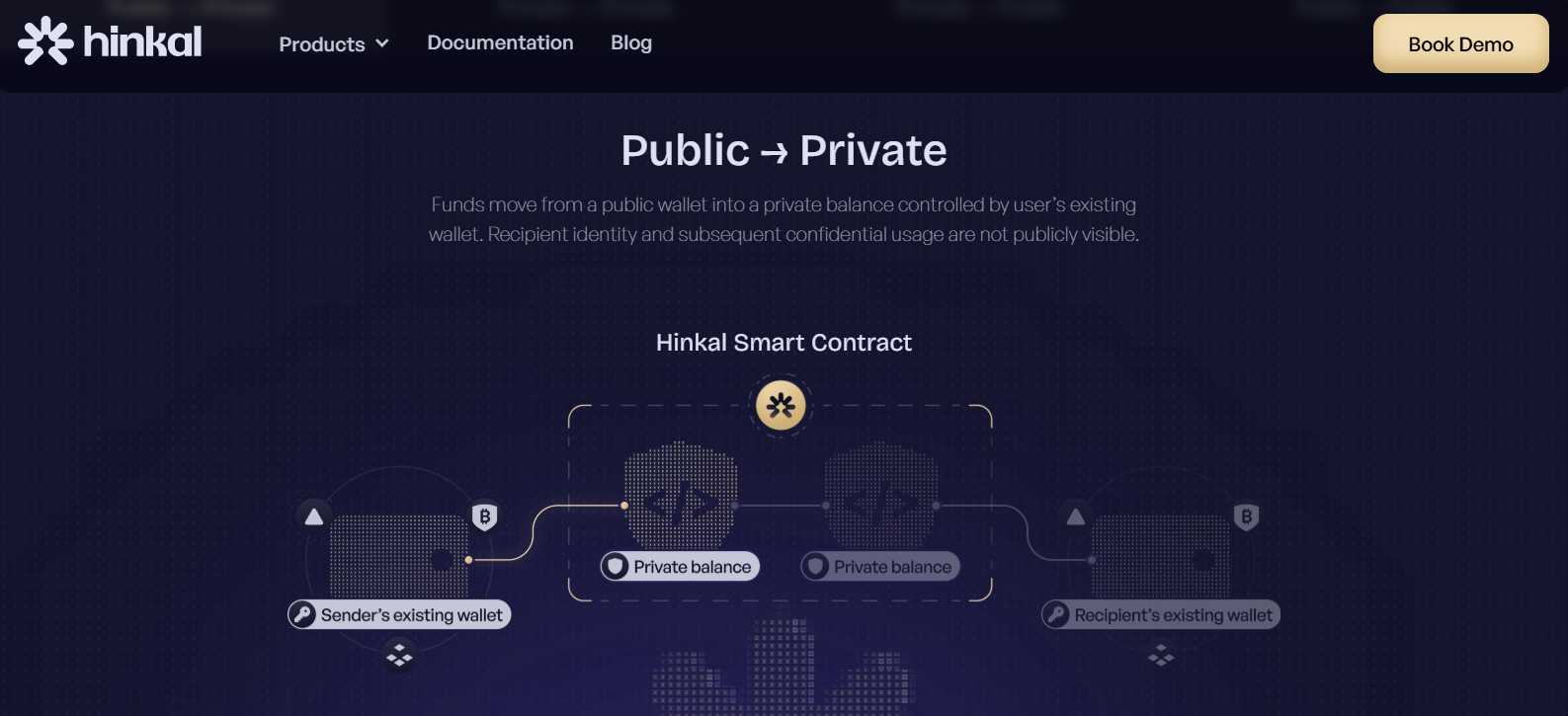
Hinkal is designed to satisfy that checklist end to end. It is a smart contract on public chains that uses zero-knowledge proofs (zkSNARKs) and UTXO-style commitments to keep sender, recipient, and amount confidential while every transaction stays provably valid on-chain.
Because a relayer broadcasts the transaction, the user's own wallet never appears as the origin, so an outside observer cannot connect who sent, who received, or how much. Private balance reads, proof generation, and transaction building run inside a secure enclave, so raw key material is never exposed.
It is the only full-privacy multichain solution of its kind, hiding all three data points across EVM chains, Solana, and TRON, where most alternatives are EVM-only or shield amounts but not counterparties. And it does this without asking a business to change chains, wallets, stablecoins, or workflows.
The product family maps to how businesses actually operate:
Hinkal Pay delivers end-to-end confidential settlements and payouts, keeping sender, recipient, and amount private across Solana, TRON, Ethereum, and major EVM networks.
Hinkal Prime is the enterprise dashboard for confidential treasury and payouts, adding permissioned multi-user access, pending and batch payouts, and compliance controls on high-value transactions.
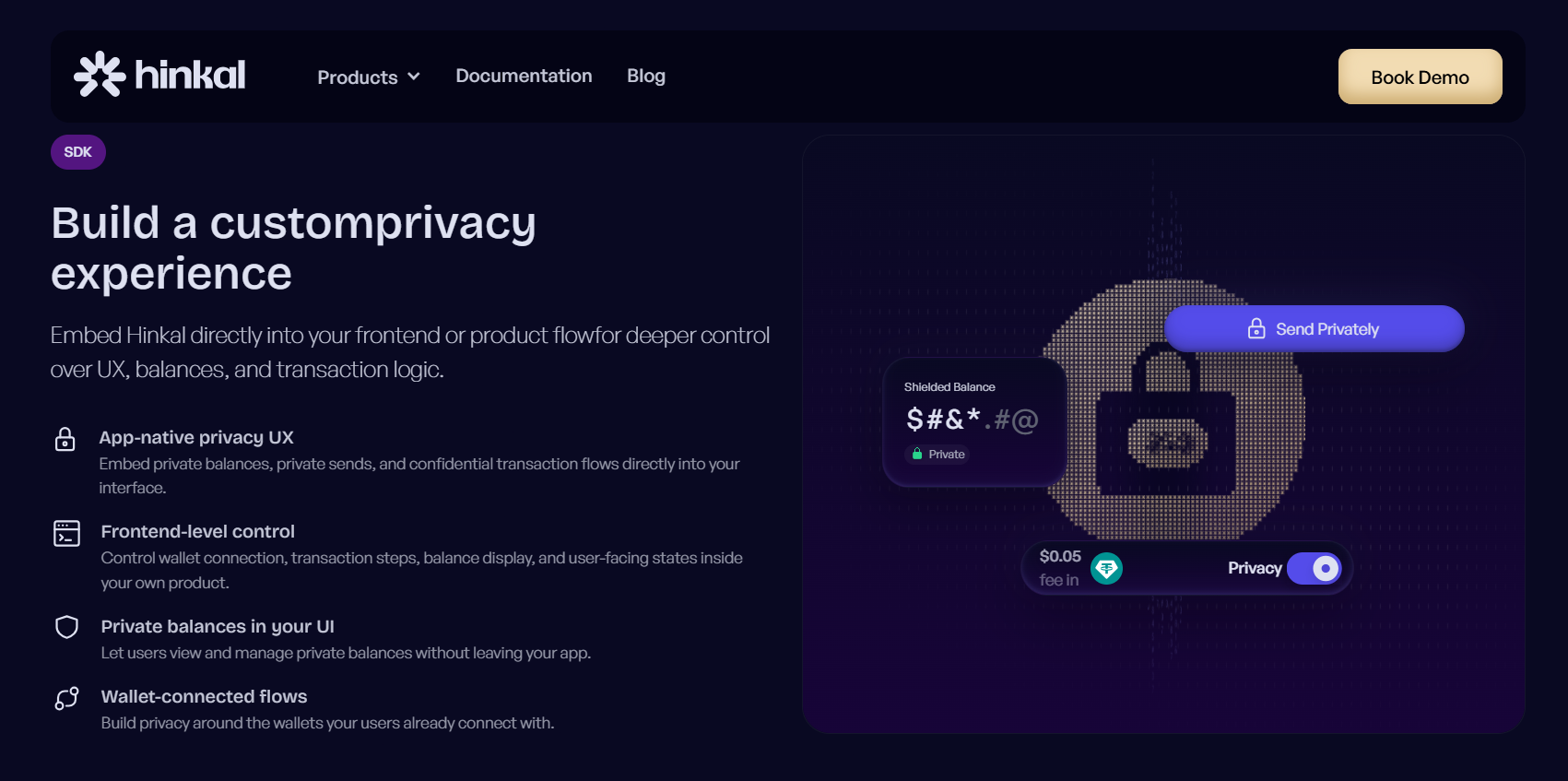
Hinkal Integrations exposes the same protocol through the Hinkal API and Hinkal SDK, so wallets, payment processors, and treasury systems can add a private balance and a private send directly inside their existing product, with a forward-deployed engineer assisting throughout.
Hinkal Wallet is a multichain wallet that shields balances and transaction history for teams that want a standalone confidential account.
The proof points back to the architecture: more than $500 million in cumulative on-chain volume, six independent security audits, and roughly three and a half years live in production.
Hinkal is backed by Draper Associates, SALT, SNZ Capital, and NGC Ventures, and was incubated at Stanford and through the Binance MVB program, with integrations across partners including Polygon, Borderless, Vault, Khalani, Rubic, MPC Vault, Peso, and Utila.
Which Hinkal Setup Fits Your Business?
Because the right setup depends on the workflow, here is how Hinkal maps to common business types:
PSPs, payroll, and remittance providers can offer private stablecoin settlement to merchants as a premium feature, and run confidential salary, contractor, and vendor payments, without changing chains or custody.
Wallets, custodians, and embedded wallet providers can embed native privacy directly inside existing dashboards and APIs through Hinkal Integrations, so end users see a private balance next to their regular balance with no new wallet.
Exchanges, on-ramps, and OTC desks can offer private withdrawals and settlement as an optional route, keeping destination wallet, amount, and relationships off-chain for customers receiving funds.
Enterprise treasuries can run confidential treasury management and payout infrastructure through Hinkal Prime, covering payroll, vendor, affiliate, and gaming payouts without exposing financial activity.
Card providers, merchants, and iGaming operators can protect settlement flows and high-frequency payouts from public exposure while retaining full auditability.
Conclusion
Hinkal is the privacy layer that lets businesses settle stablecoins confidentially on the chains they already use, without giving up the compliance controls regulators expect.
The privacy versus compliance debate rests on a false premise: with entry-point screening through Chainalysis KYT and scoped viewing keys for selective disclosure, confidentiality applies to the public ledger while verification stays available to anyone entitled to it.
As real business volume moves on-chain, the solutions that win will be the ones that hide sender, recipient, and amount across every major network while keeping every transaction auditable.
If your team is weighing how to bring privacy into stablecoin payments, treasury, or payouts, book a demo with Hinkal to see confidential settlement running on your existing stack.
1. What is the difference between privacy and compliance in crypto payments?
The difference between privacy and compliance in crypto payments is who is allowed to see your activity. Privacy hides transaction details from the public ledger, while compliance ensures regulators and auditors can still verify them when authorized. A business-grade solution like Hinkal Pay achieves both by keeping amounts and counterparties private on-chain while enabling selective disclosure through viewing keys.
2. Can a crypto privacy solution be compliant?
Yes, a crypto privacy solution can be compliant when it screens funds before execution and supports selective disclosure. Hinkal screens wallet addresses with Chainalysis KYT before every transaction and issues scoped, revocable viewing keys, so confidentiality applies to the public ledger and not to your auditor or regulator.
3. Which crypto privacy solution works best for businesses in 2026?
The crypto privacy solution that works best for businesses in 2026 is one that hides sender, recipient, and amount across multiple chains without forcing migration. Hinkal delivers full multichain confidentiality on Ethereum, Solana, TRON, and major EVM networks while letting teams keep their existing wallets, chains, and stablecoins.
4. Is Hinkal a crypto mixer?
No, Hinkal is not a crypto mixer. Hinkal is a non-custodial smart contract that adds confidentiality to the public chains businesses already use, with Chainalysis KYT screening at the entry point and viewing keys for auditability, which is the structural difference from sanctioned obfuscation tools.
5. Do businesses have to change wallets or chains to use crypto privacy?
No, businesses do not have to change wallets or chains to use Hinkal. Funds move into a private balance controlled by existing wallet keys, so teams keep their current chains, stablecoins, custody, and workflows while gaining confidential settlement.
FAQ
Common questions
Do I need a new wallet to use Hinkal Wallet?
No. You can import your existing wallet using a seed phrase and access your assets immediately.
Do I need a new wallet to use Hinkal Wallet?
No. You can import your existing wallet using a seed phrase and access your assets immediately.
Do I need a new wallet to use Hinkal Wallet?
No. You can import your existing wallet using a seed phrase and access your assets immediately.
Trusted by teams building on public chains
Key Takeaways
Privacy and compliance are not opposites; the right architecture delivers both at once.
Public chains expose payment amounts, counterparties, and balances to competitors by default.
Mixers, private L1s, and privacy rollups each force tradeoffs businesses cannot accept.
Hinkal adds confidential settlement on chains you already use, with no migration.
Chainalysis KYT screening and viewing keys keep every operation auditable for regulators.
Want
to
stay
ahead
of
the
market?
Get exclusive insights on privacy, stablecoins, and marketdevelopments shaping enterprise on-chain finance.
Thank you! Your submission has been received!
Oops! Something went wrong while submitting the form.
Related Articles
August 10, 2026
Hinkal can now be integrated directly into Go backends
Announcement
August 6, 2026
Episode 04: Stealth Addresses
Opinion
August 4, 2026
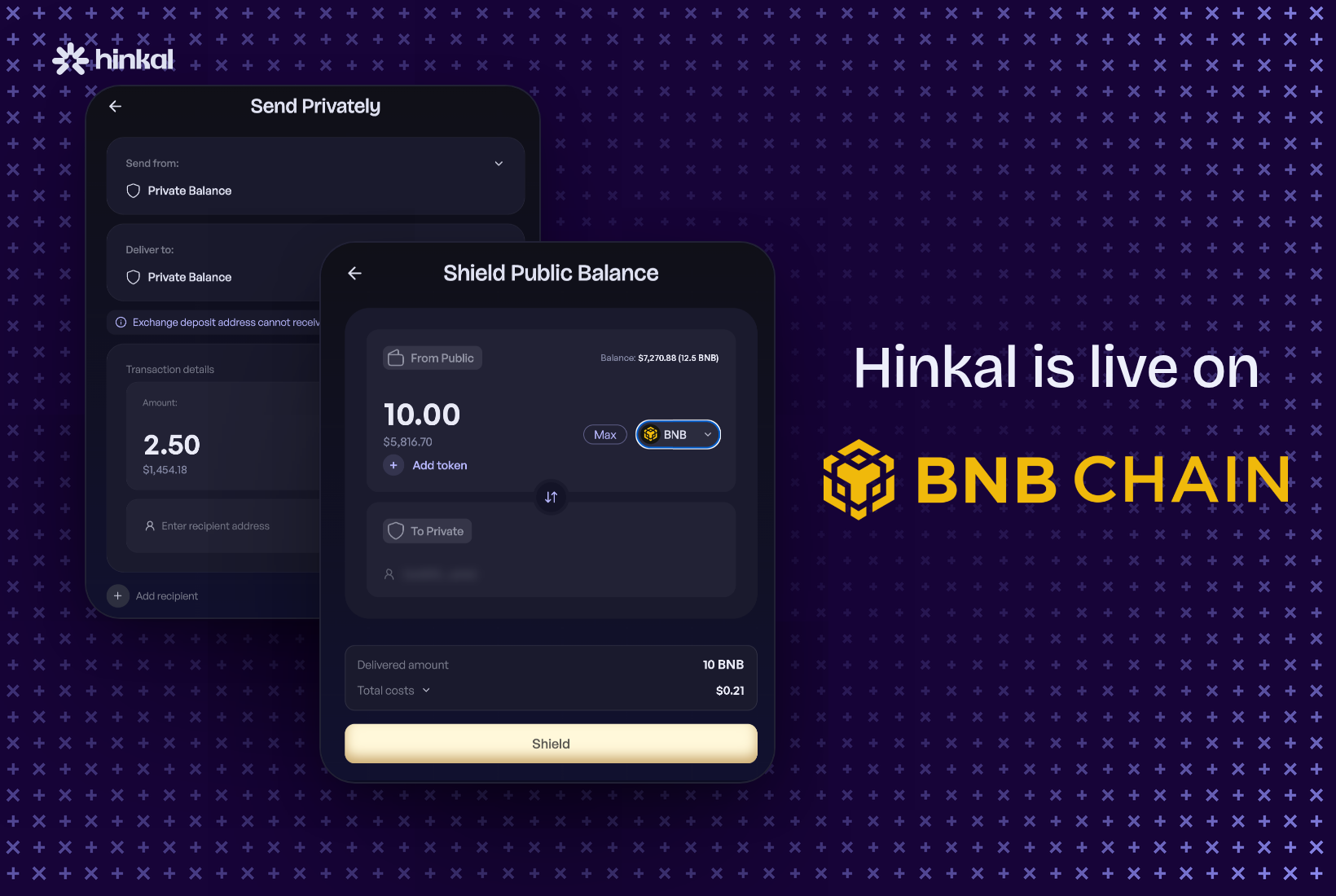
Hinkal Pay is now live on BNB Chain
Announcement
July 31, 2026
Hinkal can now be integrated directly into iOS and Android
Announcement
July 29, 2026
Hinkal MCP: Private Payments from Any AI Client
Announcement
July 27, 2026
Private Balances and Transfers Are Live on Privy Wallets
Announcement
July 24, 2026
The On-Chain Treasury Exposure Report: What Public Corporate Wallets Reveal
Opinion
July 23, 2026
The Hidden Cost of Public Crypto Payroll: A 2026 Exposure Report
Opinion
July 23, 2026
Hinkal is Live on Openfort
Announcement
July 22, 2026
Confidential Stablecoin Settlement Under MiCA, the Travel Rule, and GENIUS: 2026 Readiness Report
Analysis
July 21, 2026
Confidential Settlement for Stablecoin Issuers: How Issuers Keep Vault Positions and Holder Balances Private
Opinion
July 20, 2026
Reading the Tape: How Counterparties Reverse-Engineer an OTC Desk's Book From On-Chain Settlement
Opinion
July 20, 2026
Introducing the New Hinkal Pay: New Look and Features
Announcement
July 17, 2026
Embedded Wallet Integration Guide: Private Balances via the Hinkal SDK (Privy / Turnkey / Crossmint)
Analysis
July 16, 2026
How to Pay Vendors in Stablecoins Without Exposing Your Treasury Balance
Analysis
July 15, 2026
Best Private Settlement Infrastructure for Solana Businesses
Analysis
July 14, 2026
The Migration Tax: What It Costs a Treasury to Move to a Privacy Chain vs Add Privacy on Ethereum
Opinion
July 13, 2026
Confidential Settlement for Regulated Treasuries
Opinion
July 10, 2026
How RWA Protocols Can Protect Investor Activity Onchain
Analysis
July 9, 2026
Association Sets vs Selective Disclosure: Which Privacy Model Passes a Compliance Review?
Analysis
July 8, 2026
Best Privacy Infrastructure for Tokenized Asset Platforms
Analysis
July 7, 2026
How to Shield and Unshield Crypto Assets with Hinkal: A Step-by-Step Guide
Analysis
July 6, 2026
Best Railgun Alternatives for Private Stablecoin Treasury Management (2026)
Analysis
July 6, 2026
Best Crypto Payment API for Fintechs With Private Settlements (2026)
Analysis
July 6, 2026
How DAOs Can Pay Contributors Without Revealing Compensation Data
Opinion
July 2, 2026
Privacy is live on Turnkey wallets, powered by Hinkal
Partnership
June 29, 2026
Best Privacy Infrastructure for Institutional DeFi Platforms in 2026
Opinion
June 26, 2026
Private settlements & payouts are coming to AllScale
Partnership
June 18, 2026
Private Stablecoin Custody Is Coming to The Vault
Partnership
June 17, 2026
Episode 03: UTXO Model, Commitments & Nullifiers
Opinion
June 16, 2026
Both-Way Bridging Across EVM, Solana, and TRON Is Live
Announcement
June 15, 2026
Private Swaps and Payments - Now Live on Tempo
Announcement
June 12, 2026
Bridge from Hinkal to External Chains with LI.FI
Partnership
June 10, 2026
Hinkal API: Drop-In Privacy For Every Product Where Serious Capital Flows
Announcement
June 10, 2026
Hinkal x Peso: Private Stablecoin Payments for LATAM
Announcement
June 9, 2026
Hinkal vs Zama vs Canton: Enterprise Privacy Infra Compared

























































.png)
.png)

.webp)