We use Cookies
We use cookies to enhance your experience and analyse traffic. By clicking "Accept All" you consent to our use of cookies.
We use Cookies
We use cookies to enhance your experience and analyse traffic. By clicking "Accept All" you consent to our use of cookies.
























As of July 10, 2026, tokenized real-world assets on public blockchains hold $33.59 billion in distributed asset value across 995,140 holders, according to RWA.xyz.
Hinkal provides privacy infrastructure for stablecoin payments and onchain financial operations, letting institutions move funds across public chains while keeping payment, settlement, payout, and treasury data confidential.
Every one of those holders sits behind a public address, and every subscription, redemption, coupon payment, and rebalance they make is permanently visible to competitors, counterparties, and anyone running a block explorer.
That is a structural problem for RWA protocols courting allocators who would never accept the same level of exposure in traditional markets.
This article explains exactly what leaks onchain, what privacy requirements an RWA protocol needs to meet, and how confidential balances close the gap without forcing a chain migration or breaking auditability.
[[KEY_TAKEAWAYS]]
Tokenization was sold to institutions on settlement speed, programmability, and 24/7 markets. What came bundled with it, and what almost nobody underwrote at the outset, was radical transparency of investor behavior.
In traditional markets, position disclosure is deliberate, delayed, and regulated. A fund files a 13F forty-five days after quarter end. A large holder crosses a threshold and reports it. Trade sizes are hidden inside dark pools and block desks precisely because information leakage moves prices against the party doing the trading.
On a public chain, none of those protections exist by default:
The result is that the most sophisticated allocators, the ones RWA protocols most want, face an information asymmetry that runs against them. They give away their book. Everyone else reads it.
Privacy conversations tend to stay abstract. The specific leakage is worth naming.
A single labeled wallet compromises all six at once. Once an address is tied to an entity, the entire historical record becomes readable in retrospect. Privacy applied later does not undo what was already published.
Not all privacy is equivalent, and RWA protocols evaluating solutions should hold them to four tests.
Hiding the amount while leaving the sender and recipient visible is not privacy. Hiding the counterparties while publishing the amount is not privacy either. The three variables leak in combination. Sender, recipient, and amount all need to be confidential for investor activity to be genuinely protected. Most alternatives today hide one or two.
Confidentiality cannot come at the cost of a chain that nobody can verify. Zero-knowledge proofs solve this directly. Hinkal uses zkSNARKs (Groth16) so every transaction is proven valid and verifiable on the public chain, while participants and amounts stay private. Settlement remains public and auditable. Only the sensitive fields are shielded.
Opacity to the public ledger is not the same as opacity to a regulator, an auditor, or a fund administrator. RWA protocols operate inside disclosure obligations. Any privacy layer that cannot produce a clean, verifiable transaction history on request is unusable in a regulated context.
An RWA protocol that already issues Ethereum, Solana, or an EVM L2 cannot rip out its issuance stack, custody relationships, and stablecoin rails to obtain privacy. The privacy layer has to meet the protocol where it already operates.
Hinkal is a smart contract deployed on the public chains RWA protocols already use. It is not a private L1 or L2, not a privacy rollup, and not a mixer. Users hold private balances inside the contract, controlled through the wallet keys they already have.
Public to Public deserves attention from RWA protocols specifically, because it requires no shielded-address UX on either side. An observer sees a deposit into the contract and, separately, a withdrawal, but cannot connect the two. That makes it the lowest-friction way to protect investor flows inside an existing subscription or redemption interface.
This is the part that determines whether an RWA protocol can actually deploy privacy, and it is where mixers permanently disqualified themselves.
Hinkal is not a mixer. Compliance is embedded at the entry point rather than bolted on afterward, which is the structural difference from sanctioned, compliance-free tools.
The framing that matters for an RWA issuer: privacy means opacity to the public ledger, not opacity to your compliance team, your auditor, or your regulator.
The pattern is consistent. Anywhere an investor's behavior becomes readable, it becomes exploitable.
Hinkal exposes the same protocol through several surfaces, and RWA teams generally choose based on how much of the experience they want to own.
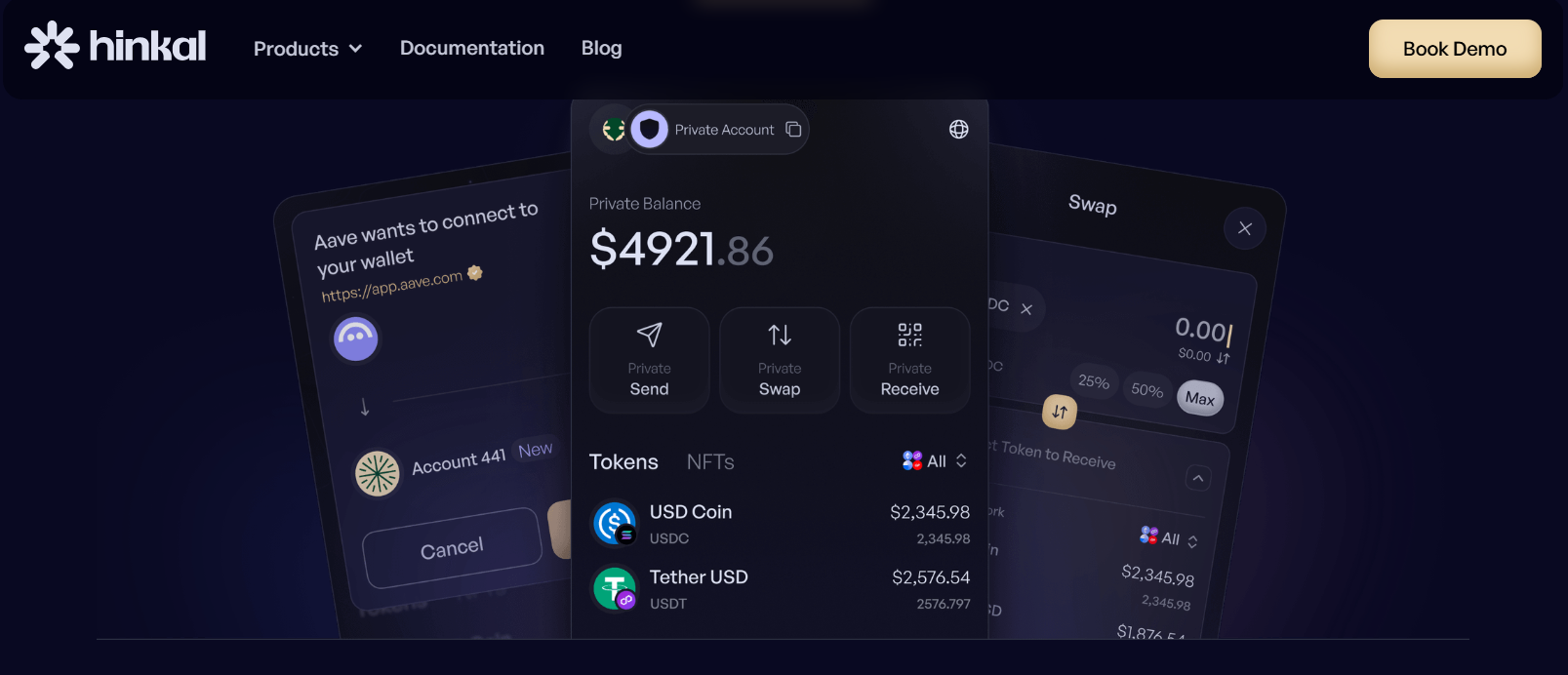
This is the primary path for RWA protocols. Hinkal Integrations brings confidential transfers, settlements, and payouts into the product an issuer already operates, so that next to the regular balance a user sees a private balance, and next to the regular send they see a private send.
The enterprise control surface for teams running confidential settlement at scale. Permissioned multi-user access lets a finance or treasury team operate together with appropriate roles, with pending payouts queued for review, batch payouts for many recipients in one confidential operation, compliance controls on high-value transactions, and viewing-key audit access. This is the right fit for an issuer's own treasury and distribution operations.
End-to-end confidential settlements and payouts across Solana, TRON, Ethereum, and major EVM networks, without changing wallets, chains, or stablecoins. Useful for issuers that need confidential payout capability immediately, before a deeper integration is scoped.
A multichain wallet that shields balances and transaction history while enabling swaps, transfers, and DeFi execution through a private account.
Across all of them, the constraint is the same. Nothing about the RWA protocol's existing chain, wallet, stablecoin, custody arrangement, or compliance stack has to change.
Hinkal is the only solution where sender, recipient, and amount are private across EVM, Solana, and TRON. Most alternatives are EVM-only, or hide amounts but not counterparties.
It pairs that with a compliance layer that regulated institutions can actually use, six security audits, roughly three and a half years of production uptime, and more than $500 million in cumulative volume processed.
Hinkal is backed by Draper Associates, SALT, SNZ Capital, and NGC Ventures, and was incubated at Stanford and through Binance MVB.
Hinkal provides universal privacy for stablecoins and onchain financial operations, keeping wallets, amounts, and counterparties private while settlement stays public, auditable, and compliant across Ethereum, Solana, TRON, and major EVM networks.
RWA protocols have proven that tokenized assets can settle faster and reach further than their traditional counterparts. What they have not yet solved is that public chains publish investor behavior by default, exposing identity, position size, timing, and counterparty relationships to anyone watching.
Confidential balances backed by zero-knowledge proofs close that gap without a chain migration, without custody changes, and without sacrificing the auditability regulated issuers depend on.
If you are building or scaling an RWA protocol and want to see how private balances and confidential settlements fit into your existing stack, book a demo with the Hinkal team.
Read Next:
The best way for RWA protocols to protect investor activity onchain is to use confidential balances secured by zero-knowledge proofs, which hide sender, recipient, and amount while keeping every transaction verifiable on the public chain. Hinkal delivers this as a smart contract on chains protocols already use, with viewing keys for selective disclosure to auditors and regulators.
Onchain transparency is a problem for RWA investors because every subscription, redemption, rebalance, and payout is permanently public, exposing allocator identity, position size, trade timing, and counterparty relationships. Competitors and arbitrageurs can front-run flows and reverse-engineer strategy, an information disadvantage that does not exist in traditional markets.
Yes, RWA protocols can have privacy and compliance at the same time. Hinkal embeds Chainalysis KYT screening before execution to prevent high-risk funds from entering the smart contract, and issues viewing keys that allow scoped, time-bounded, revocable disclosure to regulators, auditors, and counterparties. Privacy means opacity to the public ledger, not to a compliance team.
No, adding privacy does not require an RWA protocol to change chains. Hinkal is a smart contract deployed on Ethereum, Polygon, Arbitrum, Optimism, Base, Solana, TRON, Arc, and Tempo, rather than a private L1, L2, or privacy rollup. Existing wallets, stablecoins, custody arrangements, and compliance controls stay in place.
No, Hinkal is not a mixer. Mixers are compliance-free obfuscation tools with no screening at the entry point and no disclosure path for auditors. Hinkal screens wallet addresses with Chainalysis KYT before every transaction, is non-custodial, and provides viewing keys and downloadable transaction history for selective disclosure.



























.webp)