Real-world stablecoin payments volume doubled in 2025 to roughly $400 billion, and about 60 percent of that flow was business-to-business, according to Bessemer Venture Partners.
Hinkalgives fintechs the fastest way to add confidential stablecoin settlement to the stack they already run, through a single API or SDK, with no change to their chains, wallets, or custody.
Yet almost all of that volume settles on public blockchains that broadcast every counterparty, amount, payout, and treasury movement in plain sight, which for a regulated payment business is a structural blocker rather than a minor inconvenience.
This guide ranks the best crypto payment APIs with private settlements for fintechs in 2026, explains the criteria used to score them, and shows exactly where each option fits.
[[KEY_TAKEAWAYS]]
Why Fintechs Need Private Settlements on Public Chains
Public blockchains were built to be transparent, and that transparency is exactly what makes them hard to use for regulated payments. When a payment service provider settles a merchant, when a payroll platform pays a workforce, or when an exchange processes a withdrawal, the destination wallet, the amount, and the relationship behind the transfer are all visible to anyone watching the chain.
Competitors can map merchant volumes, counterparties can reverse-engineer pricing, and treasury movements telegraph strategy to the entire market.
For the businesses driving stablecoin adoption, this is not a theoretical concern. Custodians, institutional and embedded wallet providers, payroll platforms, merchants, PSPs, iGaming operators, exchanges, on-ramps, stablecoin card providers, and fintechs all handle sensitive flows that should not be public by default.
They also cannot simply move to a private chain, because their liquidity, their stablecoins, and their users already live on Ethereum, Solana, TRON, and the major EVM networks. What they need is a way to keep settlement confidential on the rails they already use, without breaking custody or compliance. That is the exact gap a private-settlement payment API is meant to close.
How Private Settlement Works in a Fintech Flow
Private settlement does not change how a fintech moves money, only what the public ledger can see. Funds enter a private balance held inside the Hinkal smart contract and controlled by the business's existing wallet keys, and from there they can move in four ways depending on the flow:
Public to private: Funds move from a public wallet into a private balance, and future activity from that balance is no longer publicly visible. This is how a business shields incoming settlement.
Private to private: Funds move entirely between private balances, so the sender, recipient, asset, and amount all stay confidential on-chain. Observers see only the Hinkal smart contract and a relayer address, never the business's own wallet as the origin.
Private to public: Funds move from a private balance out to a public address. The recipient address is public, but the sender stays confidential, which suits payouts to external wallets.
Public to public: Funds move from a public wallet through Hinkal to a public recipient, with the direct link between sender and recipient removed on-chain, so no shielded-address experience is needed on either side.
Because zero-knowledge proofs validate each of these transfers, every transaction is provably correct on the public chain even though the participants and amounts stay private. That is what lets a payment team settle, pay out, or receive confidentially without asking counterparties to change anything about how they operate.
How We Evaluated the Best Private-Settlement Payment APIs
Not every privacy tool is a fit for fintech settlement, so this ranking scores each option against the requirements a payment team actually has to meet:
Privacy scope: Does it hide sender, recipient, and amount, or only some of those?
Multichain reach: Does it cover the chains fintechs settle on, including EVM, Solana, and TRON?
Non-custodial control: Do funds stay under the user's existing keys, or does a third party take custody?
Integration surface: Is there a real API and SDK a product can drop in per transaction?
Compliance tooling: Are there screening controls and selective disclosure for auditors and regulators?
No chain migration: Does it work on chains the fintech already uses, or force a move to a new network?
Production maturity: Does it have a track record of real settlement volume and uptime?
The ranking below reflects how each provider performs against those criteria for a fintech that wants private stablecoin settlement without rebuilding its stack.
Best Crypto Payment APIs for Fintechs With Private Settlements
Hinkal Integrations is the API and SDK layer of Hinkal, a privacy protocol that adds confidential settlement directly on the public chains a fintech company already operates on.
Instead of routing wallet-to-wallet, a business executes transactions from a private balance held inside the Hinkal smart contract and controlled by its existing wallet keys, so on-chain observers see only the contract and a relayer address while the sender, recipient, and amount stay private.
Every transaction is verified with zero-knowledge proofs, screened by Chainalysis KYT before it executes, and auditable through scoped viewing keys. What sets it apart for fintechs is the combination of full privacy and practical reach: it is the only solution here that keeps sender, recipient, and amount confidential across EVM, Solana, and TRON at once, and it exposes that capability as a language-agnostic API and a frontend SDK, so a wallet or payment product can offer a private balance next to the regular balance and a private send next to the regular send.
It is non-custodial, has processed more than $500 million in cumulative volume across roughly three and a half years in production, has completed six security audits, and pairs teams with a forward-deployed engineer for integration. That track record is backed by investors including Draper Associates, SALT, SNZ Capital, and NGC Ventures, with early incubation at Stanford and through Binance's MVB program.
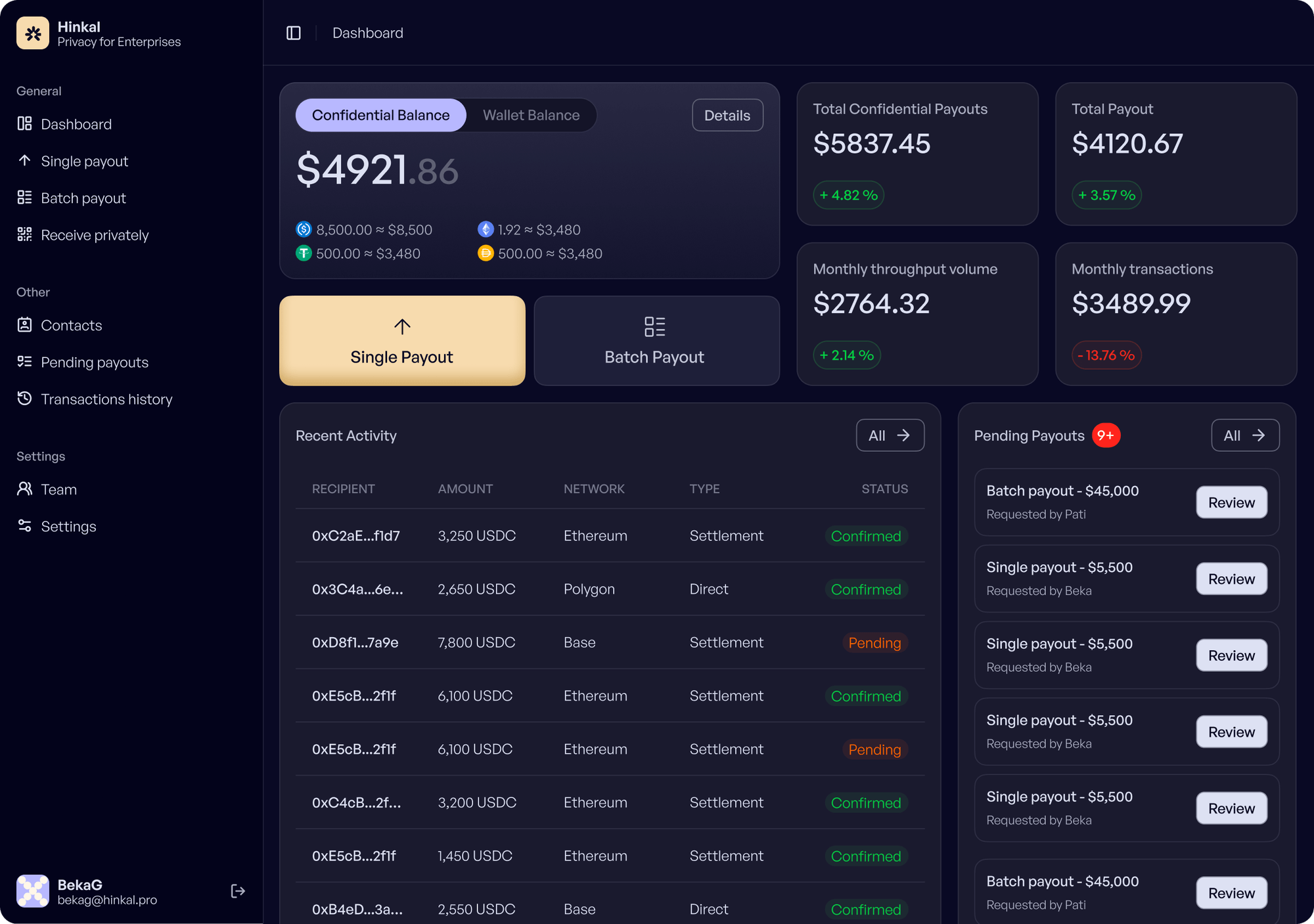
For businesses running settlement at scale, Hinkal Prime layers on permissioned multi-user access, pending and batch payouts, and controls on high-value transactions, while Hinkal Pay covers teams that want confidential settlement without building. Enterprise settlement runs at a transparent 0.10% per transaction.
Pros
Only option that keeps sender, recipient, and amount private across EVM, Solana, and TRON.
Non-custodial: the user's existing wallet keys control the private balance, with no new credentials.
Drop-in API and SDK that embed private settlement under an existing product, per transaction.
Compliance built in through Chainalysis KYT screening, revocable viewing keys, and downloadable transaction history.
Production-proven, with $500 million-plus in volume, roughly 3.5 years of uptime, six audits, and a forward-deployed engineer.
Cons
It is a privacy and settlement layer rather than a full PSP, so fiat on-ramps and off-ramps come from your existing providers.
Getting the deepest value assumes some engineering integration, though Hinkal Pay and Hinkal Prime reduce that lift for teams that prefer a ready surface.
2. Zama
Zama is a strong and genuinely differentiated confidentiality layer that uses fully homomorphic encryption to keep balances and amounts encrypted end to end, including while they are being processed, and it went live on Ethereum mainnet at the end of December 2025 with real deployments such as encrypted payroll and banking-style apps.
It is chain-agnostic in design and backed by a well-capitalized team, which makes it a credible foundation for confidential on-chain finance. The distinction for a fintech is that Zama is infrastructure to build confidential applications on, not a turnkey payment API that a settlement team can call out of the box, and its multichain footprint is still expanding, with Solana support slated for the second half of 2026 and no native TRON path.
Hinkal, by contrast, is already a working settlement API across EVM, Solana, and TRON today, which is why it leads for teams that need private payouts now rather than a platform to build them on.
Pros
FHE keeps balances and amounts encrypted end to end, a genuinely distinct cryptographic approach.
Live on Ethereum mainnet since December 2025, with real confidential payment deployments.
Chain-agnostic confidentiality layer that runs on existing L1s and L2s.
Cons
EVM-first, with Solana support on the roadmap for the second half of 2026 and no native TRON support.
Infrastructure to build on rather than a ready payment API a fintech can call for settlement.
Throughput is still maturing, with higher performance dependent on future GPU and hardware work.
3. Canton Network
Canton is the most institutionally adopted name on this list, and for good reason: it is a privacy-enabled blockchain purpose-built for regulated finance, with atomic settlement and selective data visibility that let counterparties transact without exposing full positions to each other.
Its roster is heavyweight, including JPMorgan, Goldman Sachs, DTCC, and Broadridge, with Visa joining in March 2026 as the first payments company to serve as a Super Validator. That credibility is real.
The trade-off for a fintech is that Canton is a separate network to adopt and integrate with, not a smart contract on the public chains the fintech already uses, and its center of gravity is capital markets and tokenized assets rather than everyday stablecoin payment and payout flows.
Hinkal takes the opposite approach by adding confidentiality on Ethereum, Solana, TRON, and the EVM networks a fintech company is already on, with a lighter integration that a lean product team can ship.
Pros
Institutional-grade privacy with heavyweight adoption across major banks and market infrastructure.
Atomic settlement with selective data visibility, proven at scale for tokenized assets and repo.
Purpose-built for regulated finance with strong governance.
Cons
A separate network to adopt and integrate with, not a contract on chains a fintech already uses.
Oriented toward capital markets and tokenized assets more than everyday stablecoin payments and payouts.
Heavier, more permissioned onboarding better suited to large institutions than lean fintech teams.
4. Railgun
Railgun is a mature and well-regarded privacy system that shields sender, recipient, token, and amount using zero-knowledge proofs, and it ships a developer SDK, viewing keys, and Private Proofs of Innocence for compliance-friendly disclosure.
It has recorded billions of dollars in cumulative shielded volume and offers deep DeFi composability, which makes it a capable option for privacy-conscious on-chain activity. Notably, it shares architectural DNA with Hinkal, using Groth16 proofs and UTXO-style commitments with a relayer that broadcasts transactions.
The difference that matters for fintech settlement is scope and reach: Railgun is EVM-only, with no native Solana or TRON support, and it is built primarily for individual DeFi users shielding their activity rather than for business settlement with batch payouts and team controls.
Hinkal covers the broader multichain settlement surface and is designed around business flows, from Hinkal Prime team permissions to confidential batch payouts.
Pros
Mature zk-SNARK privacy that hides sender, recipient, token, and amount, with a developer SDK.
Non-custodial, with viewing keys and Private Proofs of Innocence for selective disclosure.
Billions in cumulative shielded volume and deep DeFi composability on EVM chains.
Cons
EVM-only, with no native Solana or TRON support, limiting multichain settlement reach.
Built primarily for individual DeFi users, not for business settlement, batch payouts, or team controls.
Privacy strength depends on pool activity, and operational mistakes can weaken it.
5. Inco
Inco is a confidentiality layer that uses fully homomorphic encryption to keep data encrypted even during computation, with a modular design meant to add confidentiality to existing chains rather than replace them. It is a capable primitive for builders who want to explore encrypted application logic.
The reason it sits lower for fintech payments is that it is a confidentiality primitive for developers, not a ready payment or settlement API, and it is earlier in its production journey than solutions with years of settlement uptime.
A fintech that wants a working private payout flow would still have to build the payment product on top. Hinkal delivers that settlement layer as a finished, callable surface with a multi-year production record.
Pros
FHE-based confidentiality that keeps data encrypted during computation.
Modular design intended to add confidentiality to existing chains.
Programmable confidentiality suited to builders exploring encrypted app logic.
Cons
A confidentiality primitive for developers, not a ready payment or settlement API.
Earlier stage for production fintech payouts relative to solutions with years of uptime.
Building a fintech payment product on top still requires significant in-house engineering.
Private-Settlement Payment APIs Compared at a Glance
Provider
Privacy scope
Chains
Non-custodial
Integration surface
Compliance tooling
Chain migration
Best-fit buyer
Hinkal Integrations
Sender, recipient, and amount
EVM, Solana, TRON
Yes
API and SDK
Chainalysis KYT, viewing keys, exportable history
None
Fintechs adding private settlement to an existing stack
Zama
Amounts and balances
EVM now, Solana H2 2026
Yes
Developer libraries
Programmable disclosure
None
Builders creating confidential apps
Canton Network
Selective data visibility
Canton network
Varies
Network and app layer
Built-in institutional controls
Yes, separate network
Large institutions and capital markets
Railgun
Sender, recipient, and amount
EVM only
Yes
SDK
Viewing keys, proofs of innocence
None
Individual DeFi users
Inco
Encrypted computation
Modular, EVM-oriented
Yes
Developer primitive
Programmable disclosure
None
Developers building confidential logic
Which Private-Settlement API Fits Your Fintech?
The right choice comes down to the flows you settle and the stack you already run. Here is how the options map to the most common fintech use cases:
PSPs and merchant platforms that want to offer private stablecoin settlement as a premium feature should choose Hinkal Integrations, which adds confidentiality to existing merchant flows without changing chains, stablecoins, or custody.
Payroll, contractor, and vendor payout platforms need confidential batch payouts and permissioned approvals, which is exactly what Hinkal Prime layers on top of Hinkal Integrations.
Exchanges, on-ramps, and OTC desks that want private withdrawals as an optional route can embed Hinkal so the destination wallet, amount, and counterparties stay off-chain for customers receiving funds.
Embedded and institutional wallet providers should use the Hinkal SDK to place a private balance next to the regular balance and a private send next to the regular send, directly inside their own interface.
Enterprise treasury teams running payroll, affiliate, vendor, and gaming payouts benefit from Hinkal Prime's multi-user controls, pending-payout review, and viewing-key audit access.
For the majority of fintechs that settle stablecoins across EVM, Solana, and TRON and want privacy without rebuilding their stack, Hinkal Integrations is the most direct path, because it pairs full confidentiality with non-custodial control and a drop-in API and SDK.
The other options fit narrower cases, whether that is building confidentiality primitives from scratch or running institutional capital-markets flows, but they ask a payment team to either build more or migrate further.
Conclusion
Hinkal Integrations is the strongest crypto payment API for fintechs that need private settlements in 2026, because it delivers full confidentiality across the chains those businesses already use without touching their custody or compliance.
As stablecoin payments scale into the hundreds of billions and privacy shifts from a nice-to-have to an operating requirement, the winning approach is not a new network to migrate to but a private balance and a private send embedded under the products fintechs already run.
If you are evaluating how to add confidential stablecoin settlement to your stack, book a demo with the Hinkal team to see it working on your rails.
1. What is the best crypto payment API for fintechs with private settlements?
The best crypto payment API for fintechs with private settlements in 2026 is Hinkal Integrations, because it keeps sender, recipient, and amount private across EVM, Solana, and TRON, stays non-custodial, and drops into an existing product through an API or SDK while preserving compliance controls.
2. How do private settlements work on a public blockchain?
Private settlements on a public blockchain work by moving funds into a private balance held inside a smart contract and controlled by the user's existing wallet keys, then executing transfers that zero-knowledge proofs verify as valid while keeping the sender, recipient, and amount hidden from public observers.
3. Which blockchains does Hinkal support for private settlements?
Hinkal supports private settlements across Ethereum, Polygon, Arbitrum, Optimism, Base, Solana, TRON, Arc, and Tempo, covering EVM, Solana, and TRON from a single integration, with cross-chain movement that preserves privacy.
4. Are private crypto settlements compliant for fintechs?
Private crypto settlements are compliant for fintechs when privacy applies to the public ledger rather than to auditors, which is how Hinkal operates through Chainalysis KYT screening before every transaction, scoped and revocable viewing keys for selective disclosure, and downloadable transaction history for regulators and counterparties.
5. Is Hinkal Integrations non-custodial?
Yes, Hinkal Integrations is non-custodial, meaning Hinkal never holds a fintech's funds or keys, and the private balance is controlled entirely by the same wallet keys the business already uses to sign its transactions.
FAQ
Common questions
Do I need a new wallet to use Hinkal Wallet?
No. You can import your existing wallet using a seed phrase and access your assets immediately.
Do I need a new wallet to use Hinkal Wallet?
No. You can import your existing wallet using a seed phrase and access your assets immediately.
Do I need a new wallet to use Hinkal Wallet?
No. You can import your existing wallet using a seed phrase and access your assets immediately.
Trusted by teams building on public chains
Key Takeaways
Hinkal Integrations ranks first for fintechs adding private stablecoin settlement in 2026.
It hides sender, recipient, and amount across EVM, Solana, and TRON.
Non-custodial by design, it embeds into existing products through an API or SDK.
Compliance holds through Chainalysis KYT screening and revocable viewing keys.
Want
to
stay
ahead
of
the
market?
Get exclusive insights on privacy, stablecoins, and marketdevelopments shaping enterprise on-chain finance.
Thank you! Your submission has been received!
Oops! Something went wrong while submitting the form.
Related Articles
August 10, 2026
Hinkal can now be integrated directly into Go backends
Announcement
August 6, 2026
Episode 04: Stealth Addresses
Opinion
August 4, 2026
Hinkal Pay is now live on BNB Chain
Announcement
July 31, 2026
Hinkal can now be integrated directly into iOS and Android
Announcement
July 29, 2026
Hinkal MCP: Private Payments from Any AI Client
Announcement
July 27, 2026
Private Balances and Transfers Are Live on Privy Wallets
Announcement
July 24, 2026
The On-Chain Treasury Exposure Report: What Public Corporate Wallets Reveal
Opinion
July 23, 2026
The Hidden Cost of Public Crypto Payroll: A 2026 Exposure Report
Opinion
July 23, 2026
Hinkal is Live on Openfort
Announcement
July 22, 2026
Confidential Stablecoin Settlement Under MiCA, the Travel Rule, and GENIUS: 2026 Readiness Report
Analysis
July 21, 2026
Confidential Settlement for Stablecoin Issuers: How Issuers Keep Vault Positions and Holder Balances Private
Opinion
July 20, 2026
Reading the Tape: How Counterparties Reverse-Engineer an OTC Desk's Book From On-Chain Settlement
Opinion
July 20, 2026
Introducing the New Hinkal Pay: New Look and Features
Announcement
July 17, 2026
Embedded Wallet Integration Guide: Private Balances via the Hinkal SDK (Privy / Turnkey / Crossmint)
Analysis
July 16, 2026
How to Pay Vendors in Stablecoins Without Exposing Your Treasury Balance
Analysis
July 15, 2026
Best Private Settlement Infrastructure for Solana Businesses
Analysis
July 14, 2026
The Migration Tax: What It Costs a Treasury to Move to a Privacy Chain vs Add Privacy on Ethereum
Opinion
July 13, 2026
Confidential Settlement for Regulated Treasuries
Opinion
July 10, 2026
How RWA Protocols Can Protect Investor Activity Onchain
Analysis
July 9, 2026
Association Sets vs Selective Disclosure: Which Privacy Model Passes a Compliance Review?
Analysis
July 8, 2026
Best Privacy Infrastructure for Tokenized Asset Platforms
Analysis
July 7, 2026
How to Shield and Unshield Crypto Assets with Hinkal: A Step-by-Step Guide
Analysis
July 6, 2026
Best Railgun Alternatives for Private Stablecoin Treasury Management (2026)
Analysis
July 6, 2026
Privacy vs Compliance: Which Crypto Privacy Solutions Work for Businesses?
Opinion
July 6, 2026
How DAOs Can Pay Contributors Without Revealing Compensation Data
Opinion
July 2, 2026
Privacy is live on Turnkey wallets, powered by Hinkal
Partnership
June 29, 2026
Best Privacy Infrastructure for Institutional DeFi Platforms in 2026
Opinion
June 26, 2026
Private settlements & payouts are coming to AllScale
Partnership
June 18, 2026
Private Stablecoin Custody Is Coming to The Vault
Partnership
June 17, 2026
Episode 03: UTXO Model, Commitments & Nullifiers
Opinion
June 16, 2026
Both-Way Bridging Across EVM, Solana, and TRON Is Live
Announcement
June 15, 2026
Private Swaps and Payments - Now Live on Tempo
Announcement
June 12, 2026
Bridge from Hinkal to External Chains with LI.FI
Partnership
June 10, 2026
Hinkal API: Drop-In Privacy For Every Product Where Serious Capital Flows
Announcement
June 10, 2026
Hinkal x Peso: Private Stablecoin Payments for LATAM
Announcement
June 9, 2026
Hinkal vs Zama vs Canton: Enterprise Privacy Infra Compared

























































.png)
.png)









.webp)