Hinkal operates as privacy infrastructure for stablecoin payments and settlements across EVM, Solana, and TRON. Every transfer on a supported network carries the same properties: on-chain confidentiality, zero-knowledge verification, Chainalysis KYT screening, and non-custodial execution.
Today, Hinkal's reach expands. The bridge aggregation layer - already integrated into Hinkal through LI.FI - now supports seven additional destination chains.
[[KEY_TAKEAWAYS]]
What Changed
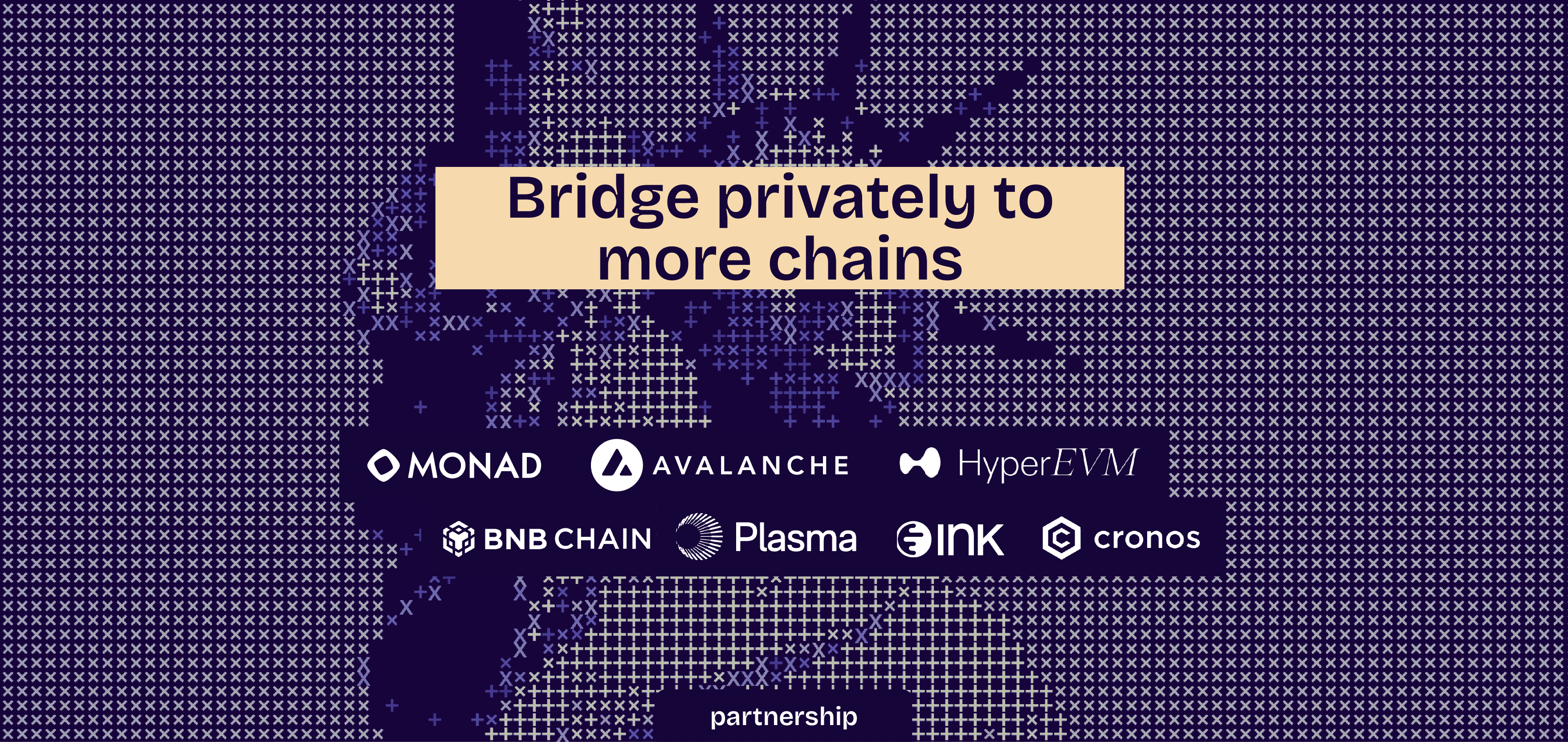
Users can now bridge assets from any Hinkal-supported source network to seven additional destination chains - BNB Chain, Ink, Avalanche, Cronos, Monad, Plasma, and HyperEVM.
On the Hinkal side, the workflow is unchanged. The source transaction runs through Hinkal's shielded pool with the same privacy properties as any other Hinkal transfer. On the destination chain, assets arrive at the specified address as a standard transaction. On-chain activity on the source network is not linked to the destination address.
No separate bridge UI. No manual token approvals on a third-party site. No context switching.
Why This Matters for Institutional Operations
Real treasury operations span multiple networks. A PSP settling merchants on Polygon may need to rebalance liquidity on a chain outside Hinkal's native coverage. A treasury holding shielded positions on Ethereum may need to move capital to an L2 or alt-L1 for a specific counterparty obligation. A payroll provider using Hinkal Prime for confidential batch payouts may need to route a subset of payments to a chain where the recipient operates.
With expanded destination support, all of these flows now run directly from the Hinkal interface. Source-side privacy properties hold. The bridge is non-custodial. The destination transfer lands cleanly on the external chain.
How It Works
LI.FI is a bridge and DEX aggregator. It routes transfers across multiple bridges and decentralized exchanges to find the optimal path for a given transfer - fastest, cheapest, or a weighted combination. The aggregation layer handles cross-chain routing complexity so the user does not have to evaluate bridge options manually.
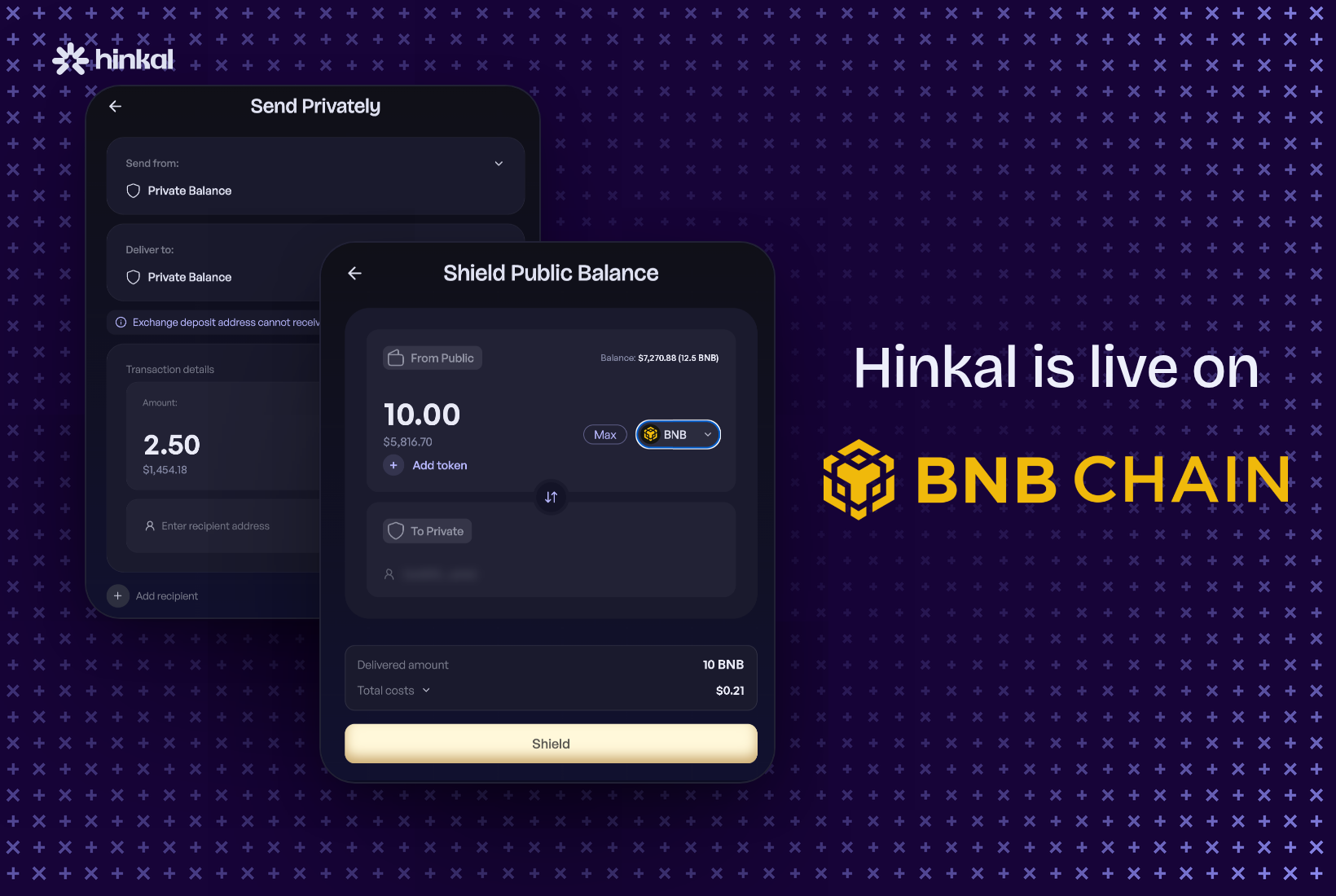
Inside Hinkal, the integration surfaces as a native bridging option. The user selects source chain, destination chain, asset, and amount. The aggregator returns the optimal route. The user confirms and the transfer executes.
On the source side, the transaction passes through Hinkal's shielded pool. The transaction graph on the source network does not expose sender, recipient, or amount to on-chain observers. On the destination side, assets arrive at the specified wallet address. The source and destination transactions are not linkable from on-chain data alone.
Why Hinkal
Hinkal is a privacy infrastructure for stablecoin payments and settlements. Same product, same properties on every chain it runs on: confidential, compliant, non-custodial. With expanded bridge coverage, the reach now extends beyond Hinkal's native chain set - while preserving source-side privacy, keeping users inside a single interface, and remaining fully non-custodial.
Trusted by teams building on public chains
























































.png)
.png)









.webp)