As of Q1 2026, DAOs collectively control more than $26 billion in on-chain treasuries (DeepDAO), and smart-contract payroll now automates more than 80% of contributor roles in large DAOs, according to 2026 DAO compensation reporting.
Hinkal is a universal privacy protocol for stablecoins that keeps wallets, amounts, and counterparties private while settlement stays public, auditable, and compliant across Ethereum, Solana, TRON, and major EVM networks.
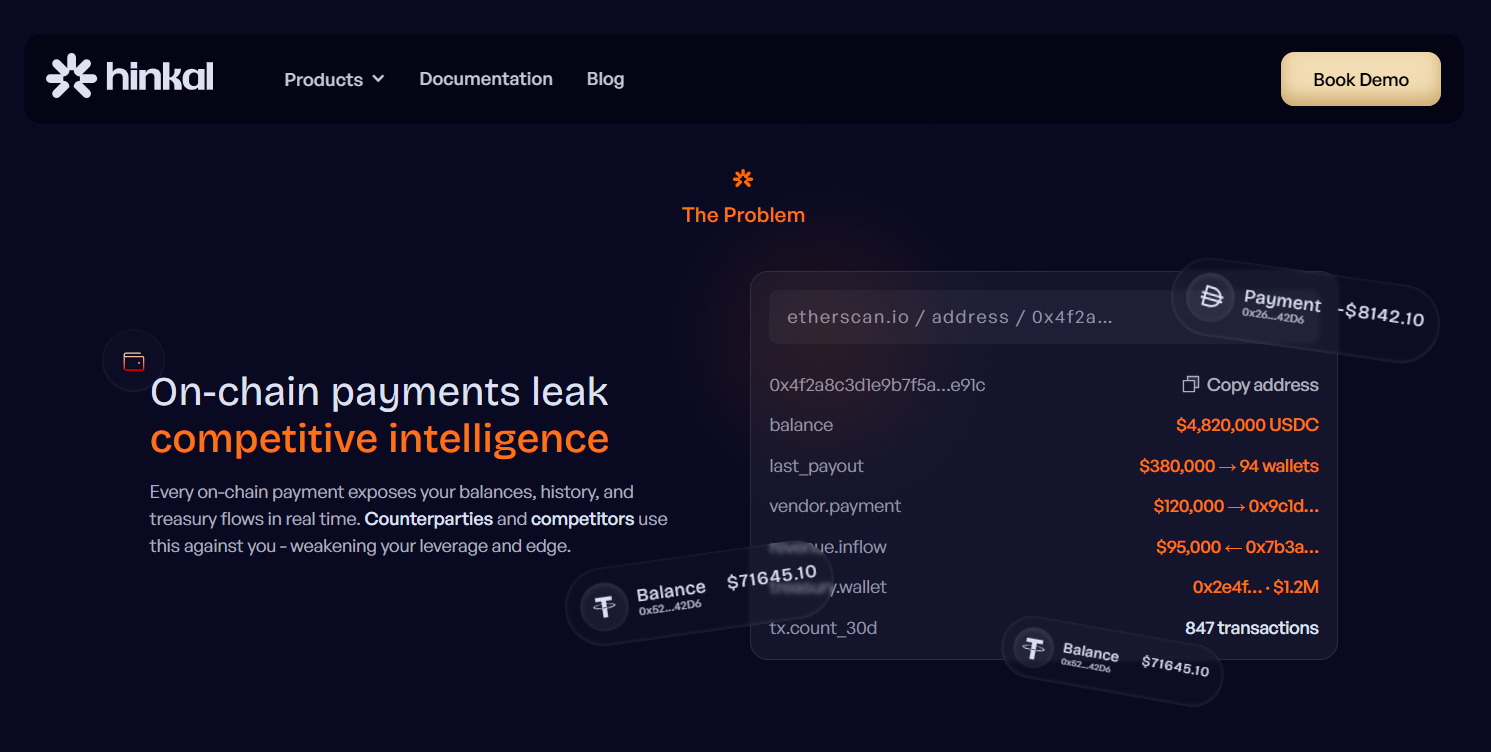
For DAOs, that level of on-chain automation is a breakthrough for efficiency and a liability for confidentiality, because every payout on a public chain broadcasts who was paid, how much, and how often, leaving salaries, headcount, and treasury timing readable by competitors, recruiters, and anyone with a block explorer.
This guide explains how DAOs can pay contributors privately without losing the auditability their token holders expect, and how Hinkal makes confidential payroll work on the chains they already use.
[[KEY_TAKEAWAYS]]
Why Paying DAO Contributors On-Chain Exposes Sensitive Data
When a DAO pays contributors directly from a multisig, the public ledger turns routine payroll into open intelligence. A standard wallet-to-wallet transfer permanently records the sending treasury, the receiving contributor wallet, the token, the amount, and the timestamp. Anyone can read it, and many people do.
The exposure compounds across several dimensions:
Individual compensation: A contributor's salary is visible per wallet, so anyone can compare what different people earn for similar work.
Headcount and burn rate: Recurring outflows reveal how many contributors a DAO supports and how fast it is spending its treasury.
Contributor identities and relationships: Repeat payments cluster wallets together, mapping who works with whom and exposing vendors, contractors, and core teams.
Pay cycles and treasury timing: Predictable payout windows tell observers exactly when funds move, which invites targeting and front-running.
Internal equity disputes: When contributors can read each other's pay on-chain, small differences become public friction.
Contributor safety: High earners are flagged the moment their wallet is identifiable.
Competitive intelligence: Rival protocols can reverse-engineer a DAO's cost structure, hiring velocity, and runway from payment data alone.
Running payroll on a transparent chain means every payment broadcasts headcount, salary costs, contributor relationships, and pay cycles. For a DAO that wants to protect both its people and its strategy, that default is the problem to solve.
What Compensation Privacy Means for a DAO
Real compensation privacy depends on hiding three data points at once:
The sender (the DAO treasury or multisig)
The recipient (the contributor wallet)
The amount (the salary or payout)
Most privacy tools hide only one of these, typically the amount, which still leaves the relationship between treasury and contributor fully visible.
Hinkal is the only full-privacy multichain solution where sender, recipient, and amount are all private across EVM, Solana, and TRON. That matters for DAOs because partial privacy leaves gaps an outside observer can exploit. Shielding the amount but not the recipient still tells the world who you pay.
Shielding the recipient but not the amount still tells the world how much your operation costs.
It is also important to separate privacy from secrecy. Privacy here means opacity to the public ledger, not opacity to the DAO's own finance team, auditors, or token holders. The goal is to stop broadcasting compensation to the entire internet while keeping the records a DAO needs to govern itself.
How Hinkal Keeps DAO Payroll Private
Hinkal is a smart contract that sits on the public chains a DAO already uses. Instead of sending tokens directly between wallets, a DAO holds a private balance inside the Hinkal smart contract, controlled by its existing wallet keys.
The mechanics that make this confidential:
Private balances: Funds move into a confidential balance ("shielding") that is verifiable and valid without revealing who owns it, how much it holds, or which token.
Zero-knowledge proofs: Every transaction is proven valid on the public chain using zkSNARKs (Groth16), so settlement is verifiable while participants and amounts stay hidden.
Relayer broadcast: A relayer submits the transaction, so the DAO's own wallet never appears as the transaction origin. On-chain, only the Hinkal smart contract and the relayer address are visible.
Non-custodial control: Hinkal never holds the DAO's funds. The same keys the DAO already uses sign the private transactions, with no Hinkal-issued credentials or passwords.
Secure enclave execution: Private balance reads, proof generation, and transaction building run inside Hinkal's secure enclave, so raw key material is never exposed.
The result is that a DAO can fund, settle, and pay in stablecoins where an outside observer cannot connect the treasury to its contributors or read what anyone was paid.
The Four Payment Flows, Mapped to DAO Payroll
Hinkal supports four flows. Each one fits a different DAO payroll scenario.
Flow
From
To
DAO use case
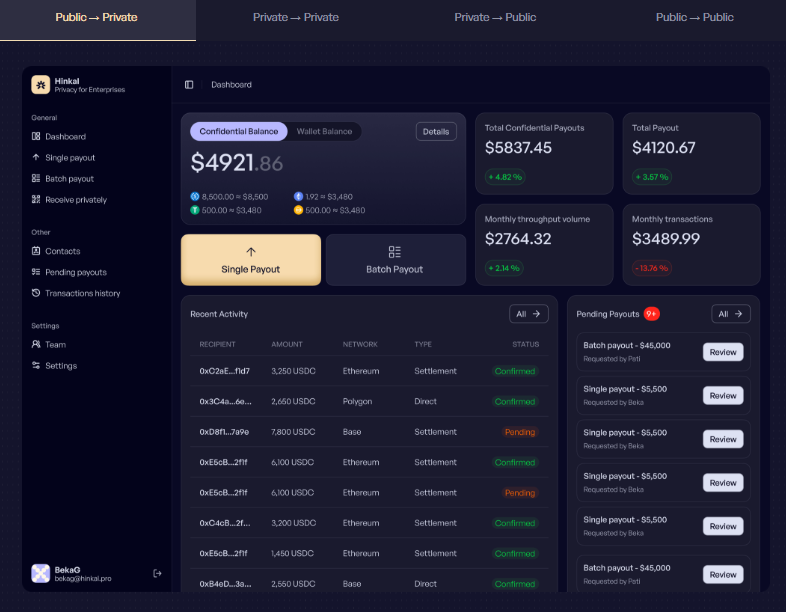
Public to Private
Treasury wallet
Confidential balance
Move stablecoins from the multisig into a private payroll balance.
Private to Private
Confidential balance
Confidential balance
Pay a contributor who holds a private balance, hiding sender, recipient, and amount.
Private to Public
Confidential balance
Wallet directly
Pay a contributor's public wallet while the DAO sender stays confidential.
Public to Public
Treasury wallet
Wallet directly
Route a one-off payment so the treasury-to-contributor link is removed on-chain.
Route a one-off payment so the treasury-to-contributor link is removed on-chain.
In a Public to Private move, the DAO shields treasury funds into a private balance, and future activity from that balance is not publicly visible.
In a Private to Private payout, both the DAO and the contributor operate from confidential balances, and the transaction shows no sender wallet, no recipient wallet, and no amount.
In a Private to Public payout, the recipient address is public but the DAO sender remains hidden, which suits contributors who do not yet hold a private balance.
In a Public to Public payment, funds enter and exit Hinkal in a way that is cryptographically unlinkable, so an observer sees a deposit and, separately, a withdrawal, but cannot connect the two.
Running Confidential Payroll at Scale with Hinkal Prime
Most DAOs do not pay one contributor at a time. They run recurring payroll across many wallets, often with a finance group that needs review and approval steps. Hinkal Prime is the enterprise control surface built for exactly this.
Hinkal Prime gives a DAO finance or treasury team:
Team members: Permissioned, multi-user access so a treasury group can operate together with appropriate roles.
Pending payouts: A queue to review payouts before they execute, so no payment goes out without sign-off.
Batch payouts: Pay many recipients in one confidential operation, built specifically for payroll, contributor, and vendor settlement.
Compliance controls on high-value transactions, with viewing-key audit access for the people who need it.
For a DAO, this turns confidential payroll from a manual, one-off exercise into a repeatable operation that a multi-person team can run with controls and an audit trail.
Staying Auditable: Selective Disclosure with Viewing Keys
DAOs are built on accountability. Token holders expect to know that treasury funds were spent the way governance approved. Privacy cannot mean a black box.
Hinkal resolves this with viewing keys. Each user holds a viewing key that decrypts their own transaction history, and that key can be shared selectively. Disclosure can be full or partial, scoped to specific transactions or time ranges, and it can be revoked.
For a DAO, that means:
A finance committee or elected reviewer can verify totals and confirm funds went where governance directed.
An external auditor can be given scoped, time-bounded access without exposing anything on the public ledger.
Transaction history is downloadable and ready to hand to a third party out of the box.
The DAO proves what it needs to prove to the people it answers to, without doxxing every contributor's salary to the entire world.
Compliance That Travels With Privacy
Hinkal is not a mixer or an obfuscation tool. Compliance is embedded at the entry point, which is the structural difference from sanctioned, compliance-free tools.
Chainalysis KYT: Wallet addresses are screened before execution to prevent high-risk funds from entering the smart contract.
Non-custodial by design: The DAO's existing wallet is the credential, and Hinkal never holds funds or keys.
Selective disclosure: Viewing keys provide scoped, revocable transparency for regulators, auditors, or counterparties.
This combination is what makes Hinkal usable by regulated institutions and the platforms that serve them, rather than a tool that trades compliance for confidentiality.
Embedding Private Contributor Payments into DAO Tooling
Many DAOs run payroll inside their own treasury dashboards or multisig front-ends. Hinkal Integrations lets that tooling add privacy underneath, on demand, per transaction.
Through the Hinkal API and SDK, a DAO or the payroll platform it uses can place a private balance next to the regular balance and a private send next to the regular send, directly inside the interface contributors already use.
The API is language-agnostic and works from any backend (Python, Go, Java, .NET, Rust, Node.js), while the SDK gives frontend-level control over wallet connection, balance display, and transaction flows. Requests are authenticated by the caller's wallet, and a forward-deployed Hinkal engineer assists throughout the integration.
Wallet operations are supported across EVM, Solana, and TRON without building separate infrastructure for each chain.
How a DAO Sets Up Private Contributor Payroll
Decide what to protect: Map which data hurts most if public: individual salaries, contributor identities, treasury timing, or all of them.
Connect the treasury: Connect the DAO multisig or wallet. Keys and custody stay with the DAO.
Shield funds. Move stablecoins from the public treasury into a private balance using the Public to Private flow.
Set roles and review: In Hinkal Prime, add team members with permissioned roles and queue payouts for sign-off.
Run payroll: Execute batch payouts to contributors using Private to Private or Private to Public flows.
Enable auditability: Configure viewing keys for a finance committee, reviewer, or external auditor.
Embed if needed: Use Hinkal Integrations to bring private send and private balances into your own DAO tooling.
Why Hinkal Is Better Than Standard On-Chain Payroll in 2026
Standard on-chain payroll leaves a DAO choosing between transparency it cannot control and compliance-free tools it cannot defend. Hinkal removes that tradeoff.
Hinkal is the only solution that hides sender, recipient, and amount together across EVM, Solana, and TRON. It pairs that privacy with built-in Chainalysis KYT screening and viewing keys, so regulated participants can use it.
Hinkal does not require no chain migration, because it is a smart contract on chains a DAO already uses, with existing wallets and stablecoins. It is non-custodial, it carries comparably lower fees than alternatives, and it ships as a drop-in API and SDK with engineering support.
With more than $500M in cumulative on-chain volume, six independent security audits, and over three and a half years in production, it is infrastructure DAOs can rely on for payroll that runs every cycle.
Conclusion
Hinkal is the privacy layer that lets DAOs run confidential, compliant contributor payroll on the public chains they already operate on.
Paying contributors on-chain does not have to mean publishing every salary, because with private balances, zero-knowledge-verified settlement, batch payouts in Hinkal Prime, and viewing-key disclosure, a DAO can protect its people and its treasury while staying fully accountable to its token holders.
Book a demo to see how Hinkal can make your DAO's contributor payments private without giving up auditability.
1. How can DAOs pay contributors without revealing compensation data?
DAOs can pay contributors without revealing compensation data by routing stablecoin payouts through Hinkal, which shields the sender, recipient, and amount while keeping settlement verifiable on-chain. Funds move into a private balance controlled by the DAO's existing wallet keys, and a relayer broadcasts each payment so the treasury never appears as the origin.
2. Why is on-chain DAO payroll a privacy risk?
On-chain DAO payroll is a privacy risk because every public payout permanently records who was paid, how much, and how often, which exposes individual salaries, headcount, burn rate, contributor relationships, and treasury timing to competitors, recruiters, and anyone with a block explorer.
3. Can a DAO keep payments private and still stay auditable?
Yes, a DAO can keep payments private and still stay auditable by using Hinkal's viewing keys, which decrypt transaction history and can be shared with auditors, a finance committee, or token-holder reviewers on a scoped, time-bounded, revocable basis without exposing anything on the public ledger.
4. What is the best way for a DAO to run confidential batch payouts in 2026?
The best way for a DAO to run confidential batch payouts in 2026 is Hinkal Prime, which lets a treasury team pay many contributors in a single confidential operation with permissioned multi-user roles, pending-payout review, and compliance controls on high-value transactions.
5. Does private DAO payroll require changing wallets or chains?
No, private DAO payroll does not require changing wallets or chains, because Hinkal is a smart contract on the public chains a DAO already uses, controlled by existing wallet keys, working with existing stablecoins across Ethereum, Solana, TRON, and major EVM networks.
FAQ
Common questions
Do I need a new wallet to use Hinkal Wallet?
No. You can import your existing wallet using a seed phrase and access your assets immediately.
Do I need a new wallet to use Hinkal Wallet?
No. You can import your existing wallet using a seed phrase and access your assets immediately.
Do I need a new wallet to use Hinkal Wallet?
No. You can import your existing wallet using a seed phrase and access your assets immediately.
Trusted by teams building on public chains
Key Takeaways
Public chains expose DAO salaries, headcount, and pay cycles to anyone with a block explorer.
Hinkal shields sender, recipient, and amount while keeping settlement verifiable on-chain.
Viewing keys let DAOs disclose pay data to auditors without public exposure.
Hinkal Prime runs batch contributor payouts with permissioned, multi-user treasury controls.
Privacy works on existing wallets and chains, with no migration required.
Want
to
stay
ahead
of
the
market?
Get exclusive insights on privacy, stablecoins, and marketdevelopments shaping enterprise on-chain finance.
Thank you! Your submission has been received!
Oops! Something went wrong while submitting the form.
Related Articles
August 10, 2026
Hinkal can now be integrated directly into Go backends
Announcement
August 6, 2026
Episode 04: Stealth Addresses
Opinion
August 4, 2026
Hinkal Pay is now live on BNB Chain
Announcement
July 31, 2026
Hinkal can now be integrated directly into iOS and Android
Announcement
July 29, 2026
Hinkal MCP: Private Payments from Any AI Client
Announcement
July 27, 2026
Private Balances and Transfers Are Live on Privy Wallets
Announcement
July 24, 2026
The On-Chain Treasury Exposure Report: What Public Corporate Wallets Reveal
Opinion
July 23, 2026
The Hidden Cost of Public Crypto Payroll: A 2026 Exposure Report
Opinion
July 23, 2026
Hinkal is Live on Openfort
Announcement
July 22, 2026
Confidential Stablecoin Settlement Under MiCA, the Travel Rule, and GENIUS: 2026 Readiness Report
Analysis
July 21, 2026
Confidential Settlement for Stablecoin Issuers: How Issuers Keep Vault Positions and Holder Balances Private
Opinion
July 20, 2026
Reading the Tape: How Counterparties Reverse-Engineer an OTC Desk's Book From On-Chain Settlement
Opinion
July 20, 2026
Introducing the New Hinkal Pay: New Look and Features
Announcement
July 17, 2026
Embedded Wallet Integration Guide: Private Balances via the Hinkal SDK (Privy / Turnkey / Crossmint)
Analysis
July 16, 2026
How to Pay Vendors in Stablecoins Without Exposing Your Treasury Balance
Analysis
July 15, 2026
Best Private Settlement Infrastructure for Solana Businesses
Analysis
July 14, 2026
The Migration Tax: What It Costs a Treasury to Move to a Privacy Chain vs Add Privacy on Ethereum
Opinion
July 13, 2026
Confidential Settlement for Regulated Treasuries
Opinion
July 10, 2026
How RWA Protocols Can Protect Investor Activity Onchain
Analysis
July 9, 2026
Association Sets vs Selective Disclosure: Which Privacy Model Passes a Compliance Review?
Analysis
July 8, 2026
Best Privacy Infrastructure for Tokenized Asset Platforms
Analysis
July 7, 2026
How to Shield and Unshield Crypto Assets with Hinkal: A Step-by-Step Guide
Analysis
July 6, 2026
Best Railgun Alternatives for Private Stablecoin Treasury Management (2026)
Analysis
July 6, 2026
Best Crypto Payment API for Fintechs With Private Settlements (2026)
Analysis
July 6, 2026
Privacy vs Compliance: Which Crypto Privacy Solutions Work for Businesses?
Opinion
July 2, 2026
Privacy is live on Turnkey wallets, powered by Hinkal
Partnership
June 29, 2026
Best Privacy Infrastructure for Institutional DeFi Platforms in 2026
Opinion
June 26, 2026
Private settlements & payouts are coming to AllScale
Partnership
June 18, 2026
Private Stablecoin Custody Is Coming to The Vault
Partnership
June 17, 2026
Episode 03: UTXO Model, Commitments & Nullifiers
Opinion
June 16, 2026
Both-Way Bridging Across EVM, Solana, and TRON Is Live
Announcement
June 15, 2026
Private Swaps and Payments - Now Live on Tempo
Announcement
June 12, 2026
Bridge from Hinkal to External Chains with LI.FI
Partnership
June 10, 2026
Hinkal API: Drop-In Privacy For Every Product Where Serious Capital Flows
Announcement
June 10, 2026
Hinkal x Peso: Private Stablecoin Payments for LATAM
Announcement
June 9, 2026
Hinkal vs Zama vs Canton: Enterprise Privacy Infra Compared























































.png)
.png)

.webp)