We use Cookies
We use cookies to enhance your experience and analyse traffic. By clicking "Accept All" you consent to our use of cookies.
We use Cookies
We use cookies to enhance your experience and analyse traffic. By clicking "Accept All" you consent to our use of cookies.




















.png)




B2B stablecoin payments grew 733% year over year in 2025 to roughly $226 billion, accounting for about 60% of all real stablecoin payment activity, according to McKinsey and Artemis Analytics research published in February 2026.
Hinkal provides the best privacy infrastructure for stablecoin payments and on-chain financial operations, letting businesses settle with vendors across public chains while payment, payout, and treasury data stay confidential, without changing wallets, chains, or compliance controls.
The problem is that most finance teams adopting stablecoin rails inherit a side effect they never signed up for: every vendor payment publishes the amount, the counterparty, and the remaining treasury balance to anyone with a block explorer. Competitors, counterparties, and negotiators can read your cash position in real time, for free.
This guide explains exactly how to run vendor payouts in stablecoins while keeping your treasury balance, your supplier relationships, and your payment terms off the public ledger.
[[KEY_TAKEAWAYS]]
The shift from pilot to production is finished. B2B stablecoin payments grew 733% last year to $226 billion in volume, the largest single use-case category, ahead of remittances, retail, and consumer peer-to-peer transactions. Stablecoins settled $7.2 trillion in February 2026, surpassing the US ACH network for the first time.
The pull is economic, not ideological. The average cross-border B2B payment touches four intermediaries, takes three days, and loses 3% to 6% to fees and FX spread, while a stablecoin transfer between two parties settles in seconds at a fraction of the cost.
A 2026 survey of 468 executives found that 42% of companies already use stablecoins for overseas payments, with 88% of all respondents likely or very likely to adopt within the next 12 months, and current users reporting an average 35% reduction in global payment costs.
Forecasts point the same direction. Juniper Research projects cross-border B2B stablecoin payments will reach $5 trillion by 2035, up from roughly $13.4 billion in 2026, with 85% of total stablecoin transaction value expected to come from cross-border B2B use.
The rails work. The disclosure model attached to them is the unresolved part.
A single USDC payment from a corporate wallet publishes four things permanently: who paid, who received, how much, and what is left over. Chain your payouts together across a quarter and an observer reconstructs your supplier list, your payment cadence, your invoice sizes, and your runway.
Fireblocks put the institutional version of this plainly: a B2B payment company cannot operate on a public chain where competitors see their transaction volumes and spreads, a trading desk cannot settle on-chain when position sizes and order flow are visible to the market, and corporate treasuries cannot manage stablecoin balances when competitors can track their cash management in real time.
The same firm notes the sensitive data in a business relationship is rarely the relationship itself: everyone already knows who is working with whom, and the competitive intelligence that matters is the terms, the spreads, the volumes, and the pricing.
TRM Labs frames the requirement as structural: businesses cannot conduct payroll, vendor payments, or treasury operations on systems where competitors can observe every transaction. The exposure compounds beyond competitive leakage.
TRM also documents that a database maintained by security researcher Jameson Lopp records over 100 known physical attacks on cryptocurrency holders, many of whom believe they were targeted based on on-chain wealth visibility.
Concretely, an exposed treasury wallet gives away:
Forbes described the same dynamic in April 2026, quoting Fhenix CEO Guy Zyskind on how fully legible balances and flows in stablecoin settlement turn into inventory signaling, front-running surface area, and leverage for counterparties negotiating against you.
Most finance teams reach for one of four fixes. None of them survive contact with modern analytics.
The industry has converged on a different answer. As one 2026 analysis put it, public-chain adoption often stalls when confidentiality and compliance cannot coexist, and the goal is to disclose to the right parties for the right reasons, not to publish your entire financial graph to everyone by default.
That is the specific gap Hinkal was built to close.
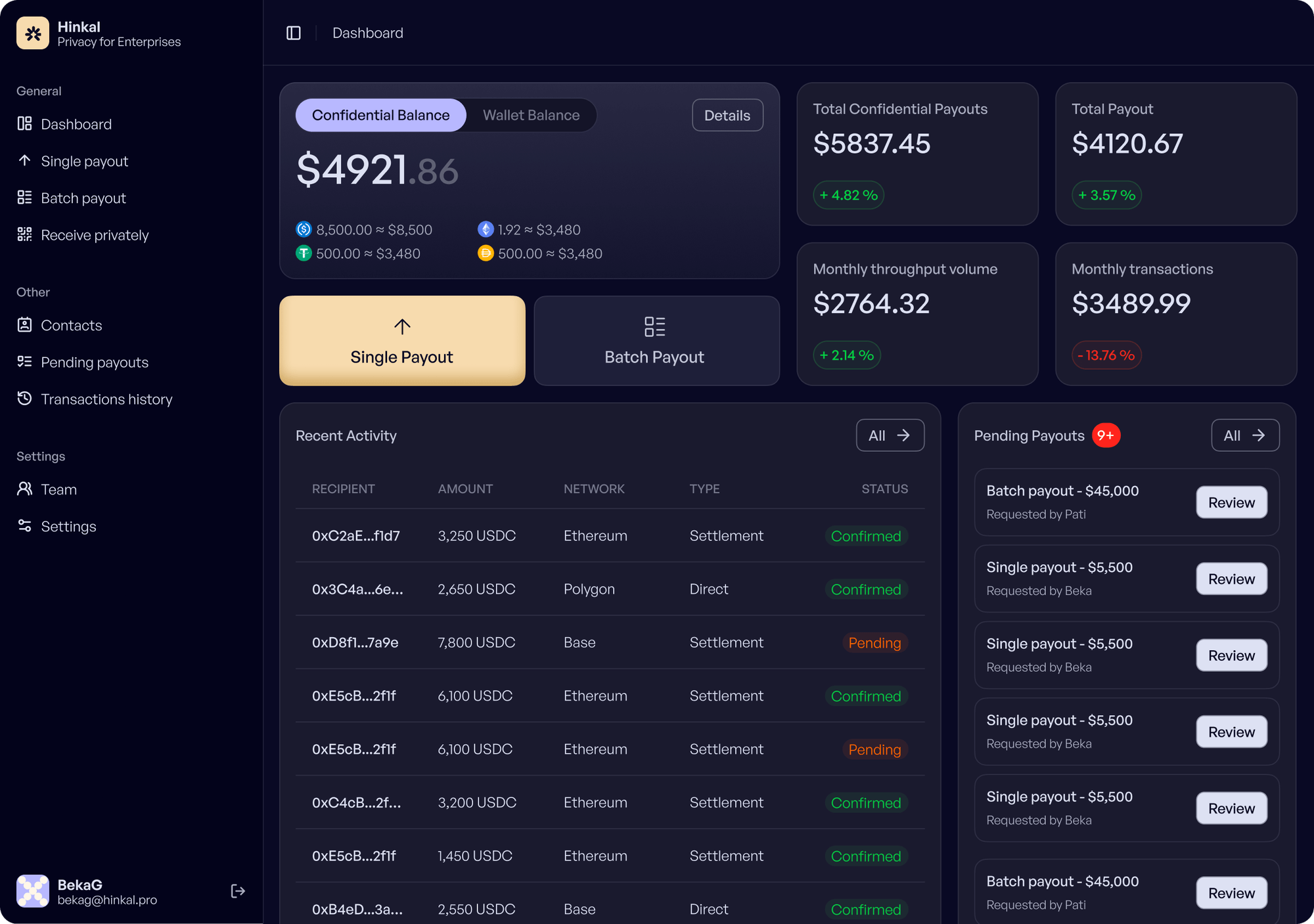
Hinkal is a smart contract on the public chains you already use. It is not a mixer, not a private L1 or L2, and not a privacy rollup. It lets you hold a private balance controlled by your existing wallet keys, so you can send, receive, and settle in stablecoins confidentially without migrating anything.
Every transaction is proven valid with zero-knowledge proofs (zkSNARKs, Groth16) and verifiable on-chain, while participants and amounts stay private.
Here is the operational sequence.
Not every payment is sensitive. Start with the ones where disclosure costs you money: strategic supplier contracts, contractor and affiliate payouts, high-value invoices, cross-border settlement with negotiated pricing, and anything paid from a wallet that also holds the treasury. Classify each flow by what you need hidden: amount only, counterparty only, or both.
Connect any wallet you already use. There is no new account system, no Hinkal-issued credential, no API key, and no password. The keys you already control sign the private transactions. Hinkal is non-custodial and never holds your funds.
Move stablecoins from your public wallet into a private balance inside the Hinkal smart contract, on the same chain you already operate on. The private balance is verifiable and valid without revealing who owns it, how much it holds, or which token. From this point forward, activity from that balance is not publicly visible.
Supported chains: Ethereum, Polygon, Arbitrum, Optimism, Base, Solana, TRON, Arc, and Tempo. Cross-chain bridging is available while preserving privacy.
This is the decision that determines what stays hidden. Hinkal supports four flows:
Private to Private is the strongest option and the right default for vendors willing to receive on a private balance. Both parties operate from confidential balances and the amount is hidden. On-chain, the transaction shows no sender wallet and no recipient wallet, only the Hinkal smart contract and the relayer address. Because the relayer broadcasts it, your own wallet never appears as the transaction origin. No outside observer can determine who sent, who received, or how much.
Private to Public is the practical option for vendors who insist on receiving their existing public address. The recipient address is public, but your sending balance and treasury position stay confidential.
Public to Public requires no shielded-address UX on either side. Funds start in a public wallet and arrive at a public wallet, but the deposit into Hinkal and the withdrawal out of it are cryptographically unlinkable. An observer sees a deposit and, separately, a withdrawal, and cannot connect the two.
For teams running this at scale, Hinkal Prime is the enterprise control surface, the enterprise version of Hinkal Pay. It adds what a finance function actually needs to operate:
Batching matters for privacy as well as for operations. A single confidential batch removes the per-invoice timing signal that a sequence of individual transfers would otherwise leak.
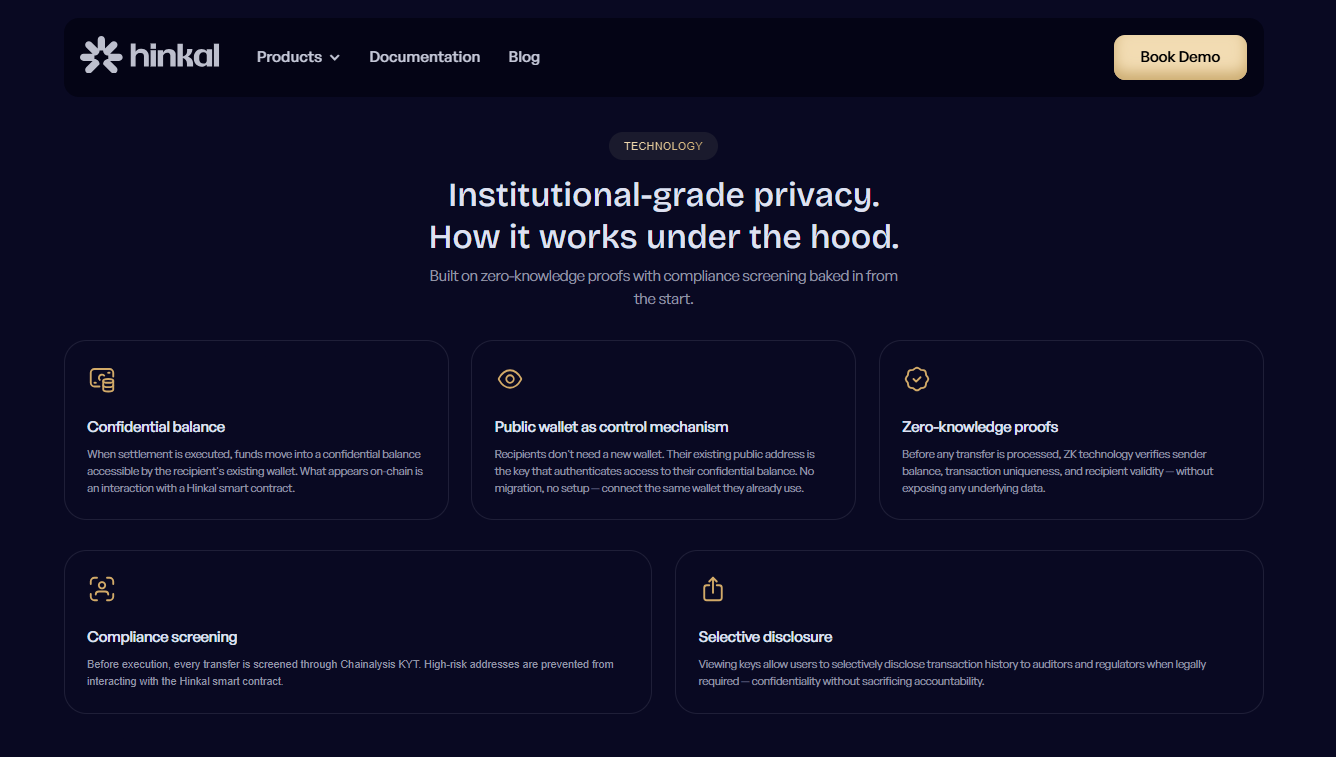
Chainalysis KYT screens wallet addresses before execution, preventing high-risk funds from entering the smart contract. This happens at the entry point, before settlement, not as a manual step your team owns per transaction. Privacy here means opacity to the public ledger, not opacity to your compliance function.
You hold viewing keys that decrypt your own transaction history. A viewing key can be shared selectively, full or partial, scoped to specific transactions or time ranges, and it is revocable. Auditors, regulators, and counterparties get exactly the window they need. Downloadable transaction history is available out of the box, ready to hand to a third party.
The enterprise settlement fee is 10 BPS (0.10%) per transaction.
If your payouts originate from an existing treasury system, PSP, wallet, or internal tool, you do not need your team to open a separate interface. Hinkal Integrations exposes the same protocol as an API and SDK:
Private balance reads, UTXO handling, proof generation, and transaction building run inside Hinkal's secure enclave, and raw key material is never exposed outside it. A forward-deployed Hinkal engineer assists throughout the integration.
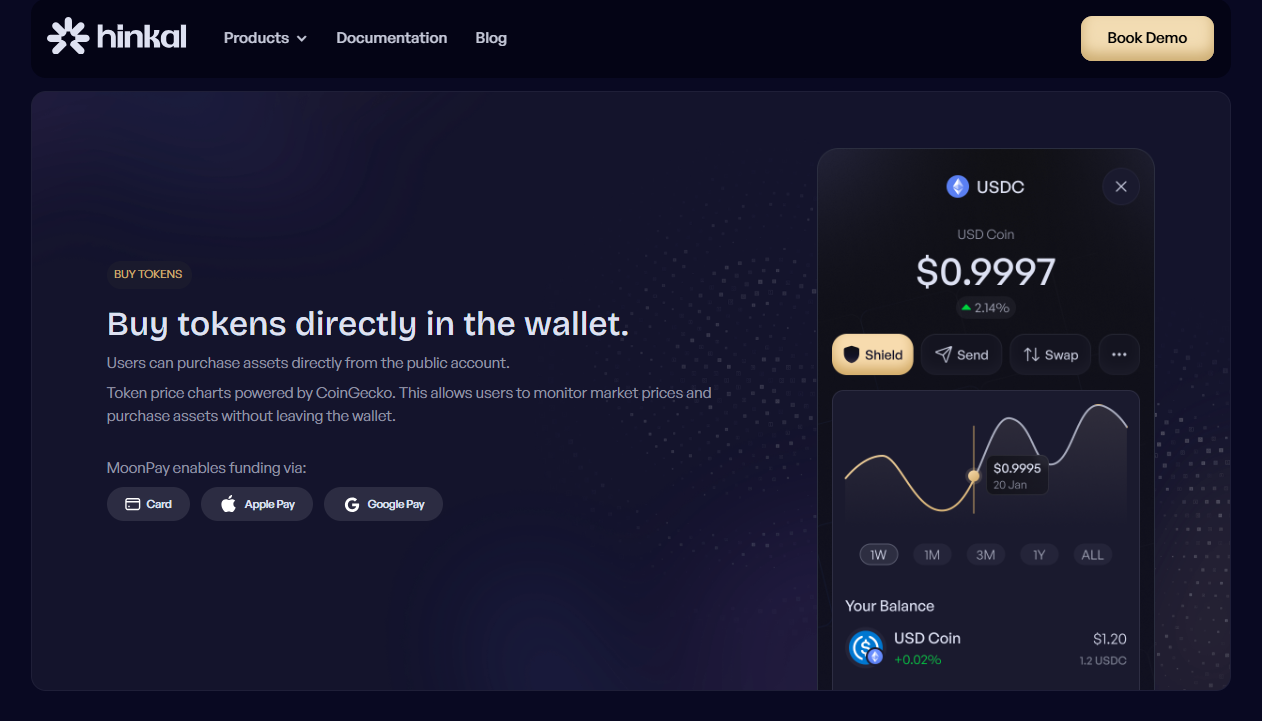
A frequent objection from auditors and finance leads: if the ledger cannot see it, is it still verifiable?
Yes. Hinkal uses UTXO-style commitments (commitments and nullifiers) stored in canonical on-chain contract state. Every transaction is proven valid through zero-knowledge proofs and verified on the public chain. The network confirms that the math is correct, that funds exist, and that nothing was double-spent, without learning the participants or the amount.
That separation is the whole point. Settlement stays public and verifiable. The commercial detail stays private.
The privacy category is crowded and the approaches are genuinely different. Confidential-transfer standards and FHE-based designs (Zama, Inco) typically hide amounts while leaving counterparties visible.
Permissioned selective-privacy networks (Canton) require operating inside a separate network. Shielded-pool protocols (Railgun, Privacy Pools) are largely EVM-only. Privacy-native chains (Aleo, Near confidential intents) ask you to move.
Hinkal's position on vendor payouts:
Track record matters as much as architecture here: Hinkal has processed $500M+ in cumulative volume, completed 6 security audits, and has run in production for roughly 3.5+ years. It is backed by Draper Associates, SALT, SNZ Capital, and NGC Ventures, and was incubated at Stanford and through Binance MVB.
The pattern repeats across a specific set of operators:
If you are a builder rather than an operator, the highest-leverage version of this is embedding it: inside your product, next to the regular balance users see a private balance, and next to the regular send they see a private send.
Moving from evaluation to a live confidential payout run is a short path, because nothing in your existing stack has to be replaced. Here is the sequence most teams follow.
Start with a working session rather than a signup. Bring the list of payout flows you classified earlier: which vendors, which chains, which stablecoins, what volume, and what needs to stay hidden (amount, counterparty, or both). The output of this step is a map of which flows move to a private balance first and which stay public for now.
Hinkal exposes the same protocol through different surfaces. Choose based on who is executing the payouts and where the payment originates.
Connect any wallet your team already uses. Hinkal is non-custodial, so there are no Hinkal-issued credentials, API keys, or passwords to provision, and no custody change to route through your security review. The keys you already control are the credential.
Pick a single high-friction flow, such as one recurring vendor or one cross-border payout lane, and run it through a private balance in parallel with your existing process. Shield a working amount, execute the payout, and compare the on-chain footprint against what your current wallet publishes.
This is the fastest way to show a CFO or a security lead the difference, because the evidence is a block explorer, not a deck.
Decide who receives viewing keys, at what scope, and for which time ranges. Configure this for auditors, counterparties, and internal reviewers now, so that reconciliation and close are solved before volume arrives rather than during it.
Downloadable transaction history is available out of the box for anything that needs to be handed to a third party.
Once the pilot corridor is proven, extend the same setup to batch payouts for payroll, contractors, affiliates, and vendors through Hinkal Prime. Adding chains is a configuration change, not a new integration, across Ethereum, Polygon, Arbitrum, Optimism, Base, Solana, TRON, Arc, and Tempo.
If your users, merchants, or customers should get confidential settlement without opting into a separate tool, integrate through Hinkal Integrations.
Standard API calls from any backend (Python, Go, Java, .NET, Rust, Node.js) cover private deposits, withdrawals, transfers, swaps, balance reads, fee checks, and recipient info, while the SDK gives frontend-level control if you want private balances and private sends rendered inside your own interface.
A forward-deployed Hinkal engineer assists throughout the integration, so the build does not sit on your roadmap waiting for internal cryptography expertise.
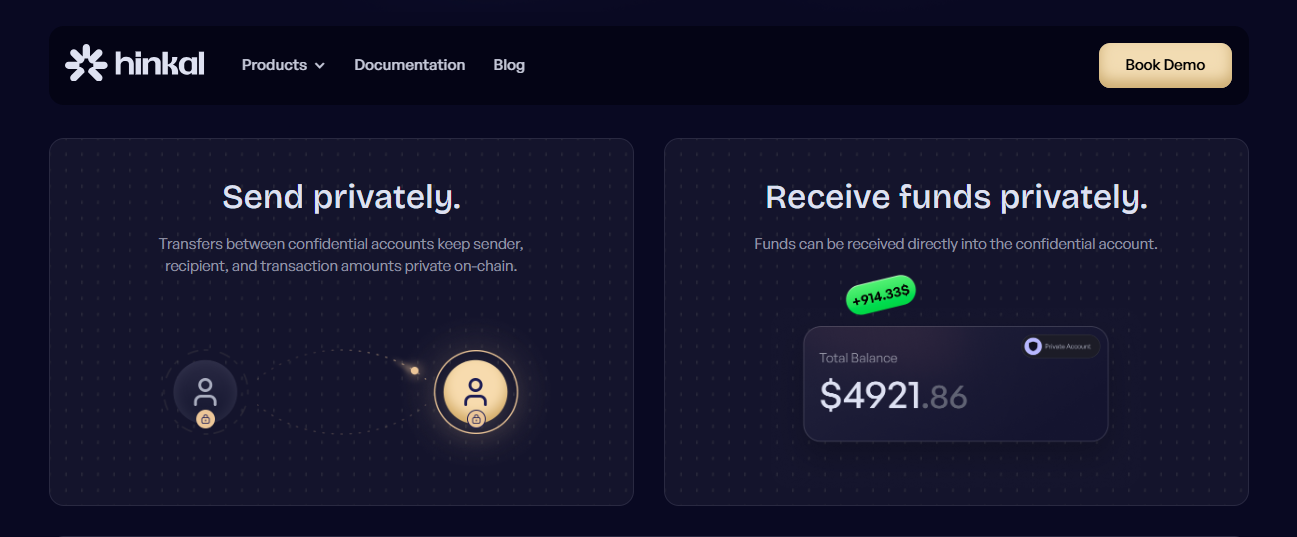
Hinkal is the privacy infrastructure that lets businesses settle stablecoin payments on public chains while keeping payment, payout, and treasury data confidential, with existing wallets, existing chains, and existing compliance controls fully intact.
Paying vendors in stablecoins without exposing your treasury balance comes down to four decisions: shield funds into a private balance controlled by your own keys, pick the right flow per vendor (private to private, private to public, or public to public), run approvals and batches through Hinkal Prime, and keep auditability through Chainalysis KYT screening and scoped viewing keys.
The rails are already faster and cheaper than correspondent banking. This is how you stop paying for them with your commercial intelligence.
Book a demo with the Hinkal team to map your vendor payout flows and see a confidential settlement run end to end.
Read Next:
You pay vendors in stablecoins without exposing your treasury balance by settling from a private balance inside a smart contract like Hinkal, rather than sending directly from your public treasury wallet. Funds are shielded into a confidential balance controlled by your existing wallet keys, the payout is executed with a zero-knowledge proof, and only the Hinkal smart contract and relayer address appear on-chain. Your remaining balance, the amount paid, and the counterparty stay off the public ledger while settlement remains verifiable.
The best way to keep vendor payment amounts private on a public blockchain is a private-to-private transfer between confidential balances, where sender, recipient, asset, and amount are all hidden. With Hinkal Pay, both parties operate from private balances and the transaction shows no sender wallet and no recipient wallet on-chain. If the vendor requires a public address, a private-to-public flow still conceals your sending balance and treasury position.
Paying vendors privately in stablecoins is compliant when the privacy layer includes screening and selective disclosure rather than blanket obfuscation. Hinkal is not a mixer: Chainalysis KYT screens wallet addresses before execution to prevent high-risk funds from entering the smart contract, viewing keys give auditors and regulators scoped, time-bounded, revocable access to transaction history, and downloadable transaction history is available out of the box. Privacy means opacity to the public ledger, not to your compliance team.
You do not need to change chains or wallets to make confidential vendor payouts with Hinkal. Hinkal is a smart contract deployed on public chains you already use, including Ethereum, Polygon, Arbitrum, Optimism, Base, Solana, TRON, Arc, and Tempo, and the private balance is controlled by the wallet keys you already hold. There is no private L1, no privacy rollup, no new custody model, and no migration of your existing stablecoins or workflows.
It costs 10 BPS (0.10%) per transaction to send confidential vendor payments through Hinkal's enterprise settlement, which is comparably lower than alternative privacy solutions. For context, traditional cross-border B2B payments commonly lose 3% to 6% of value to fees, FX spread, and intermediary charges across an average of four intermediaries and three days of settlement time. Confidential stablecoin settlement compresses that to seconds while keeping vendor amounts and treasury balances private.
































.png)






.webp)