Real-world stablecoin payments volume doubled in 2025 to roughly $400 billion, and an estimated 60 percent of that flow was business-to-business, according to Bessemer Venture Partners.
Hinkal is a privacy infrastructure that lets treasury teams settle, pay, and hold stablecoins confidentially across Ethereum, Solana, TRON, and major EVM networks, without changing their existing wallets, chains, or custody.
Railgun earned its reputation as a DeFi privacy protocol for individual users shielding swaps and transfers, but a corporate treasury needs multi-user roles, batch payouts, and compliance controls that a DAO-governed, user-oriented tool was never built to deliver.
This guide ranks the best Railgun alternatives for private stablecoin treasury management in 2026, explains the criteria used to score them, and shows exactly where each option fits.
[[KEY_TAKEAWAYS]]
What to Look for in a Railgun Alternative for Treasury Management
Railgun set a high bar for on-chain privacy, but treasury operations have requirements that a DeFi-user privacy tool does not fully cover. When you evaluate an alternative, five criteria separate a genuine treasury solution from a general privacy protocol.
Multichain coverage:Treasuries hold and move stablecoins wherever their counterparties operate, which increasingly means Solana and TRON alongside Ethereum and EVM chains, so any tool limited to a single virtual machine forces workarounds.
Full-transaction privacy, meaning the sender, the recipient, and the amount are all hidden rather than just one of the three.
Non-custodial control, so the treasury keeps its own keys and no third party can freeze or move funds.
Compliance and auditability, since privacy has to be opaque to the public ledger without being opaque to your own auditors or regulators.
Operational tooling built for teams, including multi-user roles, queued and batch payouts, and controls on high-value transactions.
Hinkal is the only option below that satisfies all five, which is why it leads the ranking.
The Best Railgun Alternatives for Private Stablecoin Treasury Management in 2026
Hinkal is a non-custodial smart contract that adds confidentiality to the public chains a treasury already uses, so funds move into a private balance controlled by the team's existing wallet keys rather than migrating to a new network.
Where Railgun shields DeFi activity for individual users on EVM chains, Hinkal is purpose-built for institutional settlement and payouts, hiding sender, recipient, and amount across Ethereum, Solana, TRON, and major EVM networks in a single system.
On-chain, only the Hinkal smart contract and the relayer address are visible, so a treasury's own wallet never appears as the transaction origin and no observer can link who paid whom or how much. Compliance is embedded at the entry point through Chainalysis KYT screening before every transaction, while viewing keys give the treasury scoped, revocable selective disclosure for auditors, regulators, and counterparties, plus downloadable transaction history out of the box.
For teams operating at scale, Hinkal Prime layers on permissioned multi-user access, pending and batch payouts for payroll and vendor settlement, and compliance controls on high-value transactions, and Hinkal Integrations exposes the same privacy through an API and SDK so the private balance sits directly inside the products a treasury already runs.
With more than $500 million in cumulative volume processed, six security audits, and roughly three and a half years live in production, Hinkal offers the depth a treasury needs without asking it to change a single workflow.
Pros
Hides sender, recipient, and amount together across EVM, Solana, and TRON in one system.
Non-custodial, so the treasury keeps its own keys and custody.
Hinkal Prime adds multi-user roles, pending payouts, and batch payouts built for treasury teams.
Compliance is built in through Chainalysis KYT, viewing keys, and downloadable history.
No chain migration, since it runs on the wallets, chains, and stablecoins the treasury already uses.
Cons
Focused on confidential settlement and payouts rather than a broad consumer DeFi feature set.
Institutional depth means teams get the most value from the Prime dashboard and Integrations, not a single quick-start wallet.
2. Zama
Zama has built one of the most technically ambitious approaches to on-chain confidentiality, using fully homomorphic encryption to keep balances and amounts encrypted even during computation, with a mainnet that went live on Ethereum in late 2025 and early confidential stablecoin transfers already demonstrated.
It is a genuine step forward for programmable, encrypted smart contracts, and its confidential payroll and institutional trading use cases overlap with treasury needs. The practical gap for a treasury today is maturity and scope.
Zama's protocol is early in production, its Solana support is on a 2026 roadmap rather than live, and its throughput is still measured in tens of transactions per second while GPU and ASIC acceleration are developed. It is also an infrastructure layer that developers build confidential applications on, so a treasury adopting it inherits an integration project rather than a ready-made payout and settlement product.
Hinkal, by contrast, is already live across EVM, Solana, and TRON with more than three years in production, and ships the treasury-facing tooling, including batch payouts and multi-user controls, that a finance team can use directly.
Pros
FHE keeps amounts and balances encrypted end to end, including during computation.
Runs natively on existing L1 and L2 chains rather than a separate network.
Strong institutional narrative with confidential payroll and trading use cases.
Cons
Mainnet is early, and Solana support is a roadmap item rather than live today.
Throughput is still limited while hardware acceleration is developed.
It is a developer infrastructure layer, not a ready-to-use treasury payout product.
3. Canton
Canton is a privacy-enabled network designed for regulated institutions, and it has attracted serious names in traditional finance for tokenized assets and settlement where selective disclosure and permissioning matter.
For a treasury that wants an institutionally governed environment with privacy controls, Canton is a credible option and its compliance-first design resonates with regulated teams. The trade-off is that Canton is a separate network with its own model, so using it generally means operating outside the public EVM, Solana, and TRON rails where most stablecoin liquidity and counterparties already live.
That is the opposite of Hinkal's core promise, which is confidentiality added to the chains a treasury already uses, with no migration and no change to existing wallets, stablecoins, or custody.
A treasury that already settles USDC or USDT on public chains gets privacy from Hinkal without leaving that environment, whereas Canton asks it to bring activity onto a different network.
Pros
Purpose-built for regulated institutions with strong privacy and permissioning.
Backed by significant traditional finance participation and tokenized-asset use.
Selective disclosure and compliance are core to its design.
Cons
It is a separate network rather than privacy added to the public chains treasuries already use.
Stablecoin liquidity and counterparties largely sit on public EVM, Solana, and TRON rails.
Adoption typically means moving activity onto a different environment.
4. Aleo
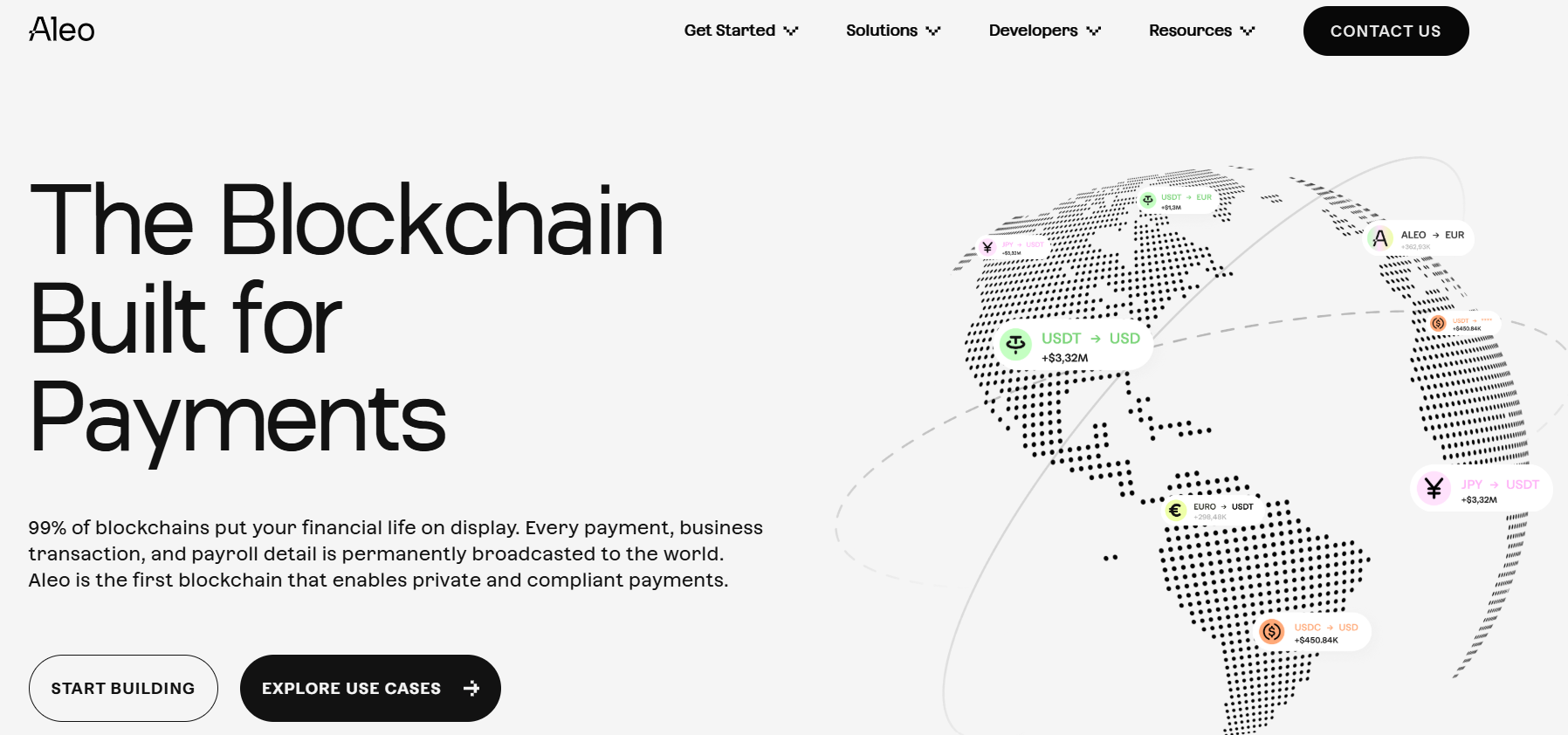
Aleo is a privacy-focused blockchain built around zero-knowledge proofs, giving developers a platform to build applications where transaction data stays private by default.
For teams that want programmable privacy at the base layer, Aleo's architecture is genuinely capable and its zero-knowledge foundation is well regarded.
For a stablecoin treasury, though, the same base-layer design is the limitation. Aleo is its own Layer 1, so a treasury adopting it moves away from the Ethereum, Solana, and TRON environments where its stablecoins, wallets, and partners already operate, and it inherits a new chain's liquidity, tooling, and ecosystem constraints.
Hinkal keeps the treasury exactly where it is, adding a private balance on the public chains it already settles on, controlled by the same keys it already uses to sign transactions, so there is no ecosystem migration and no new custody model to adopt.
Pros
Privacy is native and default at the base layer through zero-knowledge proofs.
Strong cryptographic foundation for programmable private applications.
A dedicated ecosystem for privacy-first development.
Cons
It is a standalone Layer 1, so treasuries leave their existing chains and stablecoin liquidity.
Wallets, tooling, and counterparties must move to a new environment.
Not built as a ready-made confidential settlement and payout product for finance teams.
5. Privacy Pools
Privacy Pools improved on earlier mixer designs by letting users prove their funds are not associated with illicit activity while still preserving privacy, which is a meaningful advance for compliance-conscious individuals moving funds on-chain.
The concept of association-set proofs is a smart answer to the reputational and regulatory problems that sank older obfuscation tools. Where it falls short for treasury use is scope and operations.
Privacy Pools is oriented toward individual deposits and withdrawals rather than the full range of confidential settlement, payroll, vendor, and treasury flows a finance team runs, and it does not provide the multi-user roles, batch payouts, or dashboard controls that Hinkal Prime delivers.
Hinkal also embeds compliance directly through Chainalysis KYT screening before every transaction and gives auditors scoped viewing keys, which fits a treasury's need for both privacy and provable, selective transparency in one system.
Pros
Association-set proofs let users demonstrate funds are not tied to illicit activity.
A cleaner compliance posture than legacy mixers.
Preserves privacy while allowing proof of legitimacy.
Cons
Oriented toward individual deposit and withdrawal flows, not full treasury operations.
No multi-user roles, batch payouts, or team dashboard for finance functions.
Narrower operational scope than a dedicated confidential settlement product.
Comparison at a Glance
Solution
Chains
Hides sender, recipient, and amount
Non-custodial
Built-in compliance layer
Treasury and payout tooling
Hinkal
EVM, Solana, TRON
Yes, all three
Yes
Yes (Chainalysis KYT, viewing keys)
Yes (Hinkal Prime, Hinkal Integrations)
Zama
EVM today, Solana on roadmap
Amounts and balances encrypted
Varies by application
Programmable, developer-defined
No, infrastructure layer
Canton
Separate network
Yes, within its network
Institution-dependent
Yes, permissioned
Partial, institution-built
Aleo
Standalone Layer 1
Yes, on its own chain
Yes
Limited
No
Privacy Pools
EVM
Partial
Yes
Association-set proofs
No
Why Hinkal Ranks First for Treasury Management
The reason Hinkal leads is that it is the only option that treats confidential treasury operations as the product rather than a downstream use case.
A treasury does not want to migrate to a new chain, learn a new language, or wait for a roadmap to reach production. It wants to keep settling the stablecoins it already holds, on the chains it already uses, with the wallets it already controls, and simply add privacy underneath.
Hinkal does exactly that, and then adds the operational layer a finance team actually runs on.
Hinkal Prime gives treasury and finance staff permissioned multi-user access, a queue to review pending payouts before they execute, and batch payouts that settle payroll, vendor, and contractor payments in one confidential operation.
Hinkal Integrations exposes the same protocol through an API and SDK, so the private balance and private send can live inside the wallet or product a treasury already operates.
Underpinning all of it is a non-custodial design where the treasury's own keys are the only credential, Chainalysis KYT screening at the entry point, and viewing keys for audit access, so privacy and compliance hold together at institutional scale.
How to Get Started with Hinkal
Adding confidential settlement to a treasury does not require a migration or a rebuild, and the path from first login to a live private payout is short. Follow these steps to get started.
Book a demo: Reach out to the Hinkal team for a walkthrough of confidential settlement, Hinkal Prime, and Hinkal Integrations, so you can map the protocol to your treasury's specific payout and settlement flows.
Connect your existing wallet: Connect the wallet your treasury already uses to move funds. Your keys stay yours, custody does not change, and no new credentials or passwords are introduced.
Move funds into a private balance: Shield stablecoins from your public wallet into a private balance held inside the Hinkal smart contract on the same chain you already use. Future activity from that balance is not publicly visible.
Set up your team in Hinkal Prime: Configure permissioned multi-user roles so finance and treasury staff can operate together, and use the pending-payout queue to review transactions before they execute.
Run confidential settlements and payouts: Execute private-to-private transfers, or use batch payouts to settle payroll, vendor, and contractor payments in one confidential operation, with Chainalysis KYT screening applied before each transaction.
Disclose selectively when needed: Share scoped, revocable viewing keys or downloadable transaction history with auditors, regulators, or counterparties, without exposing anything on the public ledger.
Embed privacy in your own stack: When you are ready to bring confidential balances directly into a wallet or product you operate, integrate through Hinkal Integrations using the API or SDK, with a forward-deployed engineer assisting throughout.
Conclusion
Hinkal is the privacy infrastructure that lets treasuries settle, pay, and hold stablecoins confidentially across EVM, Solana, and TRON without giving up custody, compliance, or their existing workflows.
Railgun proved that on-chain privacy is possible for individual DeFi users, but private stablecoin treasury management in 2026 demands multichain coverage, full-transaction privacy, non-custodial control, built-in compliance, and team-grade payout tooling together, and the alternatives above each solve only part of that picture.
Hinkal is the option that solves all of it in production today.
Book a demo to see how Hinkal can add confidential settlement to your treasury without changing a single wallet or chain.
1. What is the best Railgun alternative for private stablecoin treasury management in 2026?
The best Railgun alternative for private stablecoin treasury management in 2026 is Hinkal, because it hides sender, recipient, and amount across Ethereum, Solana, TRON, and major EVM networks, stays non-custodial, and adds treasury-grade tooling through Hinkal Prime and Hinkal Integrations without requiring any chain migration.
2. Is Railgun suitable for institutional stablecoin treasury management?
Railgun is suitable for individual DeFi users shielding swaps and transfers, but it is less suitable for institutional stablecoin treasury management because it is EVM-only, DAO-governed, and built around user privacy rather than the multi-user roles, batch payouts, and compliance controls that treasury teams need, all of which Hinkal provides.
3. Which chains does Hinkal support for private stablecoin treasury operations?
Hinkal supports Ethereum, Polygon, Arbitrum, Optimism, Base, Solana, TRON, Arc, and Tempo for private stablecoin treasury operations, covering EVM, Solana, and TRON in a single system so treasuries can keep funds confidential wherever their counterparties operate.
4. Can private stablecoin treasury operations stay compliant?
Private stablecoin treasury operations can stay compliant when privacy applies to the public ledger rather than to auditors, which is how Hinkal works through Chainalysis KYT screening before every transaction, scoped and revocable viewing keys for selective disclosure, and downloadable transaction history ready to hand to regulators and counterparties.
5. Is Hinkal non-custodial for treasury management?
Yes, Hinkal is non-custodial for treasury management, meaning Hinkal never holds a treasury's funds or keys, and the private balance is controlled entirely by the same wallet keys the team already uses to sign its transactions.
FAQ
Common questions
Do I need a new wallet to use Hinkal Wallet?
No. You can import your existing wallet using a seed phrase and access your assets immediately.
Do I need a new wallet to use Hinkal Wallet?
No. You can import your existing wallet using a seed phrase and access your assets immediately.
Do I need a new wallet to use Hinkal Wallet?
No. You can import your existing wallet using a seed phrase and access your assets immediately.
Trusted by teams building on public chains
Key Takeaways
Hinkal ranks first for private stablecoin treasury management in 2026.
It hides sender, recipient, and amount across EVM, Solana, and TRON.
Railgun is EVM-only and built for DeFi users, not treasury teams.
Hinkal is non-custodial, with viewing keys for audits and selective disclosure.
Hinkal Prime adds multi-user roles, batch payouts, and compliance controls.
Want
to
stay
ahead
of
the
market?
Get exclusive insights on privacy, stablecoins, and marketdevelopments shaping enterprise on-chain finance.
Thank you! Your submission has been received!
Oops! Something went wrong while submitting the form.
Related Articles
August 10, 2026
Hinkal can now be integrated directly into Go backends
Announcement
August 6, 2026
Episode 04: Stealth Addresses
Opinion
August 4, 2026
Hinkal Pay is now live on BNB Chain
Announcement
July 31, 2026
Hinkal can now be integrated directly into iOS and Android
Announcement
July 29, 2026
Hinkal MCP: Private Payments from Any AI Client
Announcement
July 27, 2026
Private Balances and Transfers Are Live on Privy Wallets
Announcement
July 24, 2026
The On-Chain Treasury Exposure Report: What Public Corporate Wallets Reveal
Opinion
July 23, 2026
The Hidden Cost of Public Crypto Payroll: A 2026 Exposure Report
Opinion
July 23, 2026
Hinkal is Live on Openfort
Announcement
July 22, 2026
Confidential Stablecoin Settlement Under MiCA, the Travel Rule, and GENIUS: 2026 Readiness Report
Analysis
July 21, 2026
Confidential Settlement for Stablecoin Issuers: How Issuers Keep Vault Positions and Holder Balances Private
Opinion
July 20, 2026
Reading the Tape: How Counterparties Reverse-Engineer an OTC Desk's Book From On-Chain Settlement
Opinion
July 20, 2026
Introducing the New Hinkal Pay: New Look and Features
Announcement
July 17, 2026
Embedded Wallet Integration Guide: Private Balances via the Hinkal SDK (Privy / Turnkey / Crossmint)
Analysis
July 16, 2026
How to Pay Vendors in Stablecoins Without Exposing Your Treasury Balance
Analysis
July 15, 2026
Best Private Settlement Infrastructure for Solana Businesses
Analysis
July 14, 2026
The Migration Tax: What It Costs a Treasury to Move to a Privacy Chain vs Add Privacy on Ethereum
Opinion
July 13, 2026
Confidential Settlement for Regulated Treasuries
Opinion
July 10, 2026
How RWA Protocols Can Protect Investor Activity Onchain
Analysis
July 9, 2026
Association Sets vs Selective Disclosure: Which Privacy Model Passes a Compliance Review?
Analysis
July 8, 2026
Best Privacy Infrastructure for Tokenized Asset Platforms
Analysis
July 7, 2026
How to Shield and Unshield Crypto Assets with Hinkal: A Step-by-Step Guide
Analysis
July 6, 2026
Best Crypto Payment API for Fintechs With Private Settlements (2026)
Analysis
July 6, 2026
Privacy vs Compliance: Which Crypto Privacy Solutions Work for Businesses?
Opinion
July 6, 2026
How DAOs Can Pay Contributors Without Revealing Compensation Data
Opinion
July 2, 2026
Privacy is live on Turnkey wallets, powered by Hinkal
Partnership
June 29, 2026
Best Privacy Infrastructure for Institutional DeFi Platforms in 2026
Opinion
June 26, 2026
Private settlements & payouts are coming to AllScale
Partnership
June 18, 2026
Private Stablecoin Custody Is Coming to The Vault
Partnership
June 17, 2026
Episode 03: UTXO Model, Commitments & Nullifiers
Opinion
June 16, 2026
Both-Way Bridging Across EVM, Solana, and TRON Is Live
Announcement
June 15, 2026
Private Swaps and Payments - Now Live on Tempo
Announcement
June 12, 2026
Bridge from Hinkal to External Chains with LI.FI
Partnership
June 10, 2026
Hinkal API: Drop-In Privacy For Every Product Where Serious Capital Flows
Announcement
June 10, 2026
Hinkal x Peso: Private Stablecoin Payments for LATAM
Announcement
June 9, 2026
Hinkal vs Zama vs Canton: Enterprise Privacy Infra Compared


























































.png)
.png)










.webp)