A June 2026 EY-Parthenon and Coinbase survey of more than 350 institutional investors found that 73% planned to increase their digital-asset allocations, with trading, custody, and tokenization the capabilities they were building out fastest.
Hinkal is a universal privacy protocol for stablecoins that keeps wallets, amounts, and counterparties private while settlement stays public, auditable, and compliant across Ethereum, Solana, TRON, and major EVM networks.
As institutions move settlement, payouts, and treasury operations on-chain, the same public ledgers that make blockchains trustworthy also broadcast every counterparty, balance, and payout size to competitors and bots.
This article ranks the leading privacy infrastructure options for institutional DeFi platforms and shows you exactly how to choose.
Key Takeaways
Hinkal ranks #1, making sender, recipient, and amount private across multiple public chains.
Only Hinkal delivers full privacy live across Ethereum, Solana, and TRON today.
Built-in Chainalysis KYT, and viewing keys keep institutions compliant.
Hinkal adds privacy through a drop-in API and SDK, with no chain migration.
Most alternatives are EVM-only, still early-stage, or require a separate network.
What Is Privacy Infrastructure for Institutional DeFi?
Privacy infrastructure for institutional DeFi is the cryptographic layer that lets a platform move stablecoins and execute on-chain financial operations without exposing sensitive payment, settlement, payout, and treasury data to the public ledger.
In practice, "institutional DeFi platform" is a broad category: it spans the operating businesses that run real on-chain value flows, custodians and institutional wallets, embedded wallet providers, payment service providers (PSPs), payroll and remittance platforms, merchants, iGaming operators, exchanges, on-ramps, stablecoin card providers, and fintechs.
Good privacy infrastructure conceals who is transacting, how much is moving, and with whom, while keeping every transaction provably valid and selectively auditable for regulators, auditors, and counterparties.
The distinction that matters for institutions is the difference between opacity to the public and opacity to your own compliance team: the right infrastructure delivers the former while preserving the latter. It is not a mixer, and it is not anonymity for its own sake; it is confidentiality with accountability built in.
Why Institutional DeFi Platforms Need Privacy Infrastructure
On a transparent chain, every payment a platform makes is a signal. Treasury movements reveal runway and strategy, payroll exposes individual salaries, vendor and affiliate payouts disclose commercial terms, and large trades broadcast positions to front-running and MEV bots before they even settle.
For a custodian, institutional wallet, embedded wallet provider, PSP, exchange, on-ramp, payroll platform, merchant, iGaming operator, stablecoin card provider, or fintech, that exposure is not a theoretical risk; it is competitive intelligence handed to rivals and a privacy liability handed to clients.
Institutions running discreet operations in traditional finance, through dark pools, bilateral OTC desks, and private banking rails, cannot simply re-publish that activity in plaintext when they move it on-chain.
The exposure looks different for each type of platform, but the need is the same:
PSPs, payroll, and remittance platforms can offer merchants private stablecoin settlement as a premium feature, and keep salary, contractor, vendor, and invoice payments confidential, without changing chains, stablecoins, or custody.
Wallets and custodians can embed native privacy directly inside existing dashboards and APIs, so end users get a private balance and a private send without a new wallet.
Exchanges, on-ramps, and OTC desks can offer private withdrawals and settlement, so a customer's destination wallet, amount, and relationships stay off-chain.
iGaming operators and stablecoin card providers can keep player payouts and card-settlement flows private rather than publishing them on a transparent ledger.
Fintechs and enterprise treasuries can run confidential payroll, vendor, affiliate, and gaming payouts without exposing their financial activity to the public chain.
The result is a structural barrier to adoption: many institutions want the speed, programmability, and 24/7 settlement of public blockchains, but cannot accept the disclosure that comes with them. Privacy infrastructure removes that barrier.
By shielding counterparties and amounts while keeping settlement verifiable and compliant, it lets platforms bring real volume on-chain without leaking the data that made them hesitate in the first place.
How to Evaluate Privacy Infrastructure for Institutional DeFi
Not all privacy is equal, and the criteria that matter to institutions are specific. Use this checklist when comparing providers:
Depth of privacy: Does it hide the sender, recipient, and amount, or only some of these? Hiding balances but leaving counterparties exposed is a partial solution.
Chain coverage: Does it work where your stablecoin liquidity, custody, and counterparties already live: across EVM, Solana, and TRON, or only on a single ecosystem?
Compliance and selective disclosure: Is there real-time transaction screening, identity control at the entry point, and scoped, revocable viewing-key disclosure for regulators and auditors?
Custody model: Does the provider ever take control of funds or keys, or does your existing wallet remain the sole credential?
Integration and migration cost: Can you embed it into your existing product through an API or SDK without moving chains, changing custody, or rebuilding workflows?
Production maturity: How long has it run in production, how much volume has it processed, and how many independent security audits back it?
These criteria reward solutions that add privacy underneath existing institutional stacks rather than asking institutions to migrate to a new network. The ranking below applies to them directly.
The 7 Best Privacy Infrastructure Providers for Institutional DeFi Platforms
1. Hinkal: Best Overall Privacy Infrastructure Provider
Hinkal is the most complete privacy infrastructure for institutional DeFi platforms because it delivers full confidentiality (sender, recipient, and amount), across Ethereum, Solana, TRON, and major EVM networks, all without asking institutions to leave the chains they already operate on.
Rather than a separate network or a new language, Hinkal is a smart contract on public chains that lets users hold private balances controlled by their existing wallet keys; funds are shielded into a private balance, transacted confidentially, and withdrawn to any address, with only the Hinkal contract and a relayer address visible on-chain.
Every transaction is proven valid through zkSNARKs (Groth16) and screened by Chainalysis KYT before execution, while gate entry and viewing keys enable scoped, revocable disclosure to auditors and regulators.
Crucially for platforms, Hinkal is distributed as a drop-in API and SDK with a forward-deployed engineer, so a custodian, PSP, or payroll provider can place a "private balance" next to the regular balance and a "private send" next to the regular send inside their own product.
With $500M+ in cumulative volume, roughly 3.5 years in production, six independent security audits, and an enterprise dashboard (Hinkal Prime) for permissioned, multi-user treasury and batch payouts, Hinkal pairs the depth of privacy that institutions need with the compliance and integration profile they require.
Pros
Full privacy: hides sender, recipient, and amount, not just balances.
Live across Ethereum, Solana, TRON, and major EVM networks, no chain migration.
Compliance built in: Chainalysis KYT, and viewing keys.
Non-custodial; the user's existing wallet keys are the only credential.
Drop-in API/SDK plus an enterprise dashboard and forward-deployed engineering support.
Cons
Focused on stablecoin payments and settlement rather than a broad general-purpose privacy chain.
Wallet and WaaS offerings are lower priority, so deep wallet-native deployments lead with the API/SDK.
2. Zama
Zama is one of the most technically ambitious projects in the space, building a cross-chain confidentiality layer powered by fully homomorphic encryption (FHE) that lets developers run confidential smart contracts, including ERC-7984 confidential tokens, directly on existing chains.
Its mainnet went live at the end of 2025, it has demonstrated genuine institutional traction such as the first confidential OTC trade with market maker GSR, and its FHE approach keeps data encrypted even during computation, which is a real cryptographic milestone.
That said, Zama is fundamentally a framework that teams build on rather than a turnkey institutional settlement product, so a platform adopting it must design and ship its own confidential application and compliance logic.
It is also EVM-first today, with Solana support not expected until the second half of 2026, and FHE throughput remains comparatively modest at present, whereas Hinkal already runs a complete, audited settlement product live across EVM, Solana, and TRON, and Chainalysis KYT compliance and a drop-in integration path that does not require building privacy from primitives.
Pros
Cutting-edge FHE keeps data encrypted throughout computation, with post-quantum properties.
Confidential ERC-7984 token standard with wrap/unwrap and OpenZeppelin libraries.
Early institutional validation, including a confidential OTC trade with GSR.
Cons
A developer framework, not a ready-made institutional settlement product to deploy.
EVM-first today; Solana support is roadmapped rather than live.
FHE throughput is still maturing relative to production payment volumes.
3. Canton Network
Canton has arguably the deepest institutional credibility of any name on this list: built by Digital Asset on the Daml smart-contract language, it is a privacy-enabled blockchain purpose-built for regulated finance, with configurable per-party visibility and adoption from DTCC, J.P. Morgan, Goldman Sachs, and Visa as a Super Validator.
For institutions building net-new tokenized-asset and settlement rails from the ground up, Canton's combination of privacy, compliance, and institutional governance is genuinely hard to match.
The trade-off is that Canton is a separate network, adopting it means migrating to Canton and building on Daml rather than adding privacy to the public chains where stablecoin liquidity, custody, and counterparties already sit.
That makes it a different category of decision: a platform that wants confidential stablecoin settlement on Ethereum, Solana, or TRON without re-platforming will find Hinkal a far lighter lift, because Hinkal layers privacy onto existing chains, wallets, and stablecoins instead of asking the institution to move.
Pros
Exceptional institutional adoption and governance (DTCC, J.P. Morgan, Goldman, Visa).
Privacy and selective disclosure built into the protocol for regulated finance.
Proven at scale for tokenized real-world assets and settlement.
Cons
A separate network: requires migrating and building on Daml.
Not designed to add privacy to existing Ethereum, Solana, or TRON stablecoin flows.
Heavier, longer-cycle adoption suited to large institutions building new rails.
4. Aleo
Aleo is a zero-knowledge Layer 1 where privacy is the default for every transaction, using its purpose-built Leo language and snarkVM to keep participants, amounts, and contract details confidential while remaining verifiable, with view keys for selective disclosure.
Its institutional ambitions are real and credible, the Circle-backed private stablecoin USDCx launched on Aleo in early 2026 with launch partners across payroll, invoicing, and compliance, and its "private by default" model is attractive for teams that want confidentiality baked in at the base layer.
The limitation for an institutional DeFi platform is the same one that applies to any standalone L1: Aleo is a new chain with a new language, new wallets, and liquidity that lives on Aleo rather than on the chains an institution already uses.
Hinkal achieves comparable depth of privacy, concealing sender, recipient, and amount, but does it on the institution's existing chains and stablecoins with no migration, which is usually the deciding factor for a platform that already has custody, compliance, and counterparties on Ethereum, Solana, or TRON.
Pros
Privacy by default at the protocol level with strong ZK foundations.
View keys enable compliant selective disclosure.
Circle-backed USDCx brings a credible private stablecoin to the network.
Cons
A separate L1 requiring migration and the Leo language.
Liquidity and assets are siloed on Aleo rather than on existing chains.
New wallets and tooling add operational overhead for institutions.
5. Railgun
Railgun is a mature, battle-tested privacy system that lives as smart contracts directly on EVM chains, letting users shield assets into "0zk" addresses and then transact, swap, and use DeFi privately while hiding sender, recipient, and amount, all without leaving their existing wallets.
Private Proofs of Innocence let users cryptographically demonstrate that their funds did not originate from flagged or illicit sources, and with several billion dollars in cumulative shielded volume it is one of the most established on-chain privacy protocols available.
Where it falls short for institutions is breadth and compliance posture: Railgun is EVM-only, so it does not cover Solana or TRON, and its compliance model is dissociation-after-the-fact via exclusion lists rather than identity control and screening at the entry point.
Hinkal takes the institution-first approach instead: Chainalysis KYT pre-screening gate funds before they enter the contract, full privacy extends across Solana and TRON as well as EVM, and an enterprise dashboard with batch payouts and forward-deployed support rounds out the offering for regulated operators.
Pros
Mature, widely used, and composable with existing EVM DeFi protocols.
Hides sender, recipient, and amount with no chain migration on EVM.
Private Proofs of Innocence provide a compliance-aware dissociation mechanism.
Cons
EVM-only; no Solana or TRON coverage.
Compliance relies on exclusion lists rather than KYT screening.
No enterprise treasury dashboard or forward-deployed integration support.
6. Inco
Inco is a flexible, modular confidentiality layer that lets developers add encrypted state to existing contracts using familiar Solidity tooling, combining FHE and trusted execution environments to deliver confidential ERC-20 balances, private DeFi primitives, and more across EVM and SVM ecosystems.
It is well-backed by investors including Circle Ventures and Coinbase Ventures, co-authored a confidential ERC-20 framework with Circle Research, and offers genuinely developer-friendly "confidentiality-as-a-service."
As with Zama, though, Inco is infrastructure for building confidential applications rather than a finished institutional settlement product, and it remains relatively early, Inco Lightning is live on Base mainnet while broader chain support is still rolling out.
An institutional DeFi platform that wants confidential stablecoin settlement in production today, with multichain coverage and compliance already wired in, will get there faster with Hinkal, which ships a complete, audited product and $500M+ of processed volume rather than a toolkit to assemble.
Pros
Modular, Solidity-friendly confidentiality-as-a-service across EVM and SVM.
Confidential ERC-20 framework co-developed with Circle Research.
Strong investor backing and an active developer ecosystem.
Cons
A developer layer to build on, not a turnkey settlement product.
Early-stage rollout; production chain coverage is still expanding.
Institutions must build and maintain their own confidential application and compliance logic.
7. Privacy Pools
Privacy Pools, built by 0xbow from research co-authored by Vitalik Buterin, is an elegant solution to the "privacy versus compliance" dilemma: using zero-knowledge proofs and an Association Set Provider, users can prove their funds belong to a "clean" set and are not associated with illicit activity, all without revealing identity.
Its credibility is high, it was integrated into the Ethereum Foundation's Kohaku wallet initiative, and its open-source ASP can be adopted by other protocols. For institutional DeFi at scale, however, its scope is narrow: Privacy Pools launched on Ethereum in 2025, supports a handful of assets, and has processed on the order of single-digit millions in volume from a primarily retail user base, with a model centered on unlinking deposits and withdrawals rather than full ongoing counterparty-and-amount confidentiality.
Hinkal operates in a different weight class for institutions: multichain coverage, full sender/recipient/amount privacy for continuous operations, plus KYT screening, enterprise payout tooling, and $500M+ in processed volume, making it the more complete fit for platforms running real settlement and payouts.
Pros
Compliant-by-design via Association Sets and a "proof of innocence" model.
Strong credibility through Vitalik Buterin's research and Ethereum Foundation integration.
Open-source ASP that other protocols can integrate.
Cons
Ethereum-only today, with a limited set of supported assets.
Smaller, primarily retail volume rather than institutional scale.
Focused on unlinking deposits/withdrawals, not full operational settlement privacy.
At-a-Glance Comparison
Provider
Full privacy (sender + recipient + amount)
Chains live today
Compliance model
Custody
Integration model
Hinkal Best
Yes
Ethereum, Solana, TRON, major EVM
Chainalysis KYT + KYC tokens + viewing keys
Non-custodial
Drop-in API/SDK, no migration
Zama
Amounts/balances; counterparty privacy is app-defined
Ethereum (EVM); Solana roadmapped
App-defined access control
Non-custodial
Build on fhEVM/SDK
Canton
Yes, configurable per party
Canton (separate L1)
Permissioned governance + selective disclosure
Institutional custody
Build on Canton/Daml (migration)
Aleo
Yes, private by default
Aleo (separate L1)
View keys for selective disclosure
Non-custodial
Build on Aleo with Leo (migration)
Railgun
Yes
EVM chains only
Private Proofs of Innocence (dissociation)
Non-custodial
Smart contract/SDK, no migration (EVM)
Inco
Amounts/state; app-defined
Base mainnet (EVM); Solana beta
App-defined; confidential ERC-20
Non-custodial
Build with Solidity library/SDK
NEAR Confidential Intents
Execution, amounts, routes hidden
Cross-chain via NEAR Intents (35+)
Selective disclosure, compliance-aware
Non-custodial
Route via NEAR Intents
Privacy Pools
Unlinks deposit/withdrawal
Ethereum (expanding)
Association Set Provider screening
Non-custodial
Deposit/withdraw via app/SDK
Why Hinkal Is the Best Choice for Institutional DeFi in 2026
The pattern across this list is clear: most options force a trade-off.
The institutional-grade networks (Canton, Aleo) ask you to migrate to a new chain; the developer frameworks (Zama, Inco) hand you primitives to build privacy yourself; and the established protocols (Railgun, Privacy Pools) are powerful but EVM- or Ethereum-bound, with compliance layered on after the fact.
Hinkal is the option that refuses the trade-off. It delivers full privacy: sender, recipient, and amount, live across Ethereum, Solana, TRON, and major EVM networks; it bakes compliance in at the entry point with Chainalysis KYT, plus viewing keys for selective disclosure; it never touches custody, since your existing wallet keys are the only credential; and it ships as a drop-in API and SDK with a forward-deployed engineer, so privacy slots underneath your existing stack with no chain migration.
Backed by $500M+ in cumulative volume, roughly 3.5 years in production, six independent audits, and an enterprise dashboard for permissioned treasury and batch payouts, Hinkal is built to add confidentiality to the institutional flows you already run, not to make you rebuild them.
And because the primary way platforms adopt Hinkal is by integrating the API and SDK, the privacy lives where your users already are: inside a custodian's or institutional wallet's dashboard, a PSP's or on-ramp's checkout, an exchange's withdrawal flow, or a payroll or card provider's product, a private balance sits next to the regular balance and a private send next to the regular send.
[[TRUSTED_BY]]
How to Get Started with Hinkal
Getting started is designed to fit around your existing operations rather than disrupt them. The typical path looks like this:
Book a demo and scope your use case: Walk through your settlement, payout, treasury, or embedded-wallet flow with the Hinkal team and identify where private balances and private sends fit.
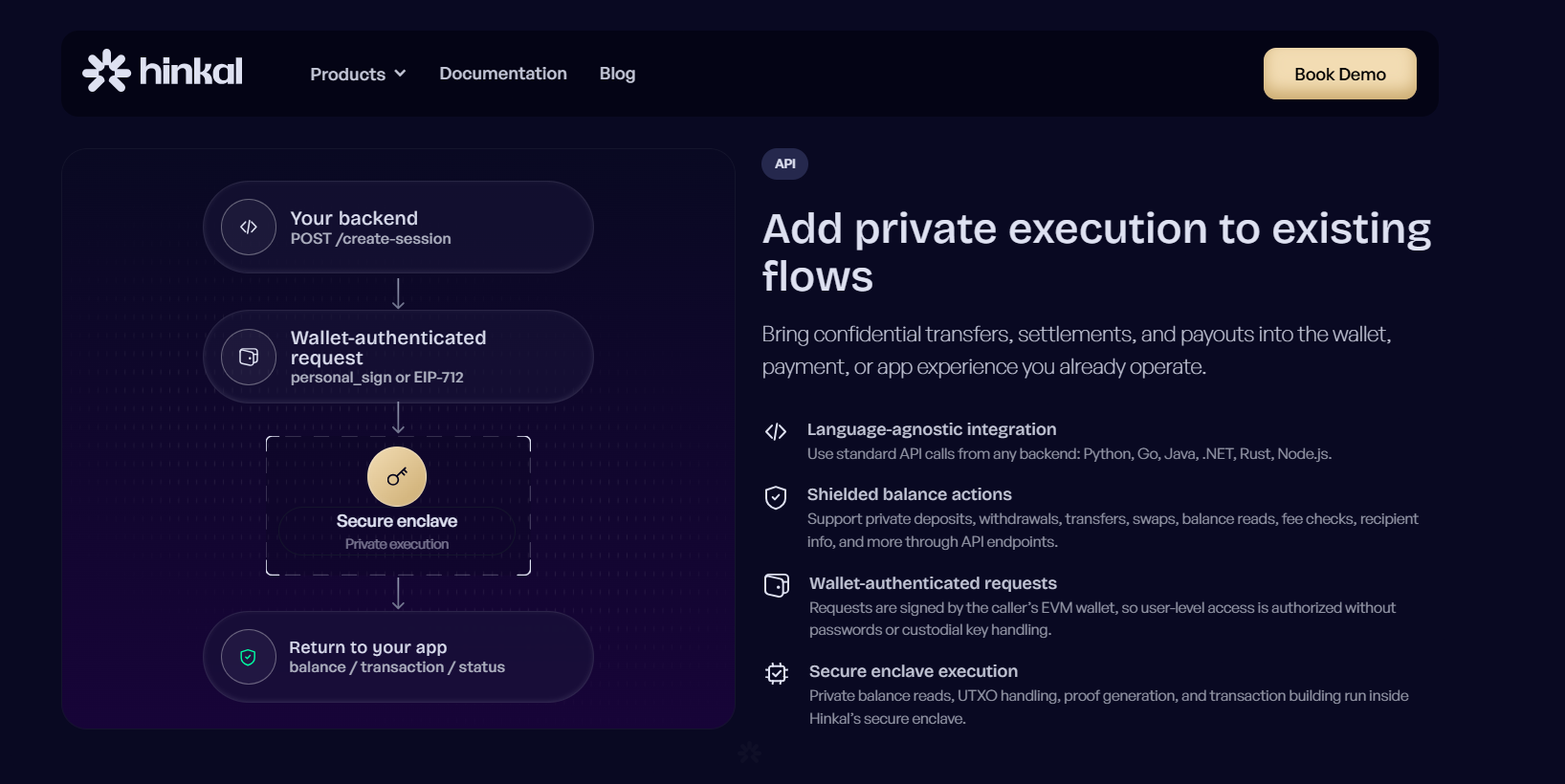
Choose your integration surface: Use the Hinkal API for drop-in private execution from any backend (Python, Go, Java, .NET, Rust, Node.js), the SDK for a custom in-product privacy UX, or Hinkal Prime if you need a permissioned enterprise dashboard for multi-user treasury and batch payouts.
Connect existing wallets and pass entry compliance: Users authenticate with the wallets they already use; Chainalysis KYT screens addresses before any funds enter the contract.
Go live with a forward-deployed engineer: A Hinkal engineer supports integration throughout, so private balances appear next to regular balances and private sends next to regular sends inside your product, without changing chains, custody, stablecoins, or compliance controls.
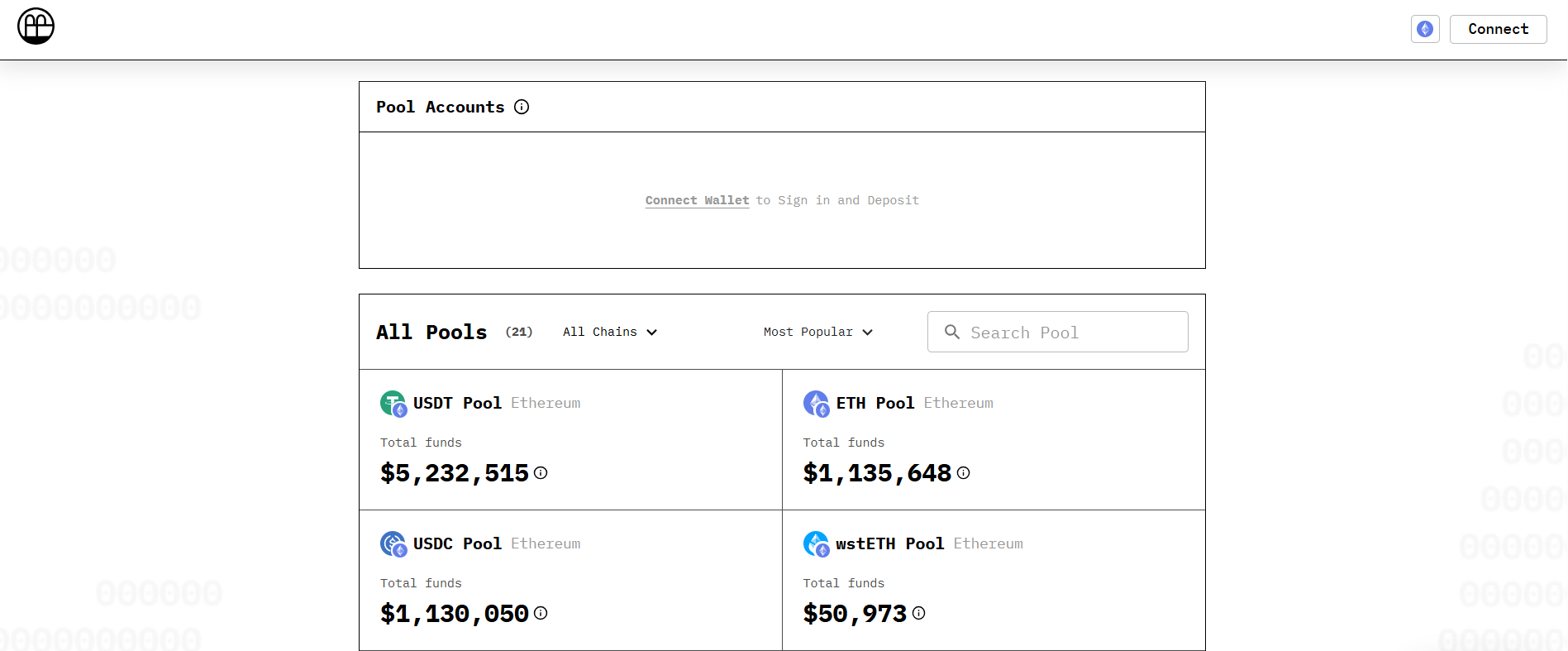
You can try confidential settlement directly at pay.hinkal.io, explore the technical reference in the Hinkal docs, or book a demo to map an institutional rollout.
Conclusion
Hinkal is the privacy infrastructure built for the way institutions actually operate, full confidentiality over wallets, amounts, and counterparties, on the public chains they already use, with compliance and auditability intact.
As institutional capital moves on-chain at scale, the platforms that win will be the ones that can offer their clients discretion without sacrificing compliance, and that is precisely the gap Hinkal closes across Ethereum, Solana, TRON, and major EVM networks.
The alternatives each solve a piece of the problem, but Hinkal solves it end-to-end: full privacy, built-in compliance, non-custodial control, and a drop-in integration that requires no migration.
Book a demo with Hinkal to see exactly how confidential settlement fits your platform across Ethereum, Solana, TRON, and major EVM networks, with no chain migration required.
Q: What is the best privacy infrastructure for institutional DeFi platforms in 2026?
A: The best privacy infrastructure for institutional DeFi platforms in 2026 is Hinkal, because it keeps sender, recipient, and amount private across Ethereum, Solana, TRON, and major EVM networks while embedding compliance through Chainalysis KYT, and viewing keys, all via a drop-in API and SDK that requires no chain migration.
Q: Why do institutional DeFi platforms need privacy infrastructure?
A: Institutional DeFi platforms need privacy infrastructure because public blockchains broadcast counterparties, balances, payout sizes, and trading strategy in plaintext, exposing competitive intelligence to rivals and bots and creating a confidentiality liability for clients. This affects custodians, institutional wallets, embedded wallet providers, PSPs, payroll platforms, merchants, iGaming operators, exchanges, on-ramps, stablecoin card providers, and fintechs alike. Privacy infrastructure shields that data while keeping settlement verifiable and auditable, removing the main barrier to bringing institutional volume on-chain.
Q: How does Hinkal keep institutional DeFi transactions private and compliant?
A: Hinkal keeps institutional DeFi transactions private and compliant by holding funds in private balances controlled by your existing wallet keys, proving every transaction valid with zkSNARKs while hiding sender, recipient, and amount. Compliance is embedded at the entry point: Chainalysis KYT screens addresses before execution, and viewing keys allow scoped, revocable disclosure to regulators and auditors.
Q: Which blockchains does Hinkal support for private institutional settlement?
A: Hinkal supports private institutional settlement across Ethereum, Polygon, Arbitrum, Optimism, Base, Solana, TRON, Arc, and Tempo, spanning EVM, Solana, and TRON ecosystems. Cross-chain bridging is available while preserving privacy, so platforms can operate on the chains where their stablecoin liquidity and custody already live.
Q: Is privacy infrastructure for institutional DeFi compliant with regulations?
A: Privacy infrastructure for institutional DeFi can be compliant with regulations when confidentiality is paired with controls rather than used to evade them. Hinkal is not a mixer: it screens funds with Chainalysis KYT before entry, and provides viewing keys for selective disclosure, so activity stays private to the public ledger but transparent to your compliance team, auditors, and regulators.
Trusted by teams building on public chains
Key Takeaways
Hinkal ranks #1, making sender, recipient, and amount private across multiple public chains.
Only Hinkal delivers full privacy live across Ethereum, Solana, and TRON today.





































.png)
.png)