We use Cookies
We use cookies to enhance your experience and analyse traffic. By clicking "Accept All" you consent to our use of cookies.
We use Cookies
We use cookies to enhance your experience and analyse traffic. By clicking "Accept All" you consent to our use of cookies.

























As of 2026, at least 10 countries impose outright bans or strict exchange restrictions on privacy coins, and the European Union's Anti-Money Laundering Regulation is set to narrow licensed access even further before 2027 (CCN, March 2026).
Hinkal offers regulated treasuries a different path: universal privacy for stablecoins that keeps wallets, amounts, and counterparties private while settlement stays public, auditable, and compliant.
Privacy coins were built to hide what public blockchains broadcast by default, but their design ties financial confidentiality to a separate, volatile asset that regulated venues and banking partners increasingly refuse to support.
This article explains why privacy coins fall short for regulated treasuries, what a compliant confidential settlement layer looks like, and how Hinkal delivers on-chain privacy without breaking compliance.
[[KEY_TAKEAWAYS]]
Stablecoins are now core treasury infrastructure, not an experiment. Adjusted stablecoin transaction volume reached a record $1.79 trillion in June 2026, up 125% from a year earlier, according to Visa's onchain data reported by CoinDesk.
Banks, fintechs, and enterprise treasuries have moved payroll, vendor settlement, and cross-border flows onto public chains for the speed, cost, and 24/7 finality they provide.
The trade-off is exposure. Public blockchains broadcast by design: who sent funds, to whom, and how much. For a regulated treasury, that means competitors can map payroll size, counterparty relationships, vendor terms, and settlement timing directly from the ledger.
Wallet clustering can link an entire organization's financial activity to a single public address. On transparent rails, every payment is a permanent, public disclosure of commercially sensitive information.
Regulated treasuries therefore need two things at once: confidentiality from the public ledger, and full transparency to their own auditors, compliance teams, and regulators. Privacy coins solve the first requirement while creating new problems around the second.
Privacy coins deliver strong on-chain confidentiality, but they are a poor structural fit for treasuries that operate inside a regulated perimeter.
There are five recurring issues.
Regulators across Asia, Europe, and North America have targeted exchange listings rather than ownership, cutting off the on-ramps and off-ramps treasuries depend on. As of 2026, at least 10 jurisdictions restrict privacy coins on licensed platforms, and the EU's Anti-Money Laundering Regulation is expected to further limit availability before 2027.
A treasury cannot build recurring payment operations on an asset it may be unable to convert, custody, or settle through regulated venues.
Even where an exchange is willing to list a privacy coin, its banking partners and payment processors may not be. This indirect pressure can restrict deposits, withdrawals, and fiat conversion without warning, which is unacceptable for treasury functions that must guarantee settlement.
Privacy coins require moving treasury value out of the dollar-denominated stablecoins finance teams already hold and into a distinct, price-volatile token. That introduces new custody, new accounting, new hedging, and new liquidity risk, before any payment is even made.
Assets like Zcash offer selective disclosure and a cleaner compliance story than mandatory-privacy coins, which is why institutional interest has grown. But optional privacy only protects users who transact correctly, and funds moving between transparent and shielded states can leak the very information a treasury needs to hide.
The asset also still carries delisting and access risk, and it does not let a treasury keep its exposure in the stablecoin it already uses.
Most privacy coins add confidentiality with no built-in screening to keep high-risk funds out. For a regulated treasury, privacy without embedded compliance is a liability, not a feature.
The alternative to a privacy coin is not a different coin. It is a confidential settlement layer that adds privacy to the assets and chains a treasury already uses.
Hinkal is a smart contract on public chains that lets users hold private balances controlled through their existing wallet keys. Instead of direct wallet-to-wallet transfers, a treasury executes transactions from a private balance. On-chain, only the Hinkal smart contract and a relayer address are visible, while sender, recipient, and amount stay private.
Every transaction is proven valid through zero-knowledge proofs (zkSNARKs), so the network verifies correctness without revealing participants or values.
Three properties make this a fit for regulated operations:
Hinkal is not a mixer or an obfuscation tool. Compliance is embedded at the point where funds enter the system, so confidentiality and auditability coexist.
This is the structural difference from sanctioned, compliance-free tools. The public sees a valid, verified transaction. The treasury's auditor sees the full picture. Nobody else can link sender, recipient, and amount.
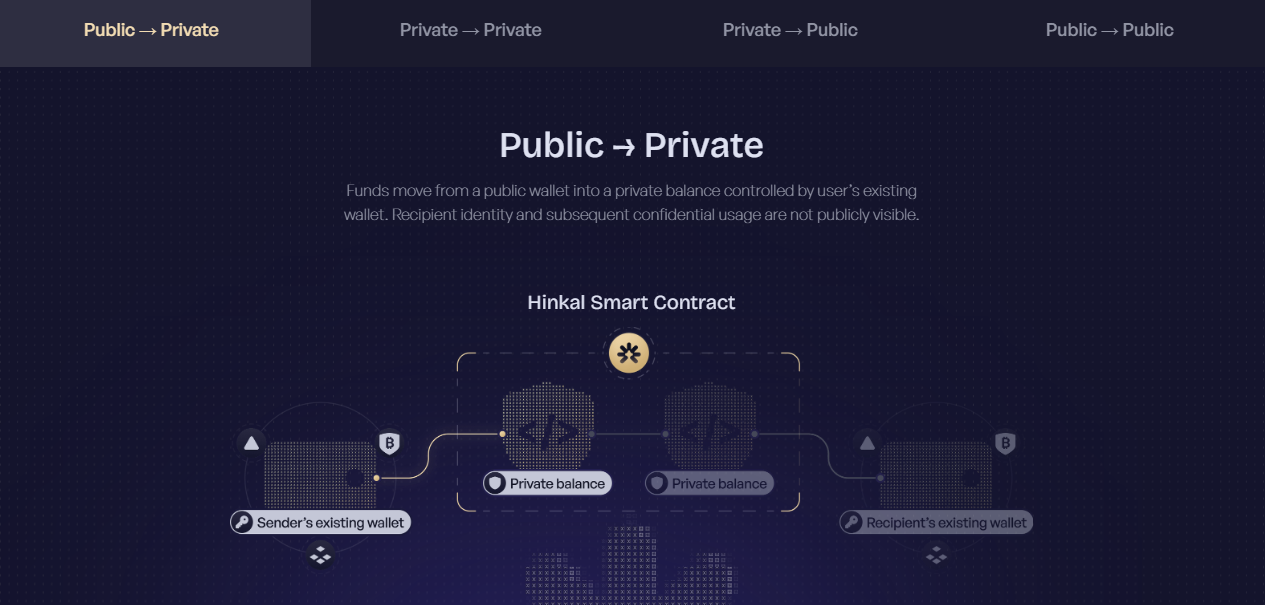
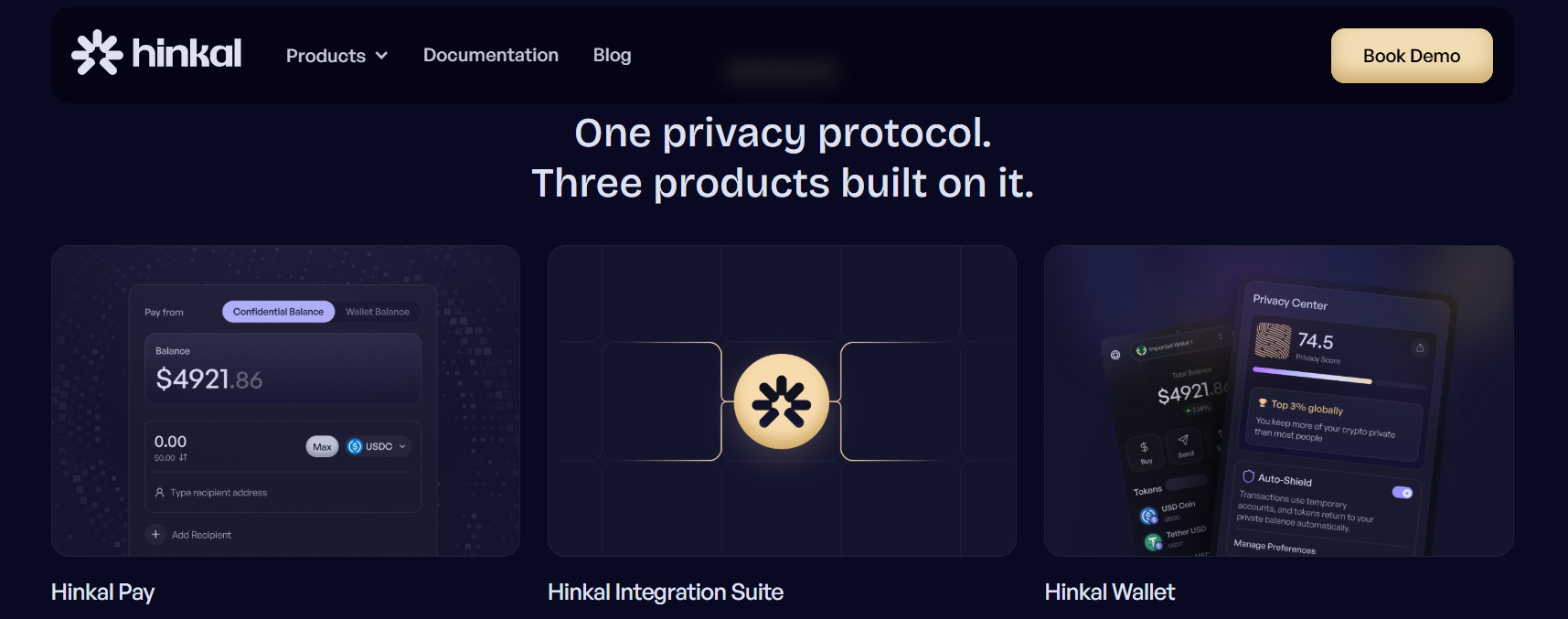
Hinkal exposes confidential settlement through several products so a treasury can adopt it at the level that fits its stack.
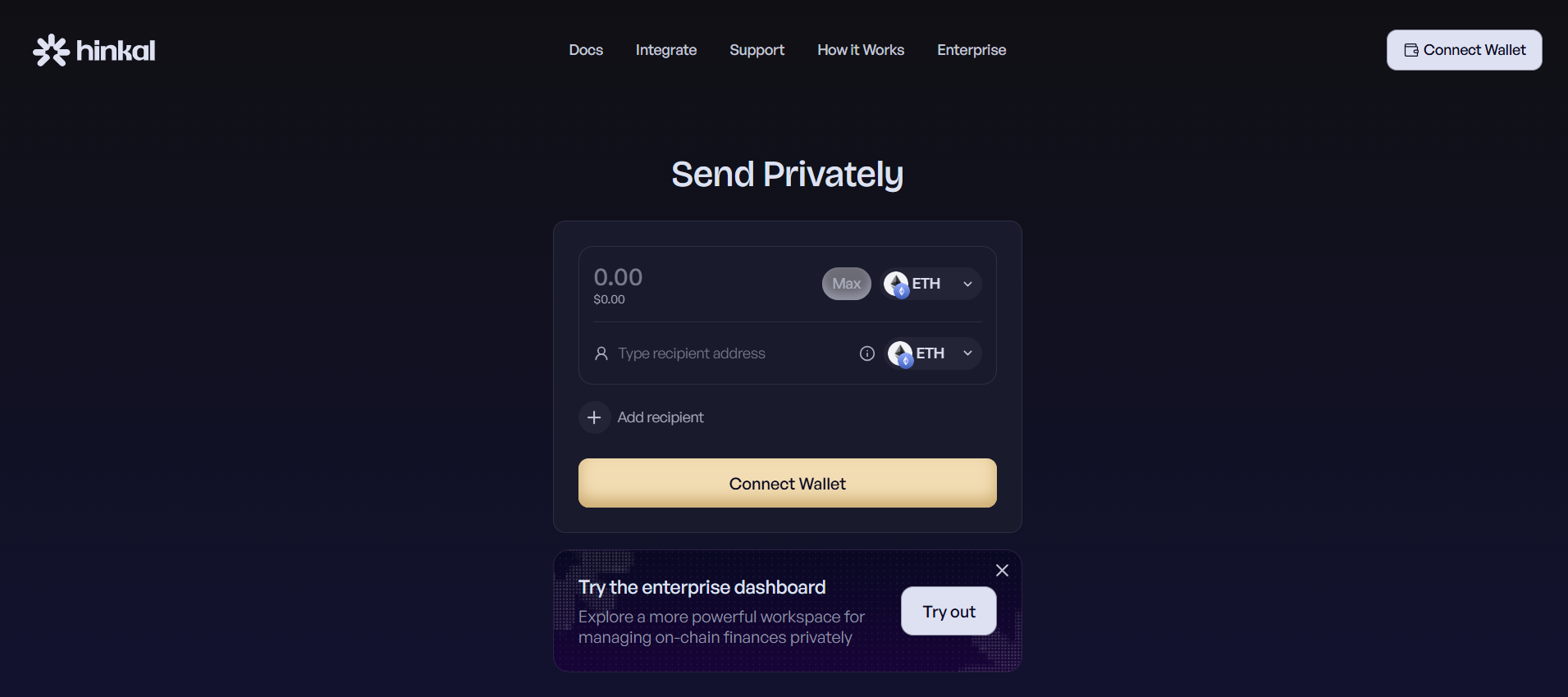
Hinkal Pay delivers end-to-end confidential settlements and payouts that keep sender, recipient, and amount private, without changing wallets, chains, or stablecoins. It supports public-to-private, private-to-private, private-to-public, and public-to-public flows, so a treasury can shield balances, settle privately, and pay out to any public address as needed.
Hinkal Prime is the enterprise dashboard for confidential treasury and payouts, built for teams running settlement at scale. It adds permissioned, multi-user access with appropriate roles, pending payouts that can be queued and reviewed before execution, batch payouts for payroll and vendor runs in a single confidential operation, and compliance controls on high-value transactions with viewing-key audit access.
Hinkal Integrations brings confidential execution into the systems a treasury already runs. Through the API and SDK, private deposits, transfers, withdrawals, swaps, balance reads, and viewing-key management can be embedded directly into an existing wallet, payment stack, or treasury system. Requests are authenticated by the caller's own wallet, and sensitive operations run inside Hinkal's secure enclave, with a forward-deployed engineer assisting throughout integration.
Confidential settlement maps directly to the payments a regulated treasury runs every day:
Hinkal is the only confidential settlement solution where sender, recipient, and amount are private together across EVM, Solana, and TRON, whereas most alternatives are single-network or hide amounts but not counterparties.
Privacy and compliance are delivered as one system, through Chainalysis KYT screening and viewing keys usable by regulated institutions.
The protocol has processed more than $500M in cumulative volume, completed 6 independent security audits, and run in production for over 3.5 years, backed by Draper Associates, SALT, SNZ Capital, and NGC Ventures, with incubation at Stanford and the Binance MVB program.
Enterprise settlement is priced at 10 basis points (0.10%) per transaction, and integration is supported by a forward-deployed engineer throughout.
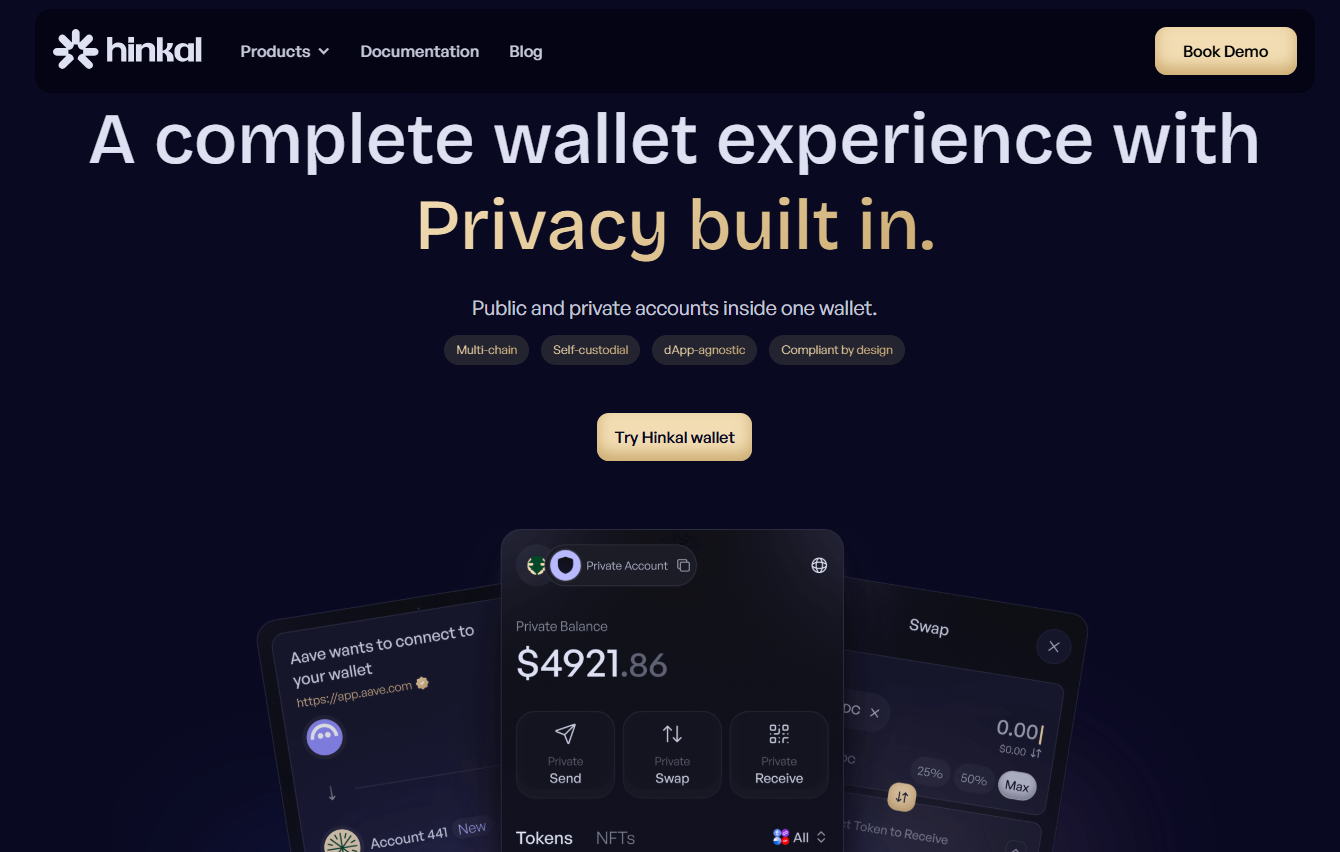
For regulated treasuries that need confidentiality without regulatory exposure, Hinkal is the compliant alternative to privacy coins: universal privacy for stablecoins that keeps wallets, amounts, and counterparties private while settlement stays public, auditable, and compliant.
Privacy coins were designed to hide on-chain activity, but their delisting risk, banking pressure, and reliance on a separate volatile asset make them a poor fit for institutional treasury operations.
Confidential settlement solves the same problem the right way, by adding privacy to the chains and stablecoins a treasury already uses, with Chainalysis KYT screening and viewing keys ensuring auditors and regulators keep full visibility.
If your treasury needs private settlement it can defend to a regulator, book a demo with Hinkal to see confidential settlement in action.
Read Next:
The best privacy coin alternative for regulated treasuries in 2026 is confidential settlement infrastructure like Hinkal, which keeps sender, recipient, and amount private on the public chains and stablecoins a treasury already uses, while preserving public verifiability and auditor access. Unlike privacy coins, it does not require adopting a separate, volatile asset or migrating to a new network.
Privacy coins are risky for regulated treasuries because they face delisting and access restrictions across at least 10 jurisdictions, depend on banking partners and payment processors that may withdraw support, and require holding a separate volatile token instead of the treasury's existing stablecoins. These factors introduce liquidity, custody, and compliance risk that most regulated finance teams cannot accept.
Confidential settlement stays compliant by screening wallet addresses with Chainalysis KYT before every transaction, issuing viewing keys that allow scoped, time-bounded, revocable disclosure to auditors and regulators, and providing downloadable transaction history out of the box. Privacy applies to the public ledger only, never to a treasury's compliance team.
Yes, regulated treasuries can keep using their existing stablecoins and chains with Hinkal because it is a smart contract that adds a private balance on the public chains already in use, controlled by existing wallet keys. There is no migration to a new network, no change to custody, and no new credentials to manage.
Hinkal differs from Zcash for treasury privacy because it is not a standalone privacy coin on its own network but a non-custodial smart contract that shields stablecoins across Ethereum, Solana, TRON, and major EVM networks. It keeps sender, recipient, and amount private together, embeds Chainalysis KYT screening at the entry point, and lets a treasury keep its value in the dollar-denominated assets it already holds rather than a separate volatile token.

































.png)
.png)




.webp)