In April 2026, blockchain intelligence firm Arkham publicly flagged a single 951 BTC transfer, worth roughly $70.5 million, moving into Tether's labeled reserve wallet, a wallet Arkham openly tracks as holding more than 97,000 BTC (as reported by The Block).
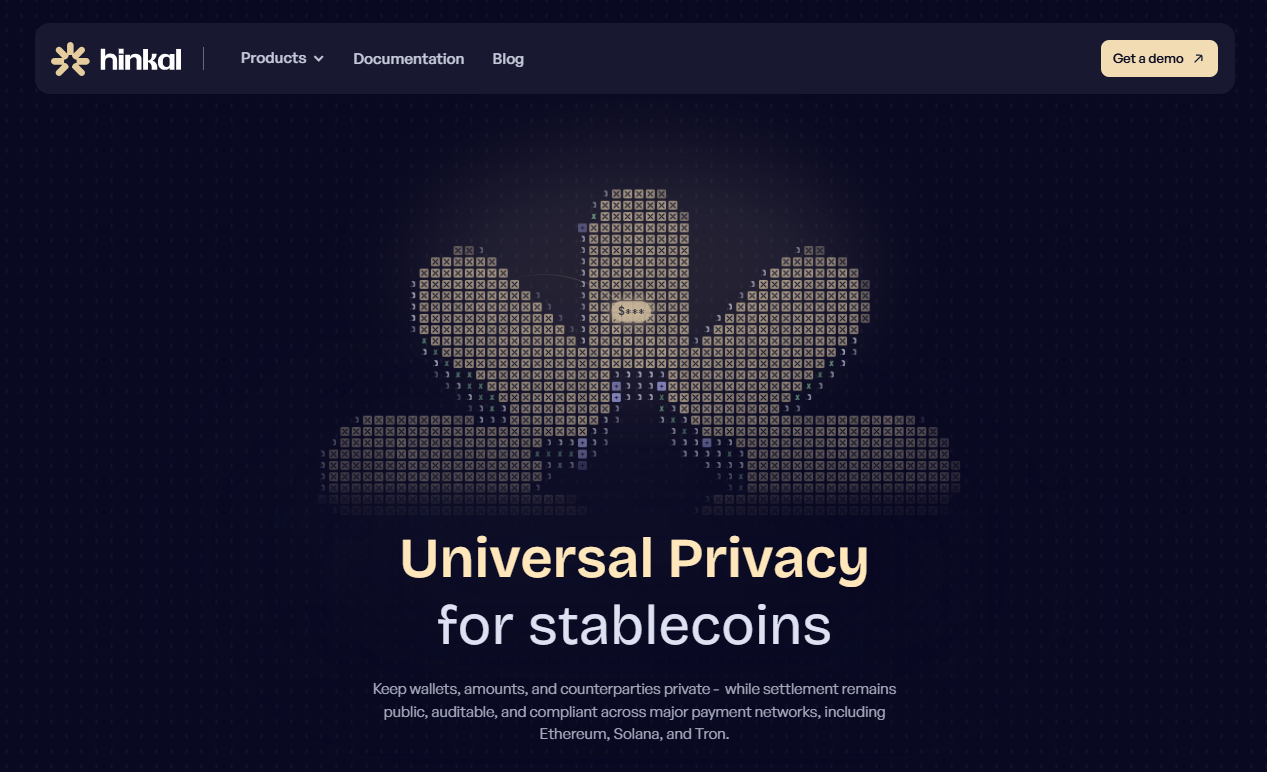
Hinkal is a universal privacy protocol for stablecoins that lets issuers move reserves, settle redemptions, and pay counterparties confidentially on the public chains they already use, while settlement stays verifiable, auditable, and compliant.
For a stablecoin issuer, that level of public visibility is not a curiosity. Reserve wallets, mint and burn flows, treasury movements, and large holder balances sit in plain view of competitors, counterparties, and automated trackers the moment they touch a public ledger.
This guide walks through exactly what a public chain exposes about an issuer, why it matters in 2026, and how confidential settlement keeps vault positions and holder balances private without breaking compliance or forcing a chain migration.
[[KEY_TAKEAWAYS]]
The Exposure Problem: What a Public Ledger Reveals About an Issuer
A stablecoin issuer runs its most sensitive financial operations on infrastructure that was designed to be radically transparent. That transparency is a feature for holders who want to verify backing. It is a liability for the issuer whose reserve strategy, redemption pipeline, and largest customer relationships become readable by anyone with a block explorer.
Here is what a public chain surfaces about an issuer, step by step.
1. Reserve and vault wallets are labeled and tracked
Blockchain intelligence platforms such as Arkham and Nansen cluster addresses, attach entity labels, and publish live balances for known issuers. Once a reserve wallet is identified, every inflow and outflow is watched in real time. The Tether reserve movement above was not leaked. It was simply observed on a public chain and pushed out as market intelligence within minutes.
2. Mint and burn flows become a public trading signal
Every fiat-backed stablecoin mints tokens when an authorized participant deposits dollars and burns them on redemption. Those events are visible on-chain as transfers to and from the zero address, and desks now treat net mint and burn flow as a leading indicator. Analysts have shown that rolling net flow can front-run the premium or discount that later appears on secondary venues.
In practice, that means an issuer's redemption pressure can be read and traded before the issuer has finished processing it.
3. Holder concentration is readable
Because balances are public, anyone can see which wallets hold the largest positions in a given stablecoin, how concentrated the float is, and when a whale is accumulating or exiting. For an issuer whose largest holders are institutional clients, that exposes commercial relationships the issuer never agreed to publish.
4. Counterparty and corridor mapping is trivial
Settlement between an issuer and a partner, a market maker, an exchange, or a payout provider draws a permanent, timestamped line between two addresses. Repeat that settlement weekly and observers can map the issuer's entire counterparty graph, estimate volumes per relationship, and infer commercial terms.
None of this requires a hack. It is the default behavior of a transparent ledger applied to a business that treats treasury positioning and client relationships as confidential.
Why This Matters More in 2026
The stakes rise with the size of the market. Total stablecoin supply surpassed $315 billion by mid-2026, and Ethereum alone holds roughly 60 percent of it. Circle's own SEC filing put USDC in circulation at $77.0 billion, up 28 percent year over year, with on-chain transaction volume growing 263 percent to $21.5 trillion.
Larger float means larger vault positions, larger redemption events, and a far more valuable target for anyone watching flows.
At the same time, the issuer field is professionalizing. Banks, card networks, and fintechs are entering as issuers and gateways, and the GENIUS Act now defines who may issue a payment stablecoin and how reserves must be backed. Under the proposed implementing rules, issuers face structured reserve disclosure to regulators, including weekly and quarterly reporting to the OCC, alongside monthly public reserve reporting.
This is the distinction that matters. Regulatory transparency is disclosure to the right parties on a defined schedule. Public-ledger transparency is disclosure to everyone, all the time, including competitors and adversarial trading desks. An issuer can be fully compliant and still be leaking competitive intelligence on every transaction.
Confidential settlement closes that gap by separating what regulators and auditors can see from what the open market can see.
Why Standard Fixes Do Not Solve It
Issuers already try to manage exposure, and the common tactics fall short.
Rotating addresses and spinning up fresh wallets slows analysts down for a while, but clustering heuristics reattach new addresses to known entities quickly, especially when funds trace back to a labeled reserve. Rotation adds operational overhead without delivering durable privacy.
Mixers and obfuscation tools are non-starters for a regulated issuer. They provide no compliance layer, they attract sanctioned-tool risk, and they sever the auditability an issuer is legally required to maintain.
Moving to a private L1, an L2, or a privacy rollup forces a chain migration. That means changing where the stablecoin lives, rebuilding integrations, fragmenting liquidity, and asking every counterparty to follow. For an issuer with billions in circulating supply across established chains, migration is not realistic.
What issuers actually need is confidentiality on the exact chains, wallets, and stablecoins they already operate, with compliance built in rather than bolted on.
How Confidential Settlement Works
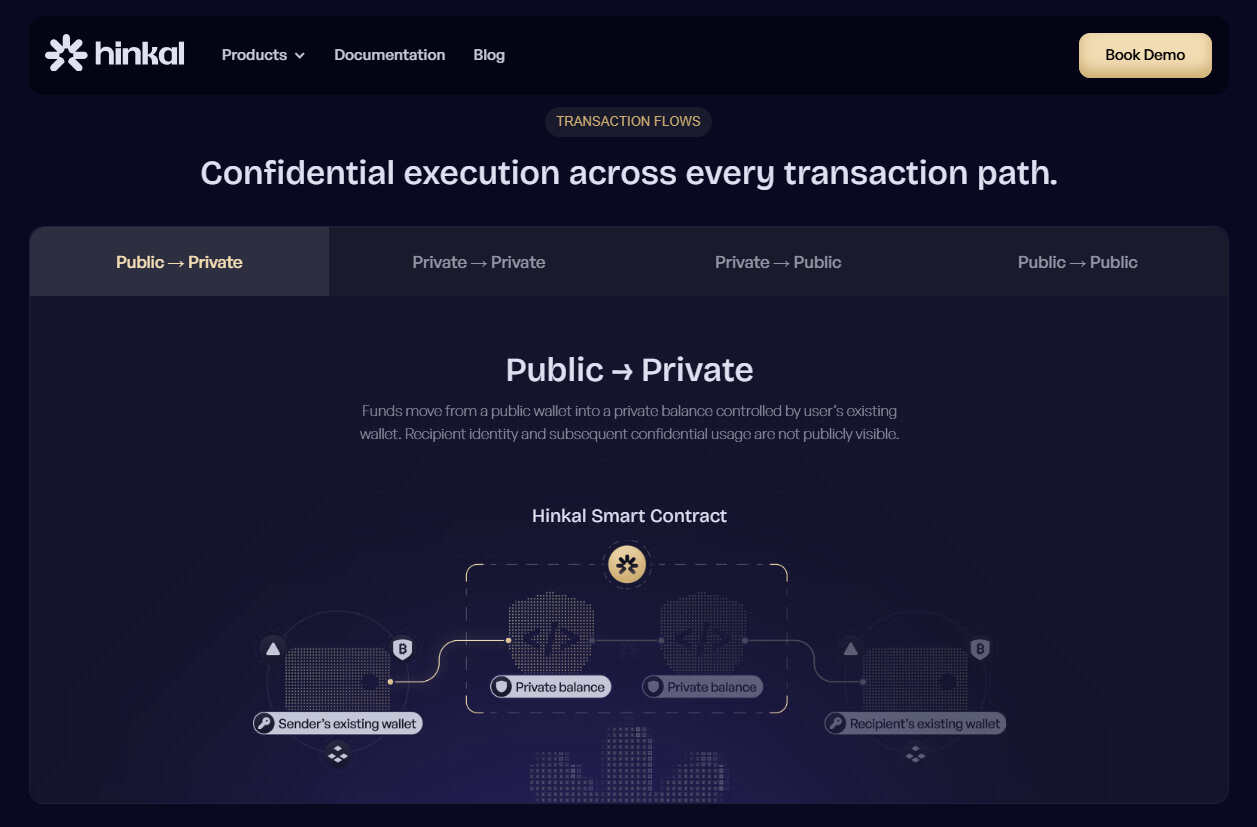
Hinkal is a smart contract deployed on public chains that lets an issuer hold a private balance controlled by its existing wallet keys. Instead of transferring value directly from one visible wallet to another, the issuer operates from a shielded balance inside the Hinkal contract.
Funds move in, transact privately, and move out to any address when needed.
The mechanics rest on a few core components.
1. Zero-knowledge proofs
Hinkal uses zkSNARKs (Groth16) with a UTXO-style model of commitments and nullifiers. Every transaction is proven valid and verifiable on the public chain, while the participants and the amount stay hidden. The network confirms the transaction is legitimate without learning who transacted or how much.
2. A relayer that breaks the origin link
Because a relayer broadcasts the transaction, the issuer's own wallet never appears as the transaction origin. On-chain, an observer sees only the Hinkal smart contract and the relayer address.
3. Unlinkable public-to-public transfers
Funds can start in a public wallet and arrive at a public wallet, while the deposit into Hinkal and the withdrawal out of it remain cryptographically unlinkable. An observer sees a deposit and, separately, a withdrawal, but cannot connect the two, and no shielded-address workflow is required on either end.
4. Fully private transfers
In a private-to-private transfer, both parties operate from confidential balances and the amount is hidden. The transaction shows no sender wallet and no recipient wallet, only the contract and the relayer. No outside party can determine who sent, who received, or how much.
5. Secure enclave execution
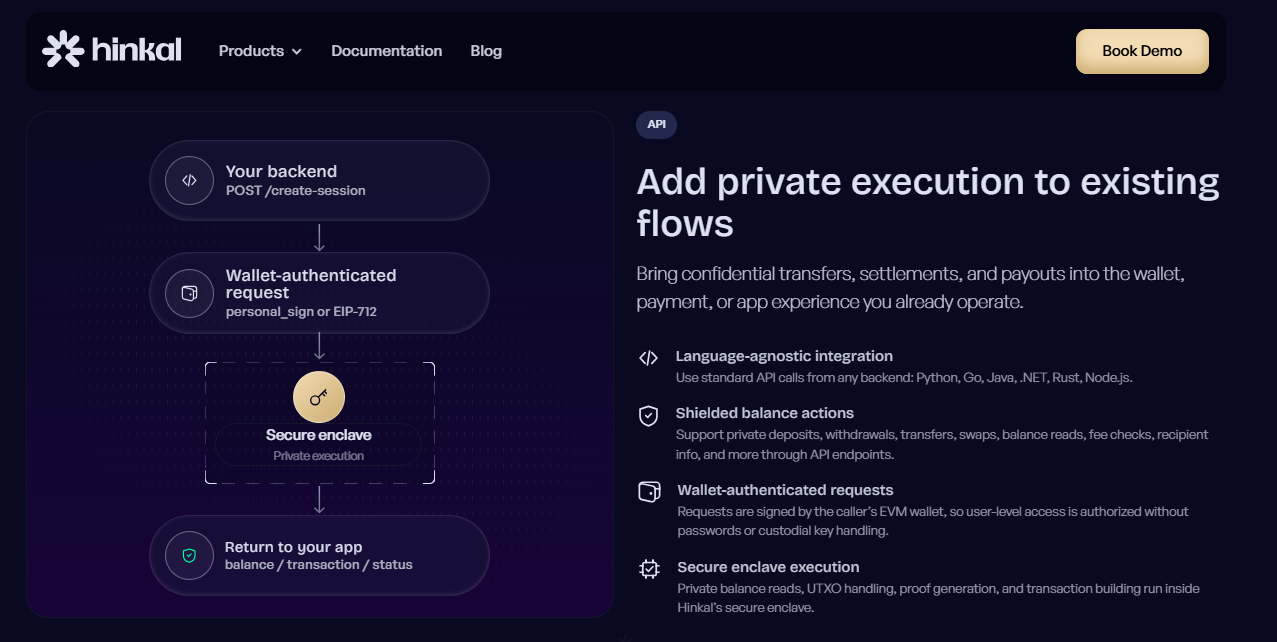
Private balance reads, UTXO handling, proof generation, and transaction building run inside Hinkal's secure enclave, so raw key material is never exposed.
Critically, none of this changes the issuer's stack. It is the same chains, the same wallets, the same stablecoins, and the same custody model. Hinkal never holds the funds. The private balance is controlled by the issuer's existing keys, with no Hinkal-issued credentials or passwords.
Keeping Vault Positions Private
For treasury and reserve operations, the goal is to remove the public signal without removing internal control.
When an issuer moves reserves, rebalances across chains, or repositions a vault, those movements normally light up on every tracker watching the labeled wallet. Routed through Hinkal, the same movement executes from a private balance.
The reserve wallet stops broadcasting its every step, the size of a rebalance is hidden, and the link between the vault and its destination is broken. Competitors lose the ability to infer strategy from wallet activity, and trading desks lose the redemption-pressure signal they would otherwise front-run.
Because settlement remains on the public chain and remains provable, the issuer keeps a verifiable record for its own reconciliation, auditors, and regulators. The position is opaque to the public ledger, not to the people entitled to see it.
Keeping Holder Balances Private
Holder-level privacy is where distribution matters most. Hinkal's primary channel is products that integrate the protocol so that, inside an institutional wallet or app, a user sees a private balance next to the regular balance and a private send next to the regular send.
For an issuer, that means holder balances and transfers can be shielded at the point of use. A large institutional client receiving a settlement does not have to expose the size of its position or its relationship with the issuer to the entire market.
Payouts to vendors, partners, affiliates, and other counterparties settle without publishing amounts or drawing a permanent line between wallets. The issuer delivers confidentiality to its holders as a product feature, without asking any of them to change wallets, chains, or stablecoins.
Compliance Without Public Exposure
Privacy that breaks compliance is useless to an issuer. Hinkal is built so that confidentiality and compliance hold at the same time.
Wallet addresses are screened before execution to prevent high-risk funds from entering the smart contract. Compliance is embedded structurally at the door, which is the difference between Hinkal and sanctioned, compliance-free obfuscation tools. Hinkal is not a mixer.
Viewing keys for selective disclosure
Each user holds a viewing key that decrypts their own transaction history. That key can be shared in full or in part, scoped to specific transactions or time ranges, and it is revocable. An issuer can hand a regulator, an auditor, or a counterparty exactly the visibility required, without exposing anything on the public ledger.
Downloadable transaction history
Records are ready to hand to a third party out of the box, which keeps audit and reporting workflows intact.
The net effect is opacity to the public market and full transparency to the parties an issuer is obligated to satisfy.
The Hinkal Products an Issuer Uses
Hinkal maps to issuer operations through a small set of products.
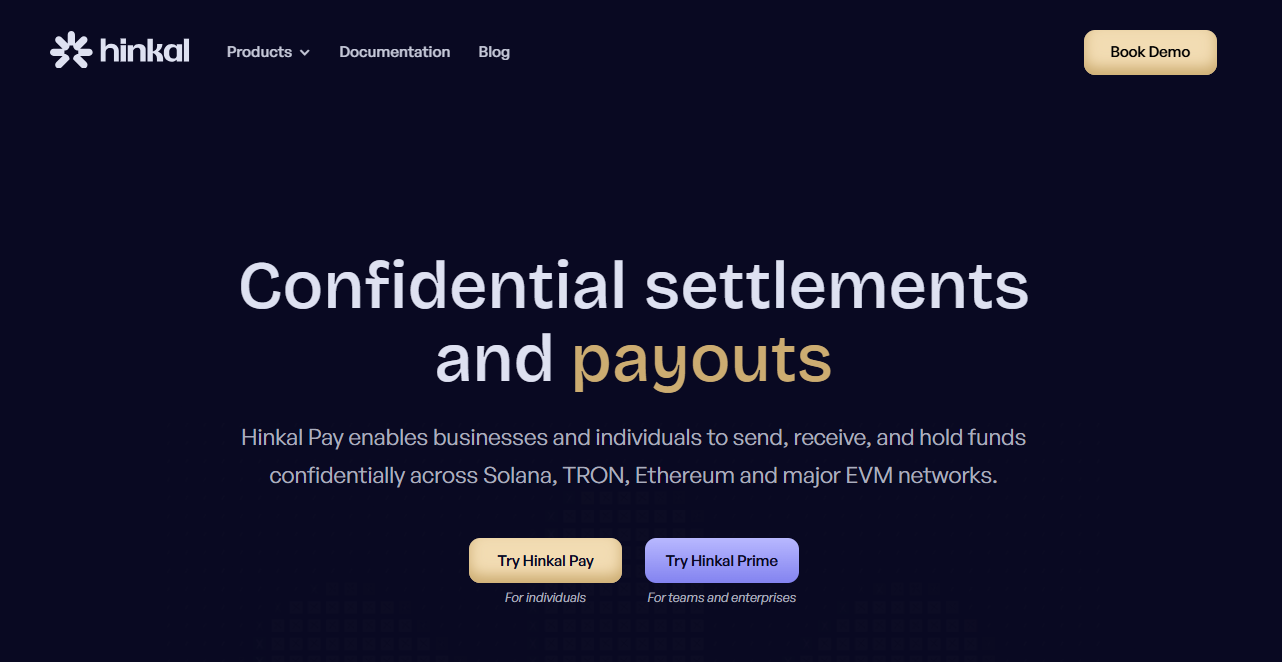
Hinkal Pay delivers end-to-end confidential settlements and payouts, keeping sender, recipient, and amount private across Solana, TRON, Ethereum, and major EVM networks. It is the core surface for reserve movement, redemption settlement, and counterparty payouts.
Hinkal Prime is the enterprise control surface for teams running confidential settlement at scale. It adds permissioned multi-user access for a treasury or finance team, pending and batch payouts for payroll, vendor, and contractor settlement, compliance controls on high-value transactions, and viewing-key audit access.
Hinkal Integrations exposes the same privacy protocol as a drop-in API and SDK, so an issuer or a wallet partner can embed private balances and private sends directly inside an existing product. Requests are authenticated by the caller's wallet, integration is language-agnostic across common backends, and a forward-deployed Hinkal engineer assists throughout. This is the channel that puts a private balance next to the regular balance inside the products holders already use.
Getting Started
Hinkal has run in production for roughly three and a half years, completed six security audits, and processed more than $500 million in cumulative volume, with backing from Draper Associates, SALT, SNZ Capital, and NGC Ventures and incubation at Stanford and Binance MVB.
Enterprise settlement is priced at 10 BPS (0.10%) per transaction.
Integration runs through the Hinkal Integrations API or SDK, with a forward-deployed engineer supporting the build, and coverage spans Ethereum, Solana, TRON, and major EVM networks including Polygon, Arbitrum, Optimism, and Base.
The path for most issuers is straightforward: identify the flows that leak the most signal today, usually reserve movement, redemption settlement, and large counterparty payouts, and route them through Hinkal Pay or Hinkal Prime first, then embed holder-level privacy through Hinkal Integrations.
Conclusion
Hinkal is the only full-privacy, multichain settlement layer that lets an issuer keep sender, recipient, and amount confidential while settlement stays public, auditable, and compliant.
A public chain, left alone, hands competitors and trading desks a live feed of an issuer's reserve strategy, redemption pressure, and largest holder relationships.
Confidential settlement removes that signal at the source, shielding vault positions and holder balances without a chain migration, without changing wallets or stablecoins, and without sacrificing the disclosure that regulators and auditors require.
If your reserves and your holders are currently readable by anyone with a block explorer, book a demo to see how Hinkal makes them private.
1. What is confidential settlement for stablecoin issuers?
Confidential settlement for stablecoin issuers is a way to move reserves, settle redemptions, and pay counterparties on public chains while keeping wallets, amounts, and counterparties private. With Hinkal, the transaction is still proven and settled on-chain, but participants and amounts stay hidden, so competitors and trackers cannot read the issuer's activity.
2. How do stablecoin issuers keep vault positions private on public chains?
Stablecoin issuers keep vault positions private on public chains by holding reserves in a shielded balance inside Hinkal's smart contract, controlled by their existing wallet keys. Reserve movements execute from that private balance, so trackers no longer see the size, timing, or destination of each rebalance, and the link between the vault and its counterparties is broken.
3. Why are stablecoin holder balances visible on-chain?
Stablecoin holder balances are visible on-chain because public blockchains record every transfer and balance in the open, and intelligence platforms label and cluster addresses to entities. Hinkal removes this exposure by letting holders operate a private balance next to their regular balance, so position sizes and relationships stay confidential.
4. Does confidential settlement break compliance for stablecoin issuers?
Confidential settlement does not break compliance for stablecoin issuers, because Hinkal embeds Chainalysis KYT screening before execution and gives each user viewing keys for scoped, revocable disclosure. Regulators and auditors receive exactly the visibility they need, while the public ledger stays opaque, which is the opposite of a mixer.
5. Which chains support confidential stablecoin settlement with Hinkal?
The chains that support confidential stablecoin settlement with Hinkal include Ethereum, Solana, TRON, and major EVM networks such as Polygon, Arbitrum, Optimism, and Base. This lets issuers add privacy across the chains, wallets, and stablecoins they already operate, with no migration required.
FAQ
Common questions
Do I need a new wallet to use Hinkal Wallet?
No. You can import your existing wallet using a seed phrase and access your assets immediately.
Do I need a new wallet to use Hinkal Wallet?
No. You can import your existing wallet using a seed phrase and access your assets immediately.
Do I need a new wallet to use Hinkal Wallet?
No. You can import your existing wallet using a seed phrase and access your assets immediately.
Trusted by teams building on public chains
Key Takeaways
Public chains expose issuer reserve wallets, mint and burn flows, and holder balances by default.



















































.png)
.png)



.webp)