As of July 2026, more than $31 billion in tokenized real-world assets is live on public blockchains, spread across 167 platforms and nearly 960,000 holders, a rise of over 400% since the start of 2025 (rwa.xyz).
Hinkal is the best universal privacy protocol for stablecoins and on-chain financial operations, keeping wallets, amounts, and counterparties private while settlement stays public, auditable, and compliant across Ethereum, Solana, TRON, and major EVM networks.
The problem for the platforms issuing and moving those assets is structural: on a public ledger, every position, subscription, redemption, and investor relationship is visible to anyone who cares to look, and that exposure is a dealbreaker for the institutions the sector is trying to win.
This article breaks down why privacy has become core infrastructure for tokenized asset platforms, the criteria that separate a serious solution from a workaround, and how Hinkal delivers confidential settlement without forcing a chain migration.
[[KEY_TAKEAWAYS]]
Why Tokenized Asset Platforms Need Privacy Infrastructure
Tokenized asset platforms bring bonds, private credit, funds, real estate, equities, and commodities on-chain so they can settle in near real time and serve as programmable collateral. The trade-off is that public blockchains broadcast transaction details to the entire network.
For a tokenized asset issuer, that means investor positions, cap-table composition, subscription and redemption sizes, treasury movements, fee structures, and counterparty relationships are all readable on a public explorer. A competitor can monitor a wallet to reverse-engineer a strategy, map a client base, or front-run a large block trade before it settles.
This is why confidentiality has moved from a nice-to-have to a gating requirement. Institutions operate on a need-to-know basis, where trade data is a guarded secret and exposing counterparties or settlement terms creates competitive and regulatory risk.
The scale of the gap is visible in the market data: A July 2026 report tracking more than 7,000 tokenized products put the total at roughly $60 billion, yet found that around $32.9 billion of surveyed value showed zero weekly transfer activity, with much of it built for permissioned use rather than open transfer.
In other words, a large share of tokenized value is sitting still in part because the rails for moving it privately and compliantly are still being built. Privacy infrastructure is the missing layer that lets that value move without broadcasting who owns it, how much they hold, and who they transact with.
What to Look for in Privacy Infrastructure for Tokenized Asset Platforms
Not every privacy approach fits an institutional tokenization stack. The strongest options share a specific set of properties. Use these criteria to evaluate any solution.
Full privacy, not partial: Sender, recipient, and amount should all be confidential. Hiding amounts alone still leaks counterparties and relationship graphs.
No chain migration: The platform should keep operating on the public chains it already uses, rather than moving assets onto a separate private L1, L2, or permissioned network.
Multichain coverage: Tokenized assets span ecosystems, so privacy should work across EVM networks, Solana, and TRON, not a single chain.
Built-in compliance and auditability: Address screening at the entry point plus selective disclosure for regulators, auditors, and counterparties, so privacy never means opacity to your own oversight.
Non-custodial: The platform and its users should retain custody through their existing wallet keys, with no third party holding funds or credentials.
Embeddable via API and SDK: Privacy should slot into the product experience users already have, not force them into a separate app.
Verifiable validity: Every confidential transaction should be provably valid on the public chain through zero-knowledge proofs, so settlement stays trustless.
How Hinkal Delivers Privacy for Tokenized Asset Platforms
Hinkal is a smart contract on the public chains platforms already operate on, not a separate network to migrate to. It gives each user a private balance (also called a shielded balance) controlled through their existing wallet keys.
Funds move in, transact confidentially, and move out to any address when needed. Every transaction is proven valid on the public chain through zero-knowledge proofs (Groth16 zkSNARKs), while the sender, recipient, and amount stay private.
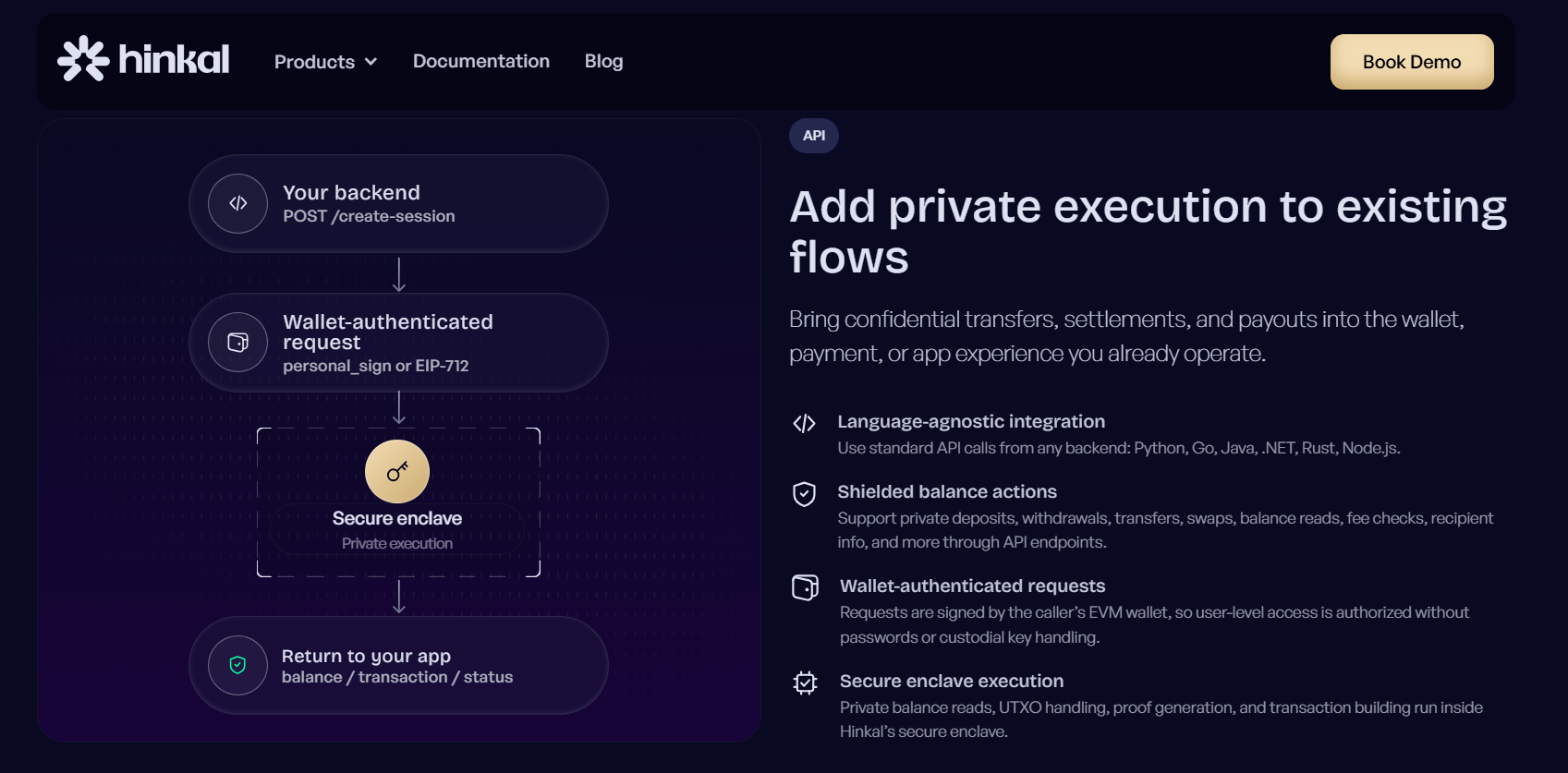
Because a relayer broadcasts the transaction, the user's own wallet never appears as the origin, and private balance reads, proof generation, and transaction building run inside Hinkal's secure enclave so raw key material is never exposed.
Hinkal has been live in production for more than 3.5 years, has processed over $500 million in cumulative volume, and has completed 6 independent security audits. It is backed by Draper Associates, SALT, SNZ Capital, and NGC Ventures, and was incubated at Stanford and Binance MVB. For a tokenized asset platform, that combination of production maturity and compliance design is what makes confidential settlement usable at institutional scale.
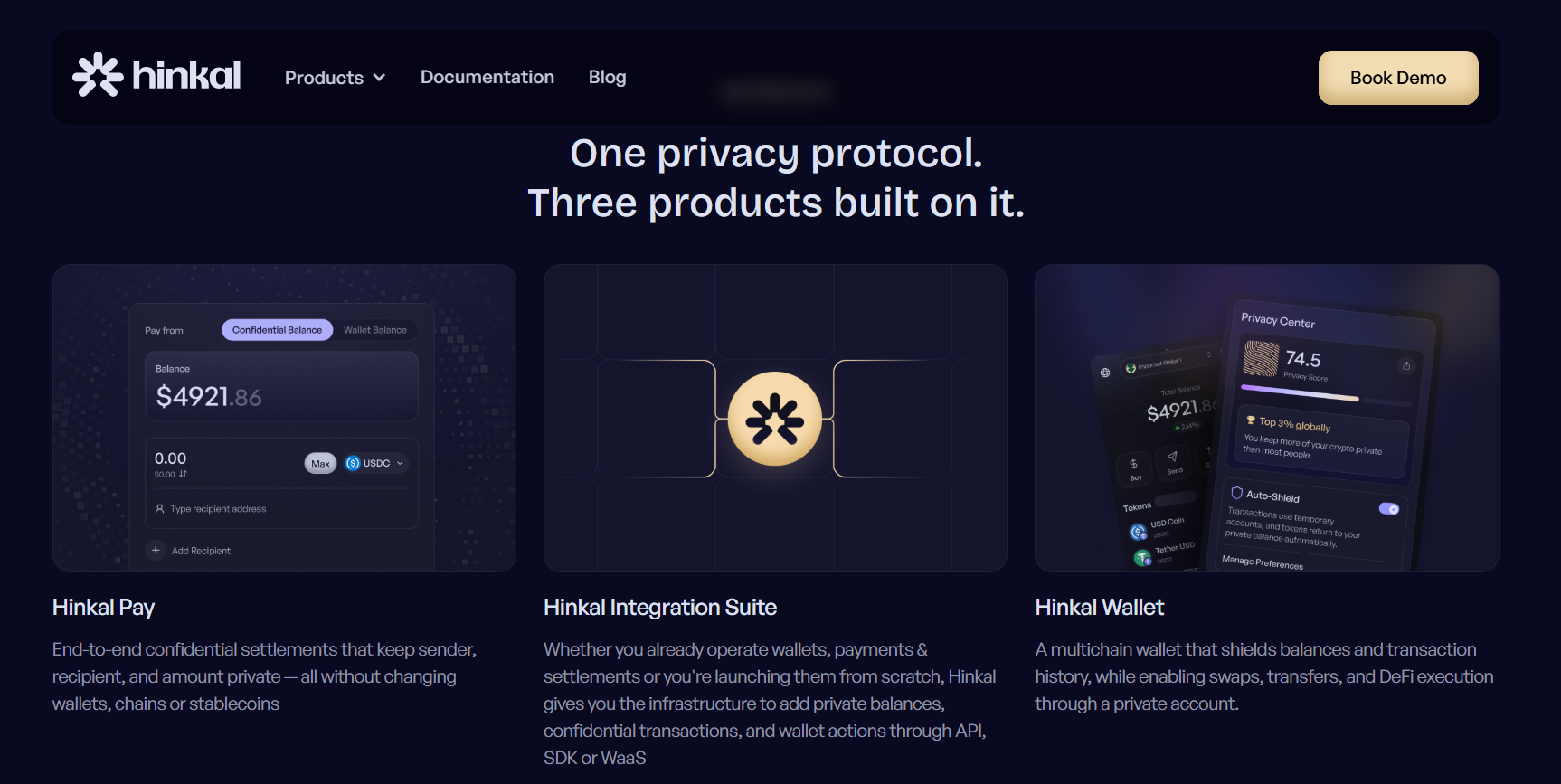
The protocol reaches platforms through several products:
This is the primary way tokenized asset platforms adopt privacy.
The API is a language-agnostic, drop-in surface that any backend can call to run private deposits, withdrawals, transfers, swaps, and balance reads, with requests signed by the caller's own wallet.
The SDK gives frontend-level control to embed private balances and confidential sends directly into an existing interface.
The result is that inside a wallet, custody dashboard, or tokenization platform, users see a private balance beside their regular balance and a private send beside their regular send. A forward-deployed Hinkal engineer supports the integration throughout.
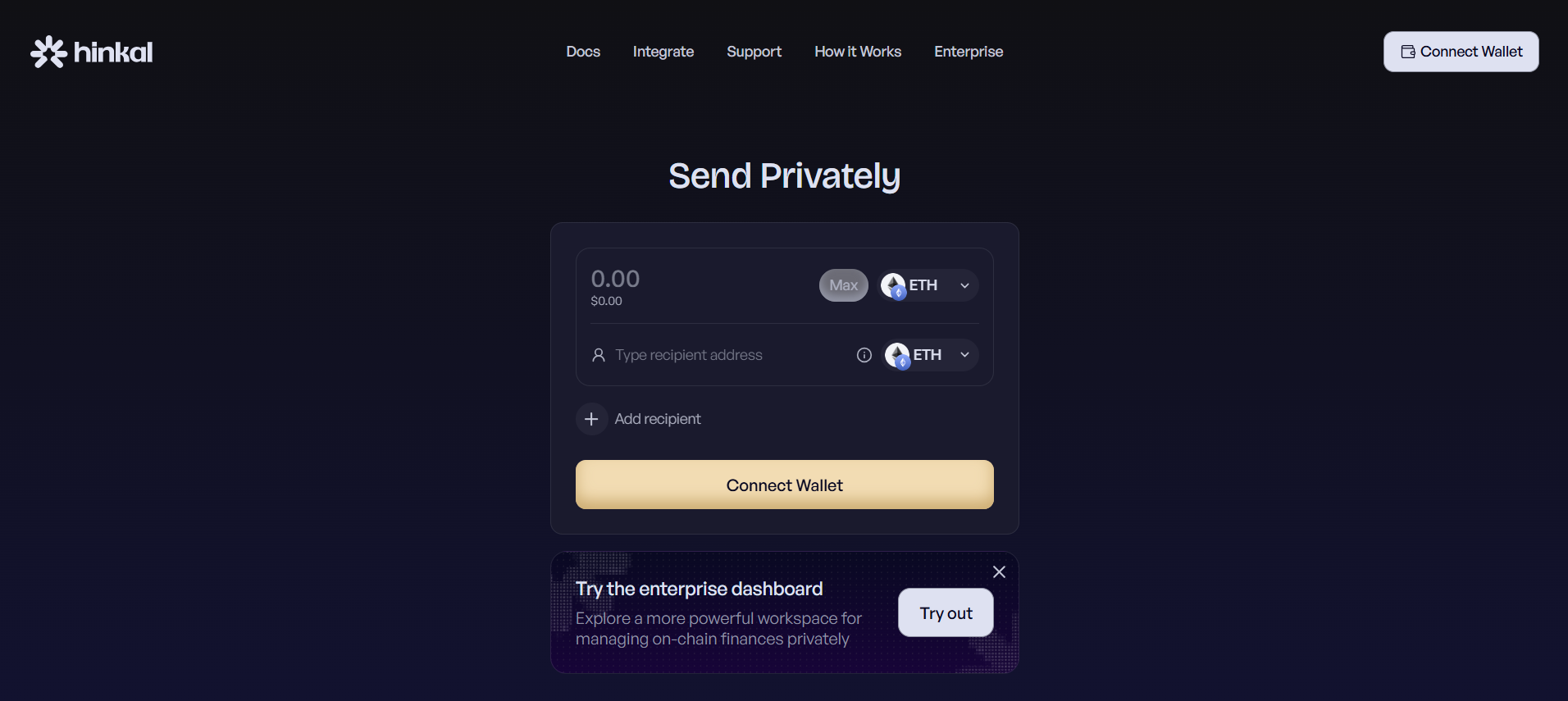
This handles confidential settlements and payouts, letting a platform send, receive, and hold funds privately across Solana, TRON, Ethereum, and major EVM networks without changing wallets, chains, or stablecoins.
This is the enterprise control surface for teams running confidential settlement at scale, with permissioned multi-user access, pending payout review, batch payouts for many recipients in one confidential operation, and compliance controls on high-value transactions with viewing-key audit access.
The confidential settlement flows map cleanly onto how tokenized assets actually move:
Flow
From
To
Public to Private
Wallet balance
Confidential balance
Private to Private
Confidential balance
Confidential balance
Private to Public
Confidential balance
Wallet directly
Public to Public
Wallet balance
Wallet directly, with sender and recipient unlinkable
Privacy Without Breaking Compliance or Auditability
The reason Hinkal works for regulated tokenized asset platforms is that privacy means opacity to the public ledger, not to your compliance team or auditor.
Three mechanisms make that possible:
Chainalysis KYT screens wallet addresses before execution, preventing high-risk funds from entering the smart contract at the entry point.
Viewing keys give each user a way to decrypt their own transaction history and share it selectively, full or partial, scoped to specific transactions or time ranges, and revocable, for regulators, auditors, or counterparties.
Downloadable transaction history is available out of the box, ready to hand to a third party.
This is the structural difference from mixers and compliance-free obfuscation tools: compliance is embedded rather than bolted on, and selective disclosure is built into the design.
How Hinkal Compares to Other Privacy Approaches
Most privacy options for tokenized assets fall into a few categories, and each has trade-offs that matter for a platform choosing infrastructure.
Permissioned institutional networks, such as Canton, deliver confidentiality by having participants transact on a separate permissioned chain where only relevant parties see the details. That works, but it asks a platform to migrate onto and operate a different network. Confidential-token and encryption-based frameworks, such as Zama's, tend to focus on hiding amounts and usually stay within a single ecosystem, most often EVM. Several other privacy tools are EVM-only and hide amounts without fully hiding counterparties.
Hinkal takes a different position on all three fronts. It is the only full-privacy multichain solution where sender, recipient, and amount are all private across EVM, Solana, and TRON. It adds confidentiality on the public chains a platform already uses, with existing wallets and existing stablecoins, so there is no chain migration and no new operator to run.
It pairs that privacy with built-in compliance through Chainalysis KYT and viewing keys, which most privacy protocols lack. It is non-custodial, so the user's existing wallet is the only credential. And it runs on a comparably lower fee base, with an enterprise settlement fee of 10 basis points (0.10%) per transaction. Integration stays frictionless through the API, SDK, and a forward-deployed engineer.
Why Hinkal Is the Best Privacy Infrastructure for Tokenized Asset Platforms
Hinkal is the best privacy infrastructure for tokenized asset platforms because it is the only solution that combines full multichain privacy, embedded compliance, and non-custodial control on the public chains platforms already use. Where most options force a trade-off between confidentiality and adoption, Hinkal removes it.
The proof points that matter for an infrastructure decision:
Full privacy across the chains that hold tokenized assets: sender, recipient, and amount are all private on Ethereum, Solana, TRON, and major EVM networks, not just hidden amounts on a single ecosystem.
Compliance and auditability built in: Chainalysis KYT screening at the entry point plus scoped, revocable viewing keys for regulators, auditors, and counterparties.
No migration and no custody change: a smart contract on existing chains, controlled by existing wallet keys, with no new network to run and no funds held by Hinkal.
Embedded, not bolted on: privacy slots into the platform's own product through the API and SDK, so users see a private balance beside the regular balance.
Production-proven: live for more than 3.5 years, over $500 million in cumulative volume, 6 independent security audits, and backing from Draper Associates, SALT, SNZ Capital, and NGC Ventures.
Use Cases Across Tokenized Asset Platforms
The same privacy layer supports the full range of participants in a tokenized asset ecosystem:
Tokenized asset issuers and RWA platforms can process subscriptions, redemptions, and secondary transfers confidentially, so investor positions, allocation sizes, and timing stay off the public ledger.
Treasuries holding tokenized instruments can move tokenized treasuries and money market fund positions without signaling size or intent to the market.
Custodians and institutional or embedded wallets can offer a native private balance beside the regular balance through Hinkal Integrations, with no separate wallet for end users.
Exchanges, on-ramps, and OTC desks can offer private withdrawals and settlement as an optional route, keeping destination wallet, amount, and relationships confidential for customers receiving funds on public chains.
Payout operations across payroll, vendor, affiliate, and distribution flows can run confidentially through Hinkal Pay and Hinkal Prime, including batch payouts in a single private operation.
How to Get Started with Hinkal
Getting started with Hinkal does not require re-architecting a tokenized asset platform. The path from evaluation to production is straightforward:
Book a demo: Walk through confidential settlement on your own flows and chains with the Hinkal team, and scope where privacy adds the most value in your product.
Choose your integration surface: Use Hinkal Integrations through the API for backend-driven private deposits, transfers, withdrawals, and swaps, or the SDK for full frontend control over private balances and confidential sends. Teams that want a ready dashboard can run confidential treasury and payouts through Hinkal Prime, or move funds directly with Hinkal Pay.
Build with a forward-deployed engineer: A Hinkal engineer supports the integration throughout, so your team is not implementing zero-knowledge settlement alone.
Go live: Once integrated, users see a private balance beside their regular balance and a private send beside their regular send, with Chainalysis KYT screening and viewing-key disclosure active from day one. No chain migration, wallet change, or new stablecoin is required.
You can try confidential settlement directly at pay.hinkal.io, review the technical details in the Hinkal docs, or book a demo to plan an embedded integration.
Conclusion
Hinkal is the privacy infrastructure built to bring tokenized asset platforms on-chain without exposing the positions, counterparties, and flows that institutions treat as confidential.
As tokenized real-world assets scale past $31 billion on public blockchains, the platforms that win institutional capital will be the ones that can settle privately while staying auditable and compliant, and that is precisely the gap Hinkal fills with full multichain privacy, embedded compliance, non-custodial control, and drop-in API and SDK integration.
If you are building or running a tokenized asset platform and want to add confidential settlement without changing your chains, wallets, or stablecoins, book a demo with the Hinkal team to see it work on your own flows.
1. What is the best privacy infrastructure for tokenized asset platforms in 2026?
The best privacy infrastructure for tokenized asset platforms in 2026 is one that keeps sender, recipient, and amount fully private while settlement stays public and auditable. Hinkal delivers this as a smart contract on the public chains platforms already use, across Ethereum, Solana, TRON, and major EVM networks, with built-in Chainalysis KYT screening, viewing keys for selective disclosure, non-custodial control, and drop-in API and SDK integration.
2. Why do tokenized asset platforms need privacy on public blockchains?
Tokenized asset platforms need privacy on public blockchains because a public ledger exposes investor positions, subscription and redemption sizes, treasury movements, and counterparty relationships to anyone. That visibility lets competitors front-run large trades and reverse-engineer strategies, and it conflicts with the confidentiality that regulated institutions require before moving assets on-chain.
3. Can privacy infrastructure for tokenized assets stay compliant?
Privacy infrastructure for tokenized assets can stay compliant when confidentiality applies to the public ledger but not to auditors or regulators. Hinkal screens wallet addresses with Chainalysis KYT before every transaction, blocks high-risk funds at the entry point, and uses viewing keys to give scoped, time-bounded, revocable disclosure to regulators, auditors, and counterparties.
4. Does Hinkal require tokenized asset platforms to migrate to a new chain?
Hinkal does not require tokenized asset platforms to migrate to a new chain. It is a smart contract that adds confidentiality on the public chains a platform already operates on, using existing wallets and existing stablecoins, rather than a private L1, L2, or permissioned network that assets must be moved onto.
5. How do tokenized asset platforms add privacy to their existing product?
Tokenized asset platforms add privacy to their existing product by integrating Hinkal Integrations through its API or SDK. The API exposes private deposits, transfers, withdrawals, swaps, and balance reads to any backend, while the SDK embeds private balances and confidential sends directly into the platform's interface, so users see a private balance beside their regular balance and a private send beside their regular send.
FAQ
Common questions
Do I need a new wallet to use Hinkal Wallet?
No. You can import your existing wallet using a seed phrase and access your assets immediately.
Do I need a new wallet to use Hinkal Wallet?
No. You can import your existing wallet using a seed phrase and access your assets immediately.
Do I need a new wallet to use Hinkal Wallet?
No. You can import your existing wallet using a seed phrase and access your assets immediately.
Trusted by teams building on public chains
Key Takeaways
Public blockchains expose every tokenized position, transfer, and counterparty, blocking serious institutional adoption.
Hinkal keeps sender, recipient, and amount private across Ethereum, Solana, TRON, and EVM.
Privacy stays compliant through Chainalysis KYT screening and viewing keys for selective disclosure.
Hinkal is non-custodial and needs no chain migration, wallet change, or new stablecoin.
Platforms embed privacy directly through Hinkal Integrations, adding a private balance beside every wallet.
Want
to
stay
ahead
of
the
market?
Get exclusive insights on privacy, stablecoins, and marketdevelopments shaping enterprise on-chain finance.
Thank you! Your submission has been received!
Oops! Something went wrong while submitting the form.
Related Articles
August 10, 2026
Hinkal can now be integrated directly into Go backends
Announcement
August 6, 2026
Episode 04: Stealth Addresses
Opinion
August 4, 2026
Hinkal Pay is now live on BNB Chain
Announcement
July 31, 2026
Hinkal can now be integrated directly into iOS and Android
Announcement
July 29, 2026
Hinkal MCP: Private Payments from Any AI Client
Announcement
July 27, 2026
Private Balances and Transfers Are Live on Privy Wallets
Announcement
July 24, 2026
The On-Chain Treasury Exposure Report: What Public Corporate Wallets Reveal
Opinion
July 23, 2026
The Hidden Cost of Public Crypto Payroll: A 2026 Exposure Report
Opinion
July 23, 2026
Hinkal is Live on Openfort
Announcement
July 22, 2026
Confidential Stablecoin Settlement Under MiCA, the Travel Rule, and GENIUS: 2026 Readiness Report
Analysis
July 21, 2026
Confidential Settlement for Stablecoin Issuers: How Issuers Keep Vault Positions and Holder Balances Private
Opinion
July 20, 2026
Reading the Tape: How Counterparties Reverse-Engineer an OTC Desk's Book From On-Chain Settlement
Opinion
July 20, 2026
Introducing the New Hinkal Pay: New Look and Features
Announcement
July 17, 2026
Embedded Wallet Integration Guide: Private Balances via the Hinkal SDK (Privy / Turnkey / Crossmint)
Analysis
July 16, 2026
How to Pay Vendors in Stablecoins Without Exposing Your Treasury Balance
Analysis
July 15, 2026
Best Private Settlement Infrastructure for Solana Businesses
Analysis
July 14, 2026
The Migration Tax: What It Costs a Treasury to Move to a Privacy Chain vs Add Privacy on Ethereum
Opinion
July 13, 2026
Confidential Settlement for Regulated Treasuries
Opinion
July 10, 2026
How RWA Protocols Can Protect Investor Activity Onchain
Analysis
July 9, 2026
Association Sets vs Selective Disclosure: Which Privacy Model Passes a Compliance Review?
Analysis
July 7, 2026
How to Shield and Unshield Crypto Assets with Hinkal: A Step-by-Step Guide
Analysis
July 6, 2026
Best Railgun Alternatives for Private Stablecoin Treasury Management (2026)
Analysis
July 6, 2026
Best Crypto Payment API for Fintechs With Private Settlements (2026)
Analysis
July 6, 2026
Privacy vs Compliance: Which Crypto Privacy Solutions Work for Businesses?
Opinion
July 6, 2026
How DAOs Can Pay Contributors Without Revealing Compensation Data
Opinion
July 2, 2026
Privacy is live on Turnkey wallets, powered by Hinkal
Partnership
June 29, 2026
Best Privacy Infrastructure for Institutional DeFi Platforms in 2026
Opinion
June 26, 2026
Private settlements & payouts are coming to AllScale
Partnership
June 18, 2026
Private Stablecoin Custody Is Coming to The Vault
Partnership
June 17, 2026
Episode 03: UTXO Model, Commitments & Nullifiers
Opinion
June 16, 2026
Both-Way Bridging Across EVM, Solana, and TRON Is Live
Announcement
June 15, 2026
Private Swaps and Payments - Now Live on Tempo
Announcement
June 12, 2026
Bridge from Hinkal to External Chains with LI.FI
Partnership
June 10, 2026
Hinkal API: Drop-In Privacy For Every Product Where Serious Capital Flows
Announcement
June 10, 2026
Hinkal x Peso: Private Stablecoin Payments for LATAM
Announcement
June 9, 2026
Hinkal vs Zama vs Canton: Enterprise Privacy Infra Compared





















































.png)
.png)

.webp)