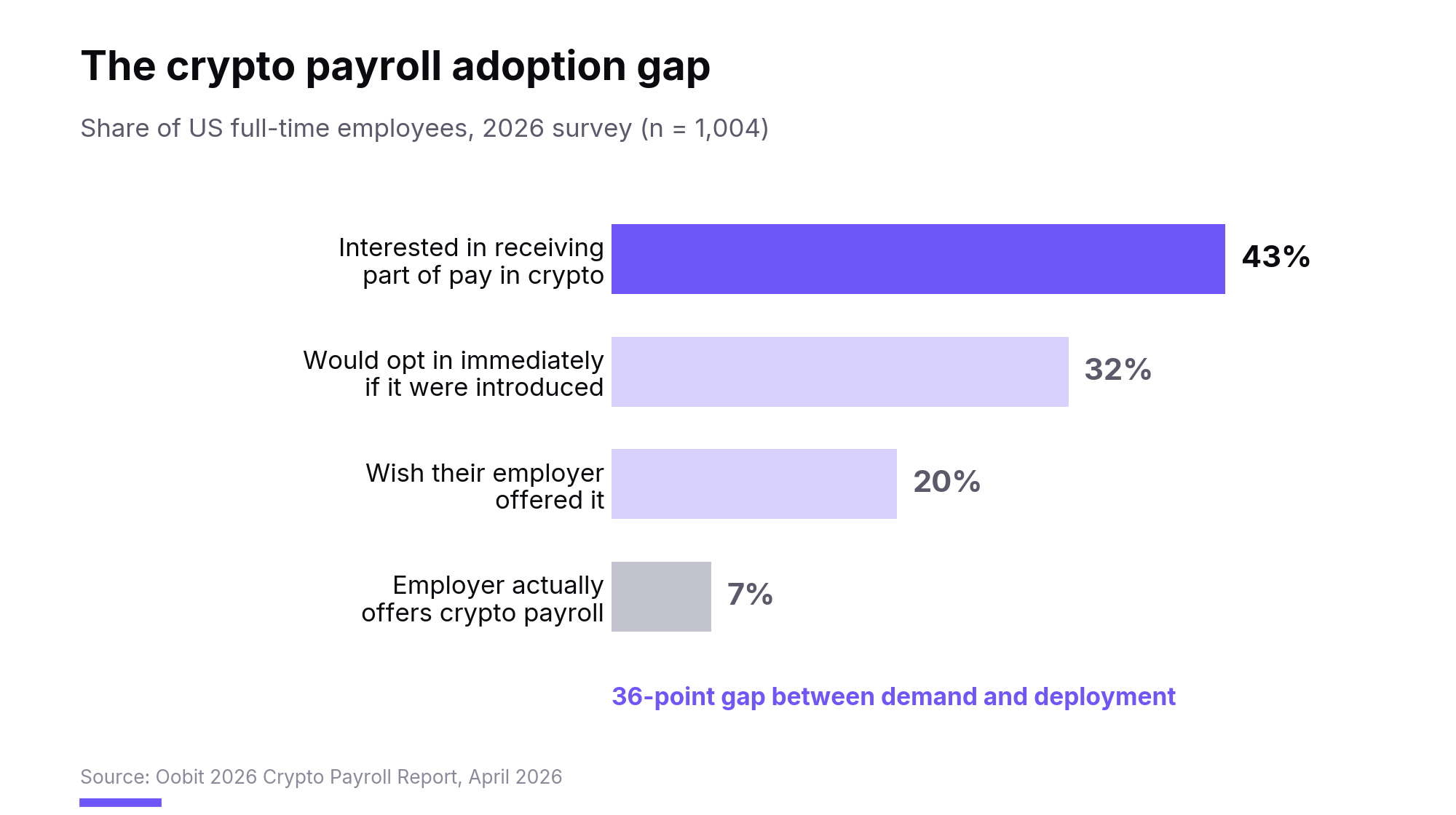
Only 7% of employees say their employer currently offers a crypto payroll option, while 43% say they want part of their pay in digital assets (Source:Oobit 2026 Crypto Payroll Report, survey of 1,004 full-time employees, April 2026).
Hinkal provides privacy infrastructure for stablecoin payments and on-chain financial operations, letting businesses run settlements and payouts across public chains while payment, payroll, and treasury data stay confidential, without changing wallets, chains, custody, or compliance controls.
That 36-point gap between demand and deployment is not a technology problem. The rails are faster and cheaper than correspondent banking, and stablecoin transfer volume hit a record $4.5 trillion in Q1 2026 (Source:Forbes), yet fewer than 1% of businesses run formal crypto payroll, because a public blockchain publishes every salary, every bonus, every headcount change, and every treasury drawdown to anyone with a block explorer.
This report quantifies that exposure: what a public payroll run reveals, what it costs in fraud, negotiation leverage, and competitive intelligence, how the 2026 market responded, and how to close the gap without migrating chains or rebuilding your payout stack.
Exposure is treated as a measurable cost category rather than a philosophical objection. Every claim below is either sourced to a 2026 publication or derived from a stated cost model with its inputs shown. Where estimates diverge across sources, both figures are given rather than the flattering one.
The 2026 Baseline: The Rails Won, The Disclosure Model Did Not
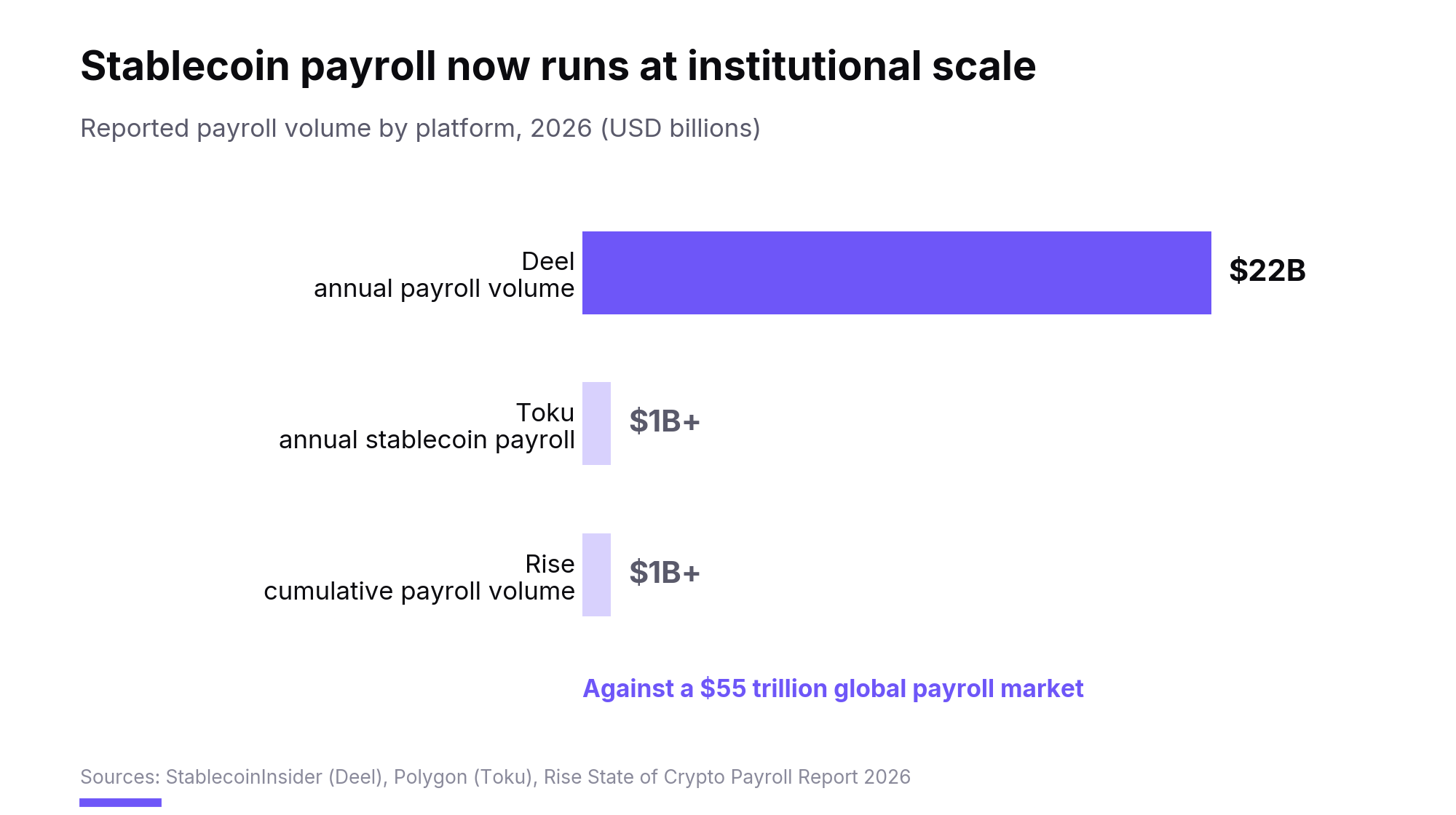
Stablecoin payroll stopped being an experiment in 2026. The volume is now institutional.
Stablecoin transfer volume, Q1 2026: $4.5 trillion, a record, with nearly two-thirds originating in Asia (Source:Forbes citing a16z crypto, April 29, 2026).
Stablecoin market capitalization: approximately $321 billion as of March 2026 (Source:StablecoinInsider).
Global payroll market: $55 trillion, the addressable opportunity for stablecoin infrastructure once privacy barriers are removed (Source:Toku, Aleo and Paxos Labs, January 2026).
Deel: the world's largest HR platform by payroll volume at $22 billion annually, announced stablecoin payroll on February 10, 2026, with UK and EU rollout from March 2026 (Source:StablecoinInsider).
Toku: more than $1 billion in annual token and stablecoin payroll volume across 100+ jurisdictions (Source:Polygon).
Rise: more than $1 billion in cumulative payroll volume, with the majority of worker withdrawals taken in stablecoins (Source:Rise State of Crypto Payroll Report 2026).
Worker uptake: 39% of surveyed crypto users and prospective users receive income in stablecoins, representing roughly 35% of their annual earnings, and 75% of that group report an increased ability to conduct international business (Source:BVNK Stablecoin Utility Report, 4,658 adults across 15 countries).
The economics are settled. A $5,000 international payment costs roughly $25 to $50 plus 1% to 3% FX through SWIFT and takes two to seven days, while the same payment in USDC on Polygon costs under $0.01 and settles in seconds (Source:MoonPay, May 2026). For 100 contractors at $5,000 per month, that difference is more than $200,000 per year in direct fees alone, before FX and float.
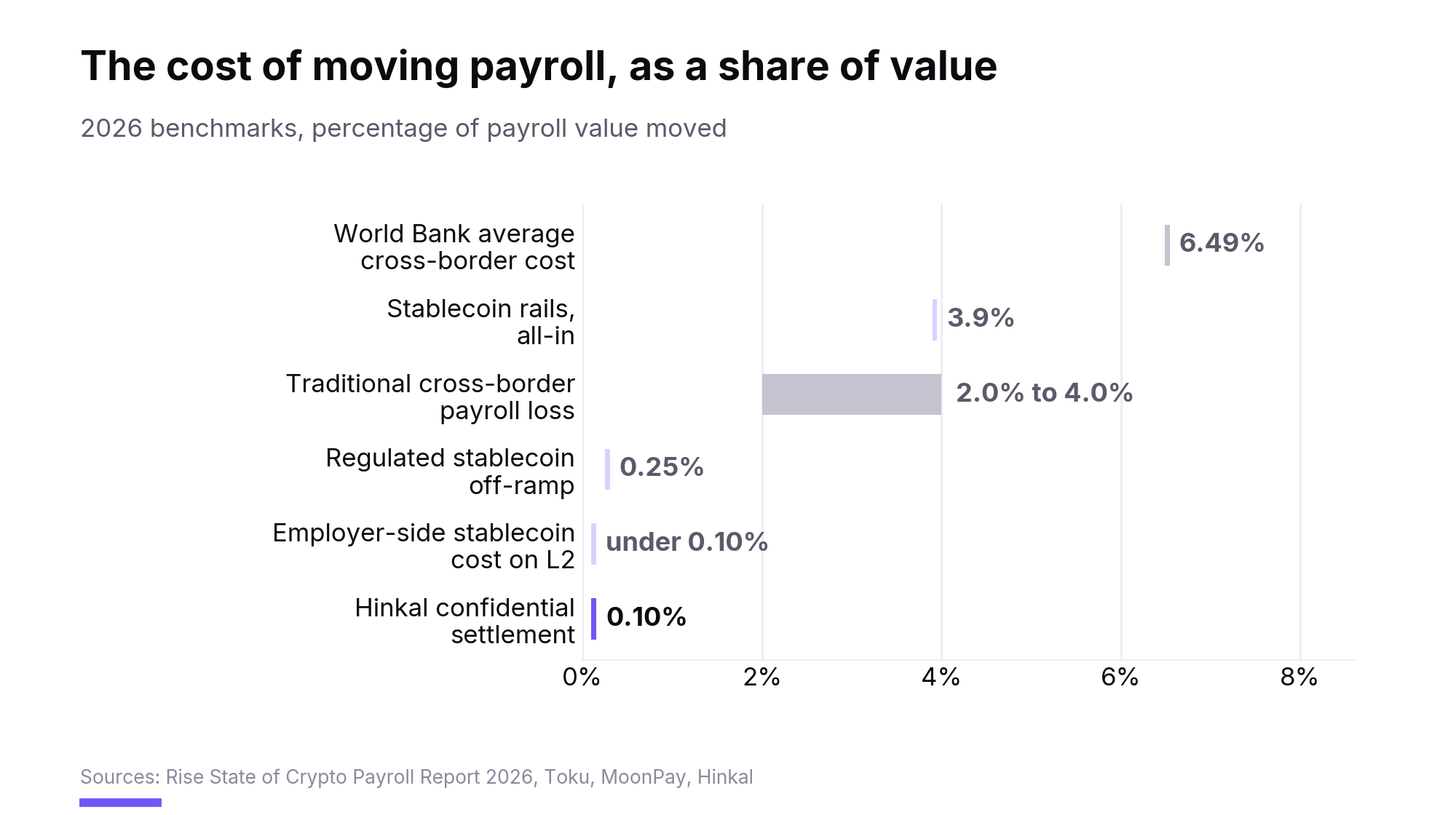
Stablecoin rails run at approximately 3.9% all-in versus the World Bank cross-border average of 6.49%, roughly 40% cheaper (Source:Rise Stablecoin Payroll Report 2026 summary).
None of that is the constraint. The constraint is that the cheapest payment rail in history is also the only one that publishes your compensation structure.
The Adoption Gap: Demand Is High, Deployment Is Not
The clearest evidence that exposure is the blocker is the size of the gap between what workers want and what employers ship.
Employer side
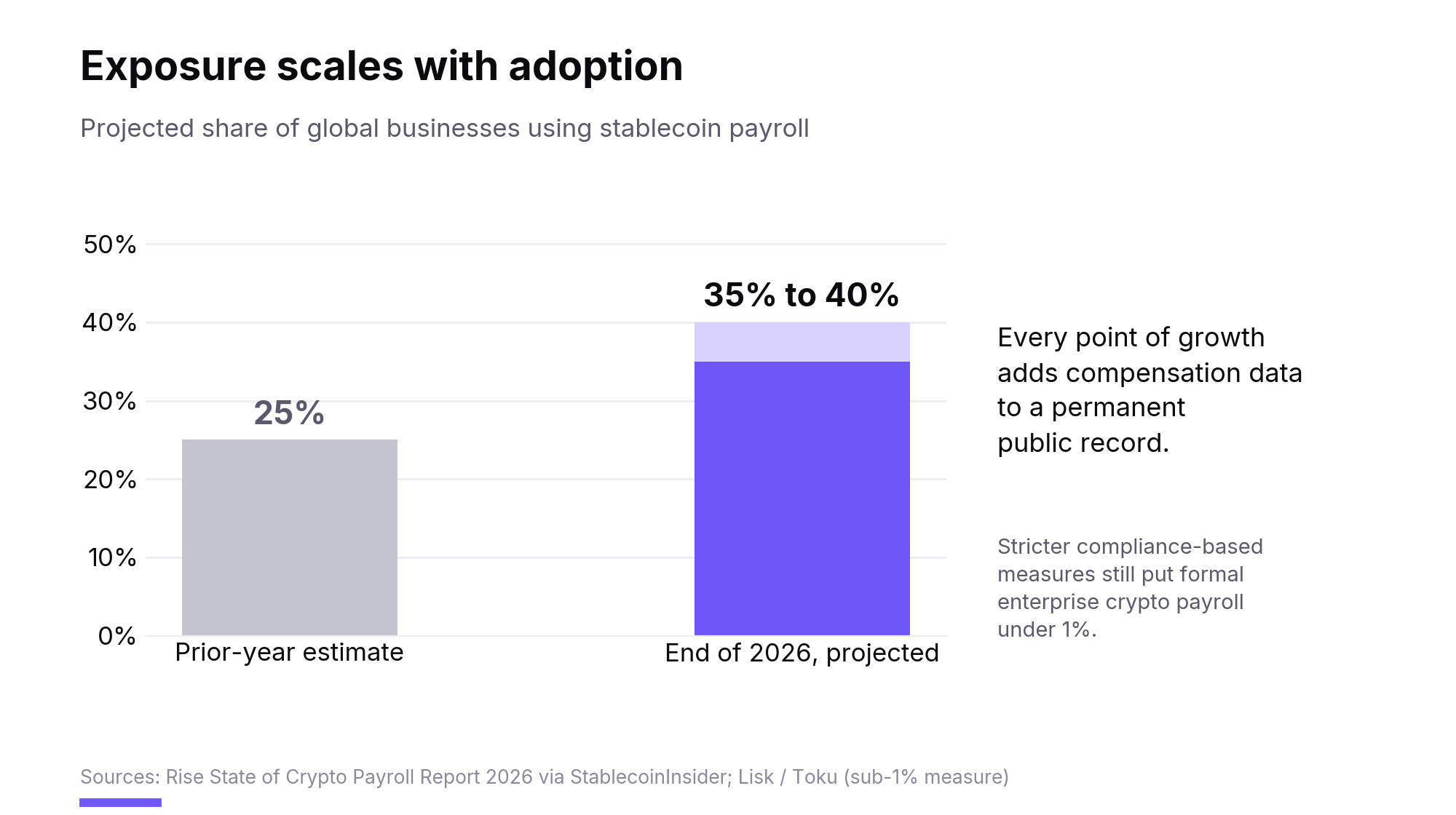
Estimates of business adoption range from less than 1%, measured by compliance-focused providers counting formal primary payroll for full-time employees, to 25% from a Pantera Capital survey of roughly 1,600 mostly crypto-adjacent professionals (Source:Lisk analysis citing Rise and compliance providers, April 2026).
That spread is the distance between enthusiasm and operational reality. The conservative figure is the one that counts, because it measures payroll that actually runs.
43% are interested in receiving some portion of pay in digital assets, rising to 57% among those who already own them.
86% of active traders and investors show interest, versus 27% of non-owners.
Only 7% say their employer offers the option, while 20% wish it did.
32% say they would opt in immediately if it were introduced.
20% have already been paid in crypto for some work: side hustles 45%, freelance 44%, full-time roles 21%.
Satisfaction among those who have received crypto pay is 78%.
Average ideal allocation is 27% of the paycheck, with the remaining 73% in fiat.
16% say crypto payroll would make them more likely to accept a job offer.
The demand signal is strong and it converts. What stalls is the employer's decision, and the reason is stated plainly by the people selling into it. Toku's CEO described the pattern in public company conversations: the CFO realizes their payroll would be public, and that is where the conversation ends (Source: StablecoinInsider, March 2026).
That sentence is the entire report in miniature. Compensation is sensitive data, and public by default is a non-starter for most employers (Source:Privacy trends 2026 analysis).
What a Public Payroll Run Actually Publishes
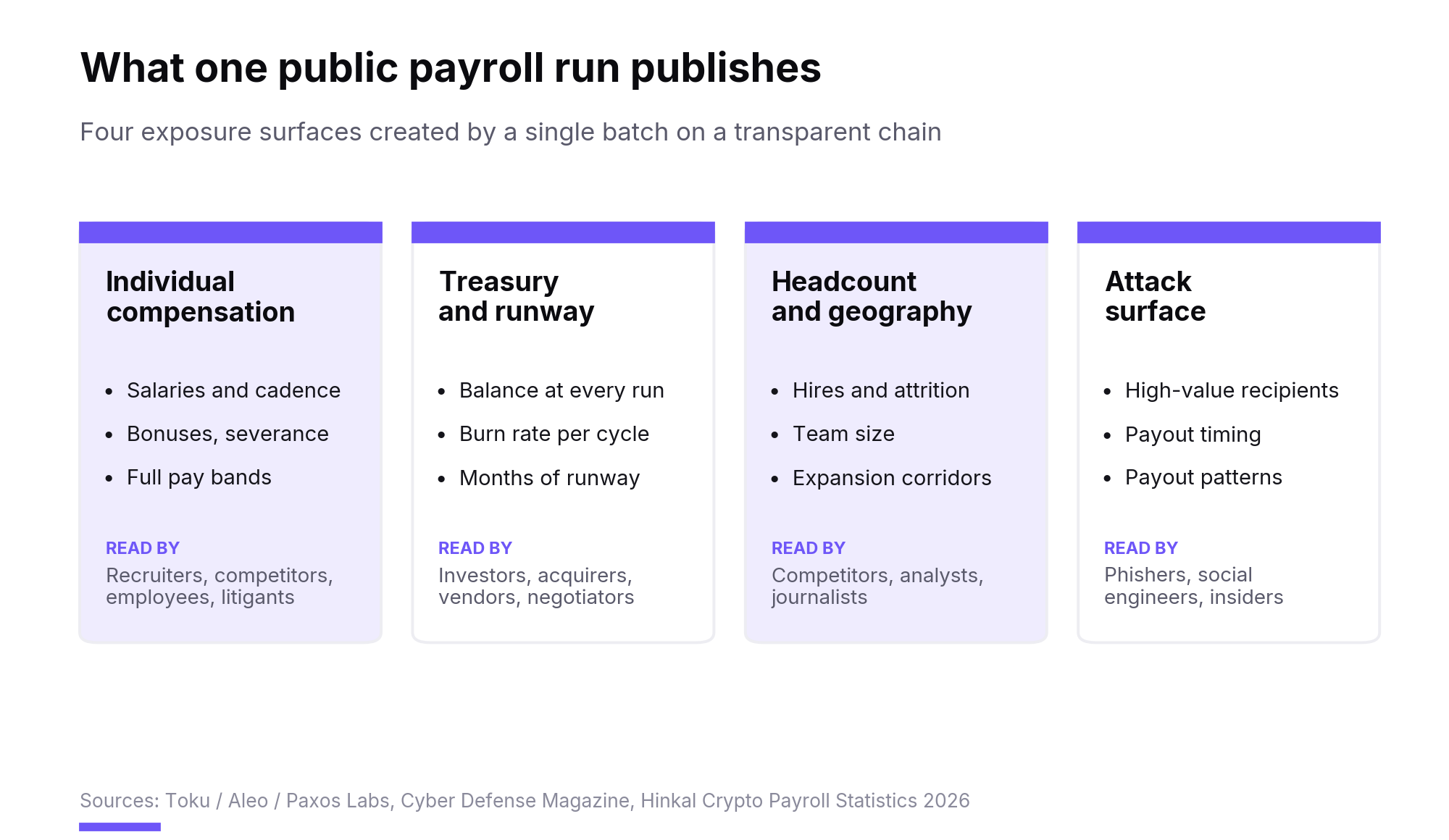
A single payroll batch on a transparent chain is not one disclosure. It is four, and they compound over time.
Exposure Surface One: Individual Compensation
Each transfer pairs a wallet address with an amount and a timestamp. Recurring transfers on the same cadence identify salaried employees. Off-cycle transfers identify bonuses, retention payments, and severance. Once one address is attributed to a person, through a public donation, an ENS name, an NFT purchase, a CEX deposit, or a doxxed social handle, that person's full compensation history becomes readable retroactively and permanently.
This is the specific exposure that drove private payroll product development in 2026. Traditional public blockchains expose sensitive employee salary data, which is why providers began deploying zero-knowledge cryptography to protect it (Source: AllScale overview of stablecoin payroll platforms).
The internal consequences are ordinary HR problems at extraordinary scale. Salary bands become public to the entire workforce. Pay compression, geographic differentials, and negotiated exceptions all become visible and litigable. No compensation philosophy survives contact with a spreadsheet that anyone can build in an afternoon.
Exposure Surface Two: Corporate Treasury and Runway
The paying wallet reveals its balance before and after every run. Batch size times cadence gives burn rate. Burn rate against balance gives runway.
For a private company, that is the most closely guarded number in the building, exposed continuously and for free.
For a public company, it is material financial data becoming public on an unmanaged schedule.
Public visibility of salaries, bonus structures, and corporate treasury balances is cited as the primary reason enterprise stablecoin payroll adoption has stayed below 1% (Source:Toku, Aleo and Paxos Labs, January 2026).
Exposure Surface Three: Headcount, Geography, and Strategy
Payroll is the highest-fidelity operational signal a company produces. The number of recipients is headcount. Additions are hires. Removals are attrition or layoffs. Clustering by off-ramp or stablecoin preference implies geography.
A sudden cluster of new recipients in one corridor is an expansion announcement your competitors read before your board does. Every on-chain payroll transaction reveals company economics to anyone with a block explorer (Source:Hinkal, 20 Crypto Payroll Statistics 2026).
Exposure Surface Four: Attack Surface
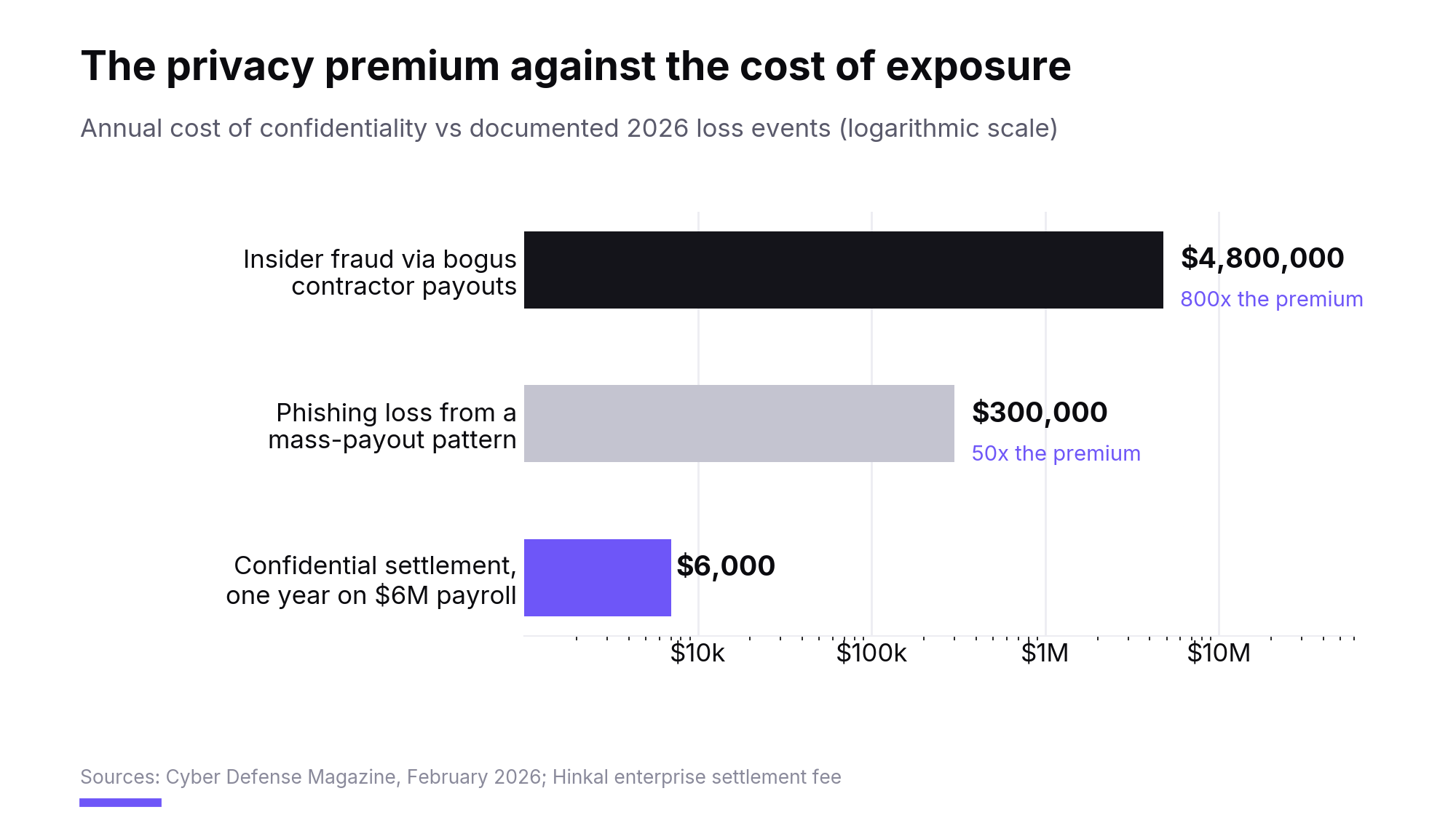
Visibility converts directly into targeting. Transparency enables monitoring of mass-payout patterns, including through fee addresses, and this monitoring has been used in phishing attacks resulting in theft, with one documented case involving $300,000 in USDT (Source:Cyber Defense Magazine, February 13, 2026). The same reporting details insider fraud amplified by wallet anonymity, including $4.8 million stolen through bogus contractor payouts.
Two structural risks sit alongside it. Single-signer hot wallets are the single largest source of payroll fraud in crypto-native companies, and crypto transactions are irreversible, so a wrong address or wrong network is permanent loss rather than a reversible error (Source:MoonPay, May 2026).
Summary of what leaks, and who benefits:
Individual compensation: Salaries, bonuses, severance, and pay bands, useful to recruiters, competitors, your own employees, and litigants.
Treasury and runway: Balance, burn rate, and months of remaining runway, useful to investors, acquirers, vendors, and anyone negotiating against you.
Headcount and geography: Hires, attrition, and expansion corridors, useful to competitors, analysts, and journalists.
Attack surface: High-value recipients and payout timing, useful to phishers, social engineers, and insiders.
Quantifying the Hidden Cost
The direct cost of crypto payroll is well documented and low. The hidden cost is the exposure premium, and it is not on any invoice.
The visible line items, 2026 benchmarks:
Traditional cross-border payroll loss: 2% to 4% per payment in FX and intermediary fees, which for 30 international contractors at $3,000 per month equals $1,800 to $3,600 lost every month (Source:Toku).
Employer-side stablecoin cost on L2: often under 0.1% of payroll value, with worker off-ramp at 0.1% to 1% (Source:MoonPay). Regulated stablecoin-to-USD conversion runs around 25 basis points with no FX markup on mid-market rates (Source:Toku).
Payroll platform fees: roughly $10 to $30 per worker per month for Bitwage and Rise, versus $50 to $200 per worker per month for a traditional employer of record (Source:Eco, May 26, 2026).
Multi-chain routing: $80 to $300 per monthly run for 100 recipients across four chains on a per-route bridge model, or $20 to $50 intent-routed, annualizing to $1,000 to $3,600 (Source:Eco).
Hinkal enterprise confidential settlement: 10 BPS (0.10%) per transaction.
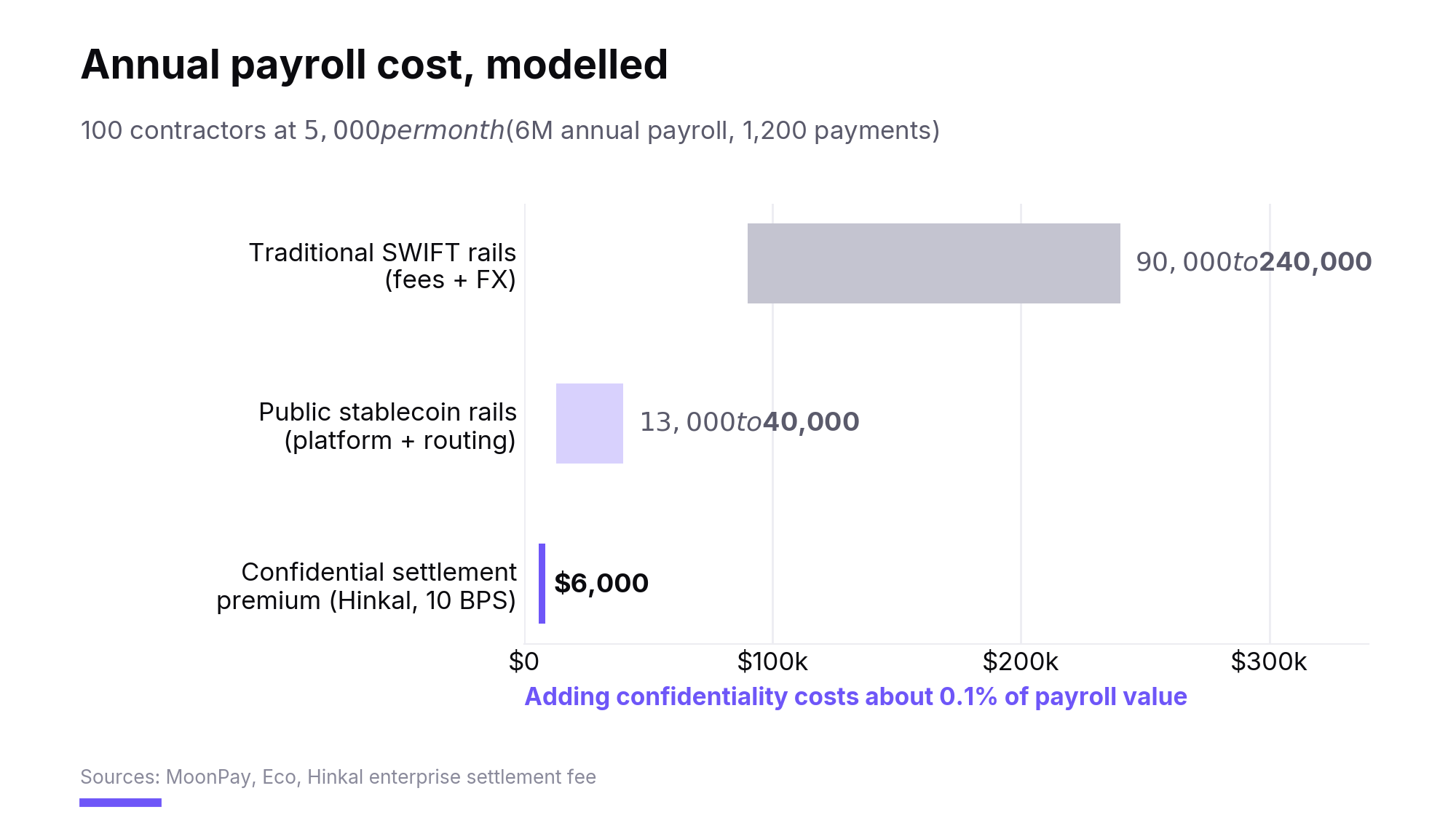
Worked model: 100 contractors at $5,000 per month. Annual payroll is $6,000,000 across 1,200 payments per year.
Traditional SWIFT rails: $30,000 to $60,000 in flat fees, plus $60,000 to $180,000 in FX at 1% to 3%, for a total of $90,000 to $240,000.
Public stablecoin rails: network fees measured in cents, platform fees of $12,000 to $36,000, and routing of $1,000 to $3,600, for a total of roughly $13,000 to $40,000 and savings of more than $200,000 against SWIFT (Source:MoonPay).
Confidential settlement premium: at 10 BPS per transaction, adding privacy to $6,000,000 of annual payroll costs approximately $6,000 per year.
That last line is the number this report exists to isolate. Confidentiality costs about 0.1% of payroll value. A single successful phishing attack on an exposed payout pattern cost one organization $300,000, or fifty years of that premium, and one insider fraud case cost $4.8 million, or eight hundred years of it (Source:Cyber Defense Magazine).
The costs that never appear as fees:
Negotiation leverage: A vendor, landlord, acquirer, or candidate who can read your runway negotiates against a number you did not disclose.
Compensation renegotiation and attrition: Published pay bands trigger internal repricing that arrives as an unbudgeted payroll increase.
Competitive intelligence: Hiring velocity and corridor expansion are strategy documents rendered as transaction logs.
Operational time: One iGaming company spent dozens of hours monthly troubleshooting payout errors before automation, a recurring labor cost against irreversible transfers (Source:Cyber Defense Magazine).
Deal risk: For public and pre-IPO companies, an uncontrolled disclosure channel for material financial data is a governance problem before it is a privacy one.
Why the Standard Workarounds Fail
1. Rotating wallets per employee
Address rotation delays clustering, it does not defeat it. Funding from a common source, consolidating dust, or reusing an off-ramp relinks the set. Rotation also shifts operational burden onto the employee, who now manages multiple addresses against irreversible transfers.
2. Paying through an intermediary or exchange
This relocates disclosure rather than removing it. The withdrawal side stays public, and you inherit a third party's operational security and reporting posture.
3. Splitting or randomizing amounts
Statistical noise against a determined analyst with a permanent ledger and a fixed monthly cadence. Payroll's regularity is precisely what makes it easy to fingerprint.
4. Migrating to a private chain, privacy rollup, or private L1
This is the approach most of the 2026 launches took, and it is the most expensive one. It asks your custodian, your compliance stack, your accounting system, your stablecoin issuer relationships, and every recipient to move with you. Adoption stalls because payroll is a two-sided flow: the worker has to be there too.
5. Using a mixer
Non-viable for any regulated entity. Compliance-free obfuscation creates sanctions exposure no treasury or finance team can carry, and it fails the audit requirement outright.
What the Market Built in 2026, and What It Costs You
The industry recognized the problem and shipped against it. The pattern is worth reading closely, because the design choice differs from Hinkal's in one decisive way.
January 29 to 30, 2026: Aleo, Toku, and Paxos Labs launched what they described as the first fully private stablecoin payroll solution, framed explicitly as removing the final barrier to enterprise stablecoin adoption, with rollout to select clients in Q1 2026 and broader availability expected by mid-2026 (Source:Toku).
February 10, 2026: Canton Network announced the first private institutional payroll transaction for a multinational company on an institutional-grade blockchain (Source:Canton Network).
2026: Request Finance introduced private stablecoin payroll through an Aleo partnership, citing salary data exposure on traditional public chains as the driver (Source:AllScale).
Three independent launches in six weeks, all solving the same problem, is the strongest available evidence that exposure is the binding constraint on a $55 trillion market.
The tradeoff is where they run. Zero-knowledge chains and institutional networks deliver confidentiality by asking you to settle somewhere new: a different chain, a different asset representation, a different set of counterparty prerequisites, and a different compliance mapping.
For a payroll flow that already works on Ethereum, Solana, or TRON in USDC or USDT, that is a migration project with a two-sided adoption requirement attached.
The alternative design is to add confidentiality to the chain the payroll already runs on.
The Hinkal Model: Confidential Payroll Without Migration
Hinkal is a smart contract on public chains that lets users hold private balances controlled through their existing wallet keys. It is not a mixer, not a private L1 or L2, and not a privacy rollup. Payroll keeps running on the chains, wallets, and stablecoins already in production.
How It Works
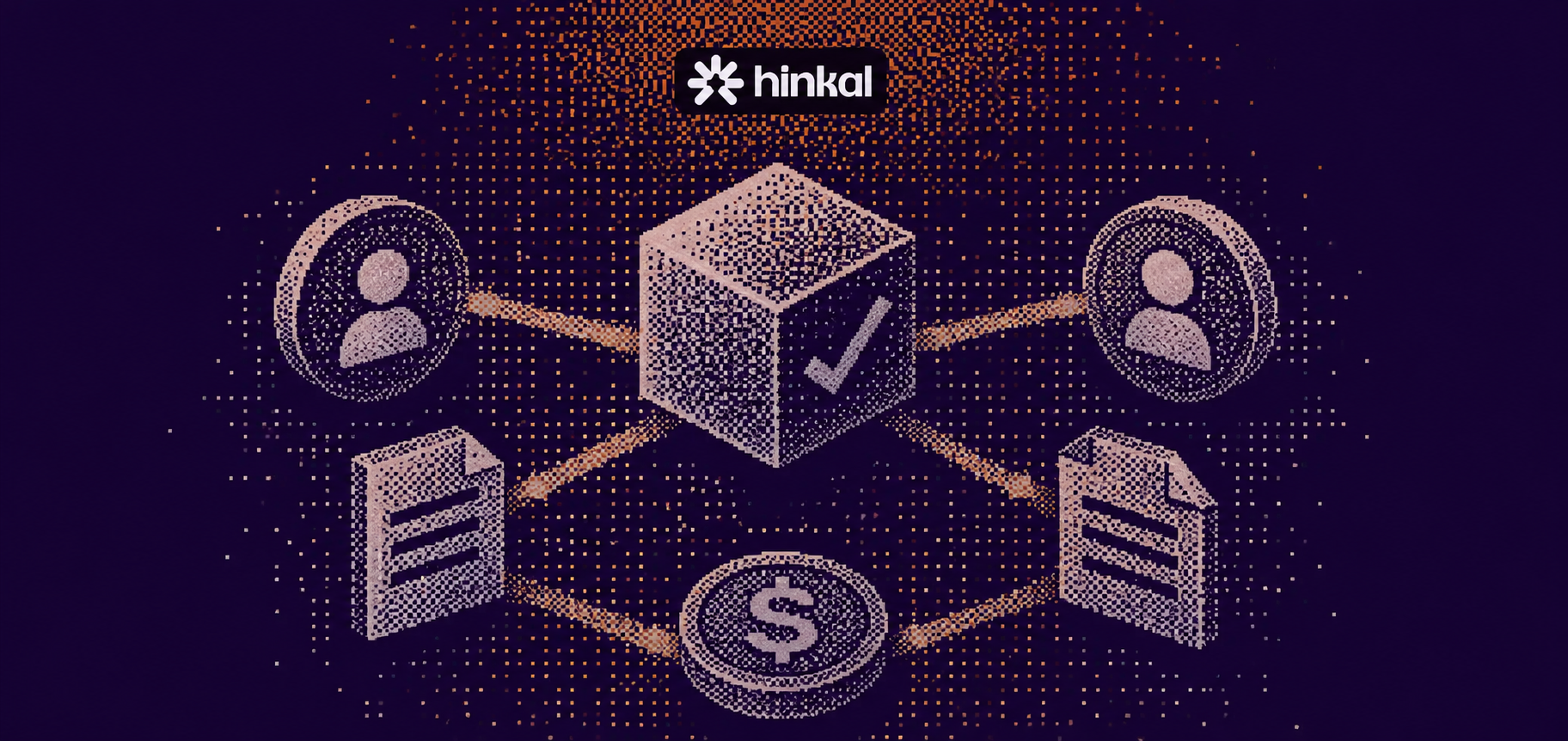
Instead of direct wallet-to-wallet transfers, payouts execute from private accounts controlled by existing wallet keys. Each transaction is proven valid with zkSNARKs (Groth16) over UTXO-style commitments and nullifiers stored in canonical on-chain contract state.
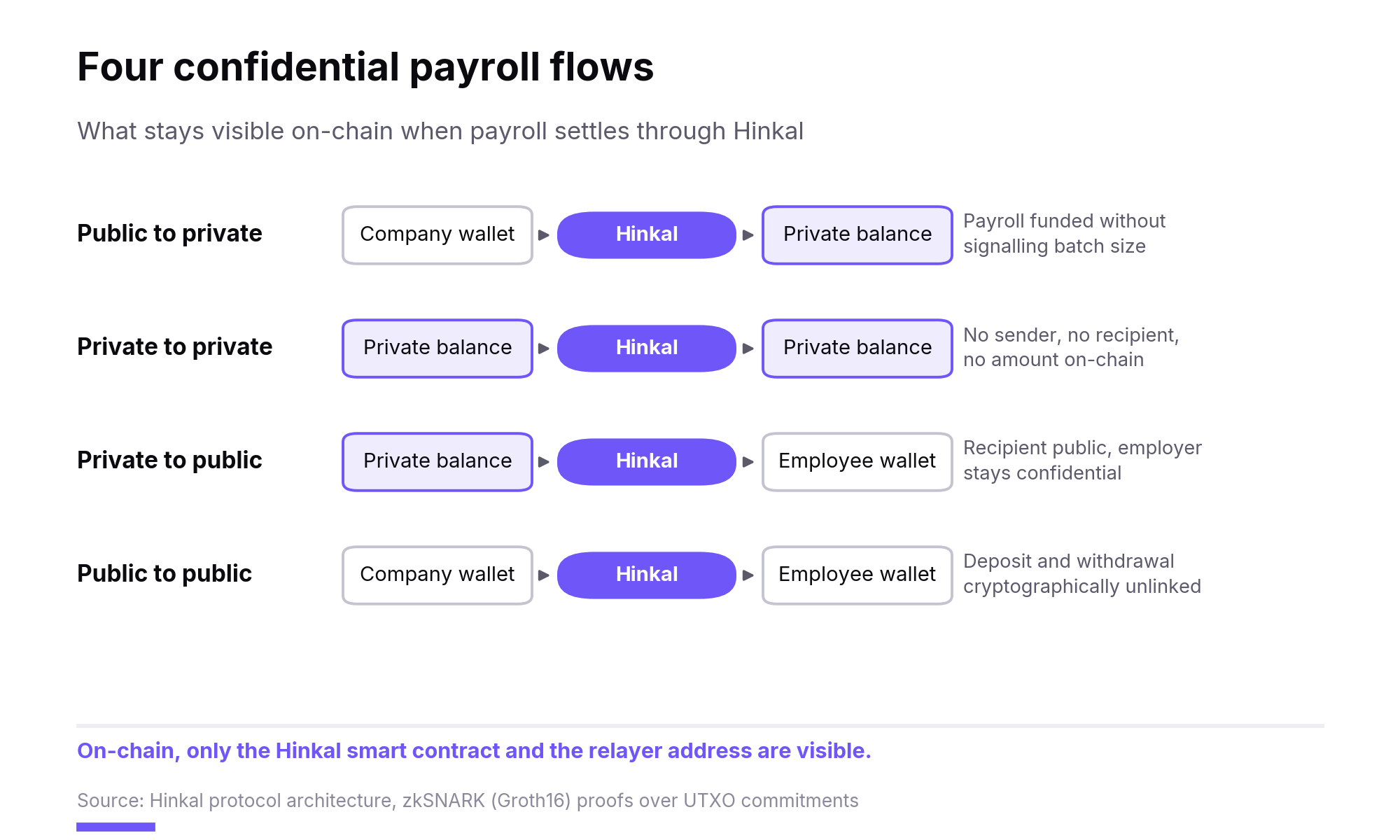
On-chain, only the Hinkal smart contract and the relayer address are visible. Because the relayer broadcasts, the company wallet never appears as the transaction origin. Sender, recipient, and amount stay private while settlement remains verifiable.
Private balance reads, UTXO handling, proof generation, and transaction building run inside Hinkal's secure enclave, and raw key material is never exposed outside it.
The Four Payroll Flows
Public to private: Funds move from the company wallet into a confidential balance. Payroll is funded without signalling batch size or timing.
Private to private: Funds move between confidential balances. Sender, recipient, asset, and amount all stay off the public ledger, with only the smart contract and relayer address visible on-chain.
Private to public: Funds move from a confidential balance to an employee's normal wallet address. The recipient address is public, the employer stays confidential.
Public to public: Funds move from the company wallet through Hinkal to the employee's wallet, with the deposit and the withdrawal cryptographically unlinkable. No shielded-address experience is required on either side.
The private-to-public and public-to-public flows matter most for payroll adoption, because they remove the two-sided problem. The recipient needs no shielded-address UX, no new chain, and no new wallet. The employer gets confidentiality on day one without waiting for every contractor in twelve countries to onboard to anything.
The Products That Run It
Hinkal Pay handles end-to-end confidential settlements and payouts across Solana, TRON, Ethereum, and major EVM networks. Connect an existing wallet, move funds to a private balance, pay out. Custody does not change and the keys stay yours.
Hinkal Prime is the enterprise control surface for payroll at scale. It adds permissioned multi-user access so a finance or treasury team operates with defined roles, pending payouts so runs are queued and reviewed before execution, batch payouts so many recipients are paid in one confidential operation for payroll, vendor, and contractor settlement, and compliance controls on high-value transactions with viewing-key audit access.
Hinkal Integrations exposes the same protocol as a drop-in surface for payroll platforms, PSPs, custodians, embedded wallet providers, and fintechs.
The API is language-agnostic across Python, Go, Java, .NET, Rust, and Node.js, with wallet-authenticated requests signed by the caller's wallet, so no passwords or custodial key handling are introduced.
The SDK gives frontend-level control for products that want private balances and private sends rendered natively inside their own interface. A forward-deployed Hinkal engineer assists throughout the integration.
Proof Points
Cumulative volume processed: $500M+ lifetime.
Security audits: 6 completed.
Production uptime: approximately 3.5+ years live in production.
Enterprise settlement fee: 10 BPS (0.10%) per transaction.
Supported chains: Ethereum, Polygon, Arbitrum, Optimism, Base, Solana, TRON, Arc, and Tempo, with cross-chain bridging available while preserving privacy.
Backing: Draper Associates, SALT, SNZ Capital, and NGC Ventures, with incubation at Stanford and Binance MVB.
Privacy Without Losing the Audit Trail
The objection that ends most privacy conversations in a finance team is auditability. It should not.
Privacy means opacity to the public ledger, not opacity to your auditor, your regulator, or your own compliance function. Hinkal separates those two things structurally:
Chainalysis KYT screens wallet addresses before execution, preventing high-risk funds from entering the smart contract. Screening sits at the entry point rather than being reconstructed after the fact.
Viewing keys decrypt a user's own transaction history and can be shared selectively, full or partial, scoped to specific transactions or time ranges, and revocable, for audits, regulators, or counterparties.
Downloadable transaction history is available out of the box, ready to hand to a third party.
This is the structural difference from compliance-free obfuscation tools. A finance team keeps every record it needs for wage reporting, fair market value at transfer, and sanctions screening. What disappears is the involuntary broadcast to everyone else.
Tax and reporting obligations do not change under confidential settlement. Crypto wages are still treated as property, valued at fair market value at transfer, and reported in fiat (Source:MoonPay).
Jurisdictional compliance, tax reporting, off-ramp quality, and the operational complexity of cross-border digital-asset payments remain the primary risks to manage in any crypto payroll program (Source:Rise State of Crypto Payroll Report 2026). Confidentiality removes public exposure, not statutory duties.
A Seven-Point Payroll Exposure Audit
Run this against your current setup. Each yes is an open exposure surface.
Can an observer identify your payroll wallet and count its recipients?
Does the recipient count change visibly when you hire or lose someone?
Can any single recipient address be attributed to a named person through public activity?
Does your paying wallet's balance disclose runway at any point in the month?
Do off-cycle transfers make bonuses, retention, or severance distinguishable from salary?
Would a competitor learn your expansion corridor from your recipient distribution?
Is your payout pattern regular enough that a phisher could time an approach to payday?
If four or more are yes, exposure is already a live operational risk, not a future one.
2026 Outlook: Exposure Scales With Adoption
Rise projects 35% to 40% global business adoption of stablecoin payroll by the end of 2026, up from roughly 25% estimates in the prior year (Source:StablecoinInsider citing Rise, March 2026). Q1 2026 concentration data shows how quickly patterns form: 80% of Rise's on-chain withdrawal volume occurred on Arbitrum, with deposit funding split roughly 30% crypto and 70% fiat.
The implication is uncomfortable. Every point of adoption growth adds compensation data to a permanent public record. The factors employees say would increase their comfort most are clearer regulation at 30%, employer matching or bonuses at 28%, and simple one-click USD conversion at 24% (Source:Oobit 2026 Crypto Payroll Report), and none of them address the disclosure problem. Confidentiality is the only intervention that makes the record safe to write.
The companies that solve it before scaling their payroll on-chain will not have to unwind anything. The companies that do not will find that the ledger does not forget, and that retroactive privacy is not a product anyone can sell them.
Conclusion
Hinkal is the privacy infrastructure that lets businesses run payroll, payouts, and treasury operations on public chains while salaries, counterparties, amounts, and balances stay confidential, with existing wallets, existing chains, and existing compliance controls fully intact.
The 2026 evidence is consistent across every source in this report: the rails are cheaper and faster, employee demand is strong and converting, and the single constraint holding adoption below 1% is that a public chain turns payroll into a permanent disclosure of compensation, headcount, runway, and strategy.
The market's answer in 2026 was to build private chains and ask everyone to move. The more practical answer is to add confidentiality where the payroll already runs, at roughly 0.1% of payroll value, with Chainalysis KYT screening at the entry point and scoped viewing keys for auditors.
Book a demo with the Hinkal team to map your payroll flows and see a confidential batch payout run end to end.
1. What is the hidden cost of public crypto payroll?
The hidden cost of public crypto payroll is the exposure premium: salaries, headcount, treasury balance, runway, and counterparty relationships become permanently readable by anyone with a block explorer, even though none of it appears as a fee. The measurable damage shows up elsewhere, in targeted phishing against mass-payout patterns (one documented case cost $300,000 in USDT), insider fraud through bogus contractor payouts ($4.8 million in another), compensation renegotiation triggered by visible pay bands, and lost negotiating leverage once vendors and acquirers can read your runway.
2. What percentage of businesses use crypto for payroll in 2026?
The percentage of businesses using crypto for payroll in 2026 is less than 1% by the strictest measure, which counts formal primary payroll for full-time employees through compliance-focused providers. Broader surveys report figures as high as 25%, including a Pantera Capital survey of roughly 1,600 mostly crypto-adjacent professionals. The gap between those two numbers is the distance between intent and operational reality, and the primary reason cited for it is that traditional blockchains expose individual salaries, bonus structures, and corporate treasury balances to public view.
3. Can competitors see employee salaries paid in stablecoins?
Competitors can see employee salaries paid in stablecoins on any transparent public chain, because every transfer permanently records the recipient address, the amount, and the timestamp. Recurring transfers on a fixed cadence identify salaried staff, off-cycle transfers identify bonuses and severance, and a single attribution of one address to one person makes that individual's entire compensation history readable retroactively. Confidential settlement through Hinkal Pay removes the sender, recipient, and amount from the public record while keeping the transaction verifiable on-chain.
4. What is the best way to make stablecoin payroll private in 2026?
The best way to make stablecoin payroll private in 2026 is to settle from a confidential balance on the chain you already use, rather than migrating payroll to a separate private network. Hinkal Pay and Hinkal Prime execute payouts from private accounts controlled by existing wallet keys, with zkSNARK proofs and a relayer so only the smart contract and relayer address appear on-chain. Private-to-public and public-to-public flows mean recipients need no new wallet, no new chain, and no shielded-address onboarding, which removes the two-sided adoption problem that stalls migration-based approaches.
5. Does private crypto payroll break compliance or audit requirements?
Private crypto payroll does not break compliance or audit requirements when the privacy layer includes pre-transaction screening and selective disclosure rather than blanket obfuscation. Hinkal screens wallet addresses with Chainalysis KYT before execution to prevent high-risk funds from entering the smart contract, issues scoped, time-bounded, revocable viewing keys so auditors and regulators can decrypt exactly what they need, and provides downloadable transaction history out of the box. Wage reporting obligations are unchanged: crypto wages are still valued at fair market value at transfer and reported in fiat.
FAQ
Common questions
Do I need a new wallet to use Hinkal Wallet?
No. You can import your existing wallet using a seed phrase and access your assets immediately.
Do I need a new wallet to use Hinkal Wallet?
No. You can import your existing wallet using a seed phrase and access your assets immediately.
Do I need a new wallet to use Hinkal Wallet?
No. You can import your existing wallet using a seed phrase and access your assets immediately.
Trusted by teams building on public chains
Key Takeaways
Public payroll transactions expose salaries, headcount, treasury balances, and counterparties to any block explorer.
Fewer than 1% of businesses run crypto payroll, despite 43% employee interest.
Exposure enables targeted attacks: one mass-payout phishing pattern cost $300,000 in USDT.
Privacy chains require migration; Hinkal adds confidentiality on chains you already use.
Confidential payroll stays auditable through viewing keys and pre-transaction Chainalysis KYT screening.
Want
to
stay
ahead
of
the
market?
Get exclusive insights on privacy, stablecoins, and marketdevelopments shaping enterprise on-chain finance.
Thank you! Your submission has been received!
Oops! Something went wrong while submitting the form.
Related Articles
July 23, 2026
Hinkal is Live on Openfort
Announcement
July 22, 2026
Confidential Stablecoin Settlement Under MiCA, the Travel Rule, and GENIUS: 2026 Readiness Report
Analysis
July 21, 2026
Confidential Settlement for Stablecoin Issuers: How Issuers Keep Vault Positions and Holder Balances Private
Analysis
July 20, 2026
Reading the Tape: How Counterparties Reverse-Engineer an OTC Desk's Book From On-Chain Settlement
Analysis
July 20, 2026
Introducing the New Hinkal Pay: New Look and Features
Announcement
July 17, 2026
Embedded Wallet Integration Guide: Private Balances via the Hinkal SDK (Privy / Turnkey / Crossmint)
Analysis
July 16, 2026
How to Pay Vendors in Stablecoins Without Exposing Your Treasury Balance
Analysis
July 15, 2026
Best Private Settlement Infrastructure for Solana Businesses
Analysis
July 14, 2026
The Migration Tax: What It Costs a Treasury to Move to a Privacy Chain vs Add Privacy on Ethereum
Opinion
July 13, 2026
Confidential Settlement for Regulated Treasuries
Opinion
July 10, 2026
How RWA Protocols Can Protect Investor Activity Onchain
Analysis
July 9, 2026
Association Sets vs Selective Disclosure: Which Privacy Model Passes a Compliance Review?
Analysis
July 8, 2026
Best Privacy Infrastructure for Tokenized Asset Platforms
Analysis
July 7, 2026
How to Shield and Unshield Crypto Assets with Hinkal: A Step-by-Step Guide
Analysis
July 6, 2026
Best Railgun Alternatives for Private Stablecoin Treasury Management (2026)
Analysis
July 6, 2026
Best Crypto Payment API for Fintechs With Private Settlements (2026)
Analysis
July 6, 2026
Privacy vs Compliance: Which Crypto Privacy Solutions Work for Businesses?
Opinion
July 6, 2026
How DAOs Can Pay Contributors Without Revealing Compensation Data
Opinion
July 2, 2026
Privacy is live on Turnkey wallets, powered by Hinkal
Partnership
June 29, 2026
Best Privacy Infrastructure for Institutional DeFi Platforms in 2026
Opinion
June 26, 2026
Private settlements & payouts are coming to AllScale
Partnership
June 18, 2026
Private Stablecoin Custody Is Coming to The Vault
Partnership
June 17, 2026
Episode 03: UTXO Model, Commitments & Nullifiers
Opinion
June 16, 2026
Both-Way Bridging Across EVM, Solana, and TRON Is Live
Announcement
June 15, 2026
Private Swaps and Payments - Now Live on Tempo
Announcement
June 12, 2026
Bridge from Hinkal to External Chains with LI.FI
Partnership
June 10, 2026
Hinkal API: Drop-In Privacy For Every Product Where Serious Capital Flows
Announcement
June 10, 2026
Hinkal x Peso: Private Stablecoin Payments for LATAM
Announcement
June 9, 2026
Hinkal vs Zama vs Canton: Enterprise Privacy Infra Compared




















































.png)
.png)





.webp)