Enterprises running treasury operations, settlements, and payouts on public blockchains face a fundamental challenge: every transaction broadcasts sensitive financial data to competitors, counterparties, and market observers. Three distinct approaches have emerged to address this: Hinkal, Aztec Network, and Zama, each representing different philosophies toward confidential blockchain transactions. While Aztec builds programmable privacy for Ethereum developers and Zama pioneers encrypted computation through fully homomorphic encryption (FHE), Hinkal delivers institutional-grade confidential settlements across multiple chains with built-in compliance controls. For enterprises needing production-ready privacy that shields sender identity, recipient identity, and transaction amount without changing existing infrastructure, Hinkal represents the most practical path forward.
[[KEY_TAKEAWAYS]]
Why Enterprises Demand Confidentiality on Public Blockchains
Public blockchain transparency creates significant business risks for enterprises. When a payment service provider settles merchant funds on-chain, competitors can map settlement volumes, counterparty relationships, and operational patterns. Treasury teams moving capital between entities broadcast their strategy. Payroll operations expose headcount, pay cycles, and salary structures.
The core problem: blockchain's transparency, its primary feature, becomes a liability for business operations requiring discretion.
Key risks for enterprises include:
- Counterparties gaining negotiating leverage from visible settlement volumes
- Competitors mapping treasury infrastructure and payment patterns
- On-chain data used against organizations in audits or negotiations
- Inability to selectively disclose transaction history to regulators
These challenges drive demand for confidential settlement solutions that maintain blockchain's verifiable settlement benefits while protecting commercially sensitive information.
Hinkal: Production-Ready Confidential Settlements Across Chains
Hinkal delivers institutional-grade confidential transactions through a non-custodial solution that shields three critical data points: sender identity, recipient identity, and transaction amount. Settlement remains publicly verifiable on the blockchain, but the commercial relationships and financial details stay confidential.
Core capabilities include:
- Multi-chain support: Operates across Ethereum, Solana, Tron, and Polygon without requiring network migration
- Zero recipient setup: Counterparties receive confidential payments via existing wallets. No new wallet, no integration required
- Built-in compliance: Chainalysis KYT enforcement blocks flagged wallets at the deposit solution; Viewing Keys enable selective disclosure to auditors and regulators
- Integrity Check: For transactions over $10,000, zero-knowledge proofs via Reclaim Protocol confirm verification status without exposing identity data
The Confidential Payments SDK enables enterprises to integrate confidential settlement flows directly into existing products without changing custody arrangements or payment rails. Hinkal Pay converts any transfer into a confidential transaction, while Hinkal Wallet provides continuous privacy for account activity across chains.
What makes Hinkal distinct: The combination of multi-chain reach, zero recipient friction, and native compliance controls positions Hinkal for institutional use cases where regulatory requirements mandate both confidentiality and auditability.
Zero-Knowledge Proofs: The Foundation for Confidential Transactions
Zero-knowledge proofs (ZKPs) enable one party to prove a statement is true without revealing the underlying data. In blockchain contexts, ZKPs verify transaction validity, confirming sufficient balances, correct calculations, and proper authorization, without exposing sender, recipient, or amount details.
ZKPs power confidential transactions by:
- Proving transaction legitimacy without revealing inputs
- Enabling verifiable settlement while maintaining confidentiality
- Allowing selective disclosure of specific transaction details when required
Both Hinkal and Aztec leverage ZK-SNARK technology for their privacy guarantees, though with different architectural approaches. Hinkal applies ZKPs as a confidentiality solution across existing public chains, while Aztec builds a dedicated zkRollup network where privacy is native to the entire execution environment.
Aztec Network
Aztec Network approaches blockchain confidentiality through a dedicated zkRollup architecture on Ethereum. The network enables developers to build privacy-first applications using Noir, a custom zero-knowledge programming language designed for confidential smart contract execution.
Aztec's key characteristics:
- Architecture: Dedicated zkRollup settling to Ethereum mainnet
- Developer focus: Noir language enables programmable privacy logic
- Network scale: 100+ sequencers
- Performance: 6-second finality on the solution
- Status: Ignition Chain mainnet launched in November 2025
Aztec's strength lies in enabling developers to create custom privacy applications with fine-grained control over what information remains confidential. For teams building privacy-native dApps on Ethereum, Aztec provides comprehensive tooling and a mature developer ecosystem.
Architectural consideration: Aztec operates exclusively on Ethereum, meaning enterprises running treasury across multiple chains would need separate solutions for non-Ethereum assets.
Zama
Zama takes a fundamentally different cryptographic approach through fully homomorphic encryption (FHE), which enables computation on encrypted data without decryption. This capability extends beyond confidential transfers to confidential smart contract execution where inputs, state, and outputs remain encrypted throughout processing.
Zama's key characteristics:
- Technology: FHE enables computation on encrypted data, not just encrypted transfers
- Developer tools: fhEVM provides Solidity-like development experience for confidential smart contracts
- Access control: Programmable ACLs and threshold key management for fine-grained disclosure
- Backing: $1B+ valuation with Pantera Capital and Protocol Labs support
- Performance: Scaling to thousands of TPS planned with hardware acceleration
- Status: Mainnet launched in late December 2025
Zama's FHE approach enables use cases impossible with ZKPs alone, such as confidential on-chain machine learning or smart contracts that process encrypted inputs without ever seeing plaintext data. The largest FHE research team globally continues advancing performance.
Architectural consideration: FHE carries computational overhead compared to ZKP approaches, though Zama's roadmap includes hardware acceleration through FPGAs and ASICs.
Comparative Analysis: Design Philosophies and Trade-offs
Each solution reflects different priorities and serves distinct enterprise needs:
Deployment Model:
- Hinkal: Confidentiality solution on existing public chains, no migration required
- Aztec: Dedicated zkRollup requiring Ethereum settlement
- Zama: Modular technology deployable across chains via fhEVM
Chain Support:
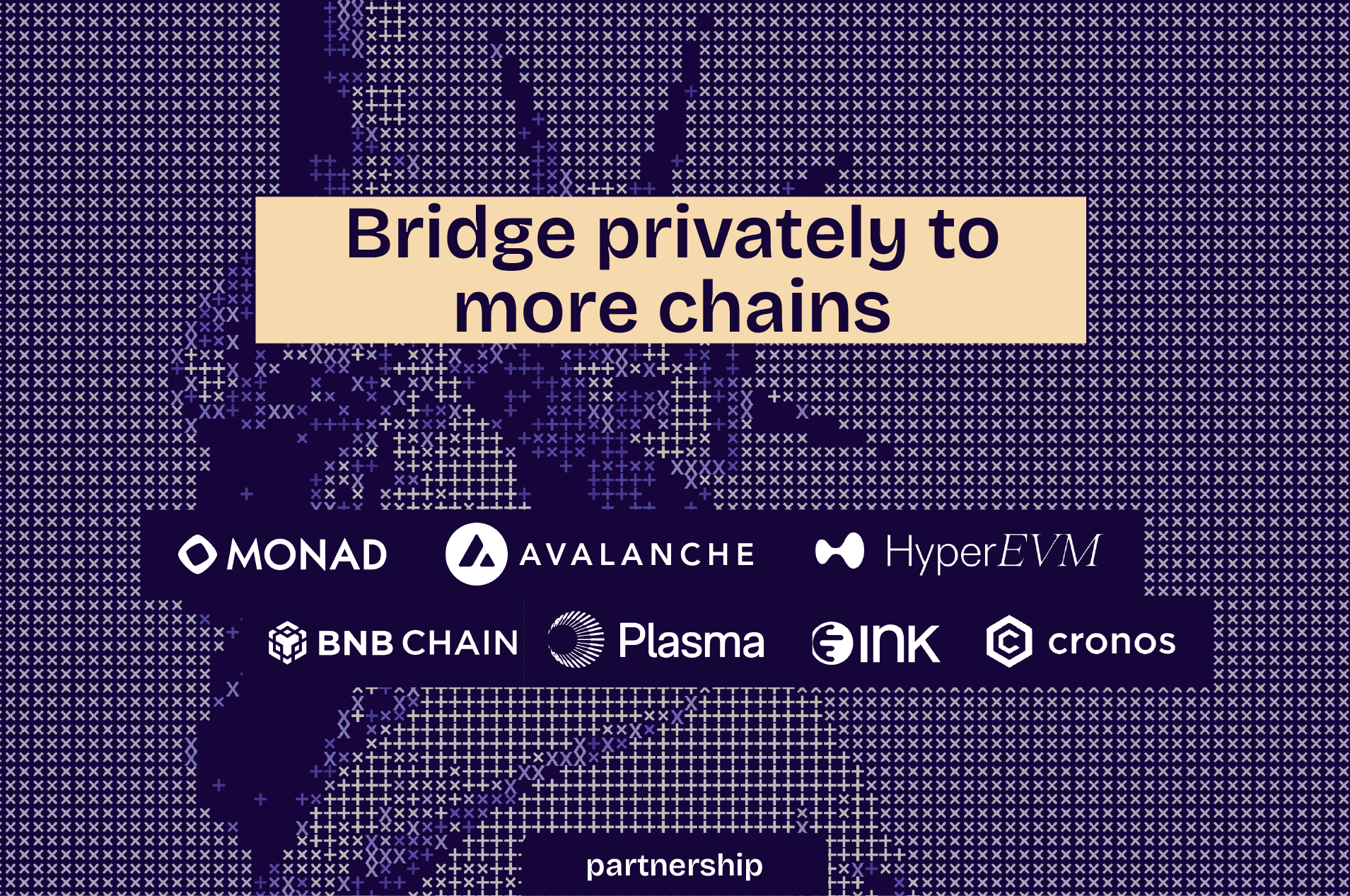
- Hinkal: Ethereum, Solana, Tron, Polygon, Arbitrum, Optimism, Base, Arc
- Aztec: Ethereum only
- Zama: Ethereum + other solutions (extensible)
Compliance Integration:
Recipient Experience:
- Hinkal: Zero setup, recipients use existing wallets
- Aztec: Both parties interact with zkRollup architecture
- Zama: Depends on implementation
Production Status:
Compliance and Selective Disclosure for Institutional Adoption
For regulated enterprises, pure confidentiality without auditability creates regulatory risk. Institutions need the ability to prove compliance when required while maintaining operational confidentiality day-to-day.
Hinkal's compliance framework includes:
- Viewing Keys: Enable revealing full or partial transaction history to auditors, regulators, or internal compliance teams on demand
- KYT Enforcement: Chainalysis integration blocks flagged wallets at the deposit solution, preventing tainted funds from entering
- Integrity Check: Zero-knowledge proofs confirm prior verification on major exchanges without exposing identity data
- Custom Pool Deployments: Heavily regulated entities can deploy dedicated pools with configurable compliance logic and optional master-key visibility
This compliance-ready architecture explains why 53% of Hinkal volume uses USDC. Institutions are comfortable using regulated, freezable stablecoins because compliance controls are built into Hinkal.
Aztec positions compliance as an application-level concern, giving developers flexibility for custom KYC/KYT integration.
Zama offers programmable access control through ACLs and threshold key management, enabling fine-grained disclosure rules.
Real-World Impact: Use Cases for Confidential Settlement
Payment Service Providers (PSPs): PSPs settling merchant funds expose merchant economics and counterparty relationships. With Hinkal, PSPs route funds to a merchant's confidential balance. Merchants connect their existing wallet to see the balance and execute payouts with no merchant-side integration required.
Payroll and Treasury Operations: Companies running crypto payroll expose headcount, pay cycles, and salary costs. Hinkal routes salary payments so sender and amounts stay confidential while employees receive funds on existing wallets.
OTC Desks: Bilateral settlement of large trades exposes volumes and counterparty patterns. Hinkal enables confidential settlement where counterparties access funds through existing wallets without revealing trade details on-chain.
Wallet Providers: Hinkal provides multi-chain private send where the recipient also receives confidentially. Once one wallet integrates Hinkal, users can send confidentially to recipients on any other wallet. The recipient connects and sees their confidential balance.
Why Hinkal is The Best Alternative for Aztec and Zama
For enterprises evaluating privacy technology stacks, Hinkal offers distinct advantages:
- Production-proven: $400M+ processed with 6 independent audits
- Multi-chain reality: Enterprises run treasury across multiple networks. Hinkal supports Ethereum, Solana, Tron, and Polygon without fragmentation
- Zero friction deployment: Recipients use existing wallets; PSPs settling with thousands of merchants benefit from no per-merchant integration
- Native compliance: Built-in Chainalysis KYT and Viewing Keys
- Speed to production: SDK integration enables deployment in weeks
Aztec's programmable approach offers capabilities for Ethereum-focused development teams building privacy-native applications. Zama represents the frontier for cutting-edge R&D requiring encrypted computation. Hinkal delivers confidential multi-chain settlements with compliance controls.






















































.png)
.png)










.webp)